How simplicity is becoming a core competitive advantage in data architecture

You want your team to win. Simple data architecture helps you do that. It cuts out extra steps, so you move faster and make fewer mistakes. Simplicity gives you more time for ideas and less time fixing problems. You build trust with clear systems that everyone understands. Today, simplicity is not just a tech choice—it’s your core competitive advantage.
Key Takeaways
Simplicity in data architecture speeds up decision-making. Clear systems help teams access information quickly and respond to customer needs.
Complex data systems increase risks and costs. Simplifying architecture reduces errors, enhances security, and lowers operational expenses.
Unified platforms streamline data management. They provide real-time insights, improve efficiency, and simplify onboarding for new team members.
Building trust is essential. Clear and consistent data systems foster credibility and help teams focus on delivering results.
Ongoing simplification is key. Regularly review and refine your data architecture to adapt to changes and maintain a competitive edge.
The Cost of Complexity

Slower Execution
Complex data systems slow you down. You spend extra time waiting for data to move, transform, and load. Sometimes, you face bottlenecks like slow extraction or inefficient workflows. These delays can cost your business big money. Take a look at this table:
Industry | Cost of Delays |
|---|---|
Financial Services | Flawed decisions and breaches due to slow data. |
Retail | USD 1.1 trillion lost annually due to inventory mismanagement. |
Healthcare | USD 20 billion lost annually due to medical errors from outdated data. |
Technology/AI | USD 406 million lost due to underperforming AI models from outdated data. |
You see these numbers? They show how slow data hurts every industry.
Higher Risk
When your data architecture is complex, you face more risks. Data silos block sharing and make analysis harder. Inconsistent data leads to mistakes. Security gaps open the door to cyberattacks. Technical debt piles up, making your systems fragile and expensive to fix. You might even face big fines if you miss compliance rules. Simplifying your architecture helps you lower these risks and protect your core competitive advantage.
Resource Drain
Complex systems drain your resources. You use more energy and water in your data centers. Employees waste hours moving data between platforms. This leads to higher labor costs and more errors. Financial firms pay millions in penalties and spend extra time on audits because their systems don’t connect well. You lose money that could go toward innovation.
Talent Challenges
You struggle to find and keep talent when your architecture is complicated. Teams need special skills to manage complex systems. Hiring takes longer and costs more. With a simple setup, you attract more candidates and make onboarding easier. You build teams that focus on solving business problems, not just fixing technical issues.
Simplicity as a Core Competitive Advantage
Faster Decisions
You want your team to make quick decisions. Simple data architecture helps you do that. When you remove unnecessary steps, you get the information you need faster. You don’t waste time searching for data or waiting for systems to sync. Take the Pizza Dash Ordering System as an example. It avoids storing complex payment details, so orders move smoothly. The system records and processes orders efficiently. Regular synchronization between mobile and central databases keeps data reliable and fast. This approach lets you respond to customer needs right away.
Simplicity cuts through confusion. You see the root causes of problems and fix them quickly. Your team spends less time untangling complicated workflows and more time making smart choices. That’s how you turn simplicity into a core competitive advantage.
Greater Scalability
Your business grows. Your data grows with it. Simple data architecture makes scaling easy. You don’t have to rebuild your systems every time you add new users or data sources. Scalable analytics systems expand seamlessly as your needs change. They reduce manual effort and keep performance steady.
You avoid architectural sprawl, so your team stays focused.
Automation and AI-powered workflows boost productivity.
Cloud-based tools handle bigger data volumes without slowing down.
If you design your architecture to handle growth from the start, you prevent bottlenecks and downtime. You save money by consolidating data management into unified systems. This lets you scale efficiently and keeps your business moving forward. Simplicity gives you a core competitive advantage when you need to adapt fast.
Building Trust
Trust matters. You build trust when your data systems are clear and consistent. Stakeholders see progress and know what to expect. Research shows that clarity creates momentum. When you simplify the path, you unlock real progress and connect scattered work.
Clarity gives your team direction.
Consistency earns credibility with stakeholders.
Discipline builds respect and shows you care about outcomes.
You earn trust by delivering results, not just activity. Simple data architecture makes your processes visible and reliable. People believe in your systems because they see them work. That trust becomes your core competitive advantage.
Enabling Innovation
You want to innovate. Simplicity helps you do that. When your architecture is easy to understand, you can adopt new technologies like AI and machine learning faster. You don’t get stuck fixing old problems or managing technical debt. Teams focus on extracting value from data, not wrestling with complexity.
Evidence Type | Description |
|---|---|
Performance at Scale | The VAST DataBase achieves up to 300% performance improvements compared to traditional systems, enabling faster insights. |
Simplicity Over Assembly | VAST provides a streamlined solution that reduces operational overhead, allowing teams to focus on data value extraction. |
You maximize the value of your data with efficient management and analysis. Good governance and clear performance metrics help you measure success. A balanced scorecard approach lets you design coordinated metrics for data performance.
Simplicity supports advanced technologies and keeps your team ready for the next big thing. You turn data into business value and stay ahead of the competition.
Strategies for Simplicity
Streamlined Data Stack
You want your data stack to work for you, not against you. Start by using ELT—extract, load, transform. Store raw data and transform it only when you need to. This speeds up your workflow and keeps things efficient. Make sure you have proper governance. Clean and accessible data helps you make smart decisions. Set up a single source of truth for your most important data. This gives you a clear view of your customers and business. Align each part of your tech stack with your goals. Focus on data quality and governance. These steps help you build a strong foundation.
Use ELT to boost speed.
Keep data clean and accessible.
Create a single source of truth.
Align tech stack with business needs.
Prioritize data quality.
Unified Platforms
Unified platforms make your life easier. You get real-time insights and quick decisions. You don’t have to deal with ETL bottlenecks. These platforms scale as your data grows. They are user-friendly and help everyone access data without calling IT. You save money by using fewer tools. Onboarding becomes simple. AI-powered analytics automate insights and improve efficiency.
Benefit | Description |
|---|---|
Agility and Speed | Real-time insights for fast decisions. |
Scalability with Simplicity | Handles more data without extra work. |
User-Centric Design | Easy for everyone to use. |
Cost Efficiencies | Cuts down on tool costs. |
Single Source of Truth | Keeps data consistent and accurate. |
Simplified Onboarding | Makes learning new tools easy. |
AI-Powered Analytics | Automates insights and boosts efficiency. |
Leadership Focus
You need leaders who keep things simple. Good communication builds understanding and stops complexity from creeping in. When everyone shares responsibility, your team thinks about architecture together. A simple-first mindset keeps your solution clear from start to finish. Leaders who focus on simplicity help you gain a core competitive advantage.
Communicate clearly.
Make simplicity a shared goal.
Keep a simple-first mindset.
Modular Infrastructure
Modular infrastructure lets you adapt fast. You can add new tech as it comes out. Your system handles both old and new workloads. You scale quickly when demand spikes. Flexible infrastructure matches resources to your needs. Maintenance and upgrades stay easy, so you focus on what matters.
Integrate new technologies easily.
Support diverse workloads.
Scale quickly.
Reduce energy and costs.
Simplify maintenance.
Ongoing Simplification
You need to review your architecture often. Use pure functions with no hidden dependencies. Automated testing checks data quality and pipeline behavior. Try a two-stage approach: keep raw data and final data, skip extra steps. This keeps your architecture clear and reliable.
Principle | Description |
|---|---|
Functional | Pure functions, predictable outputs. |
Tested | Automated tests for quality and reliability. |
Two-stage | Raw and final data only, no extra stages. |
Tip: Simplicity is not a one-time fix. Keep reviewing and improving your data architecture to stay ahead.
Real-World Success Stories
Tech Industry Example
You see big results when tech companies simplify their data architecture. Take a look at how Paycor, Banco ABC Brasil, and TelevisaUnivision tackled their challenges:
Company | Challenge | Solution | Results |
|---|---|---|---|
Paycor | Data fragmentation across departments | Cloud data warehouse and integration | 512% ROI, 90% less AI prep time, 36.5 hours saved annually |
Banco ABC Brasil | Manual data extraction, outdated info | Data management in Google Cloud | 70% faster credit approvals, 30% faster decisions, 50% faster ingestion |
TelevisaUnivision | Need for robust governance and quality | Cloud-native data management platform | 44% lower integration costs, 35% better customer service efficiency |
You notice how each company solved a different problem with a simple, unified platform. They moved faster, saved money, and improved customer service. You can do the same by focusing on clarity and integration.
Financial Services Example
Financial firms also benefit from simplicity. Harris Associates, an asset management company, used a smart data fabric to boost performance and client engagement. You get timely and consistent data, which helps you make better decisions.
Improved portfolio performance
Enhanced client engagement
Increased efficiency
Reduced costs
You gain more when your data architecture supports growth and reliability. Here’s what you get:
High availability for secure storage and recovery
Consistency for data integrity
Real-time analytics for immediate insights
You build trust and stay ahead in a fast-moving market.
Lessons from Leaders
Industry leaders share valuable tips for keeping things simple. You should maintain consistent reasoning and intelligence layers. This helps AI systems act reliably, even across distributed environments.
Understand your data to drive action.
Create a data modernization strategy to avoid duplicate data.
Set up early warning systems to catch anomalies.
You transform complexity into a competitive advantage when you build a scalable foundation and keep your data architecture clear. Simplicity lets you innovate and grow without getting stuck in technical problems.
You build a stronger team when you keep your data architecture simple. Companies like LEGO save millions, speed up product launches, and boost collaboration. Take a look at these results:
Organization | Outcome | Impact |
|---|---|---|
LEGO | Cost savings | €30 million saved yearly |
LEGO | Faster development | 22% quicker cycles |
LEGO | Fewer defects | 35% drop in errors |
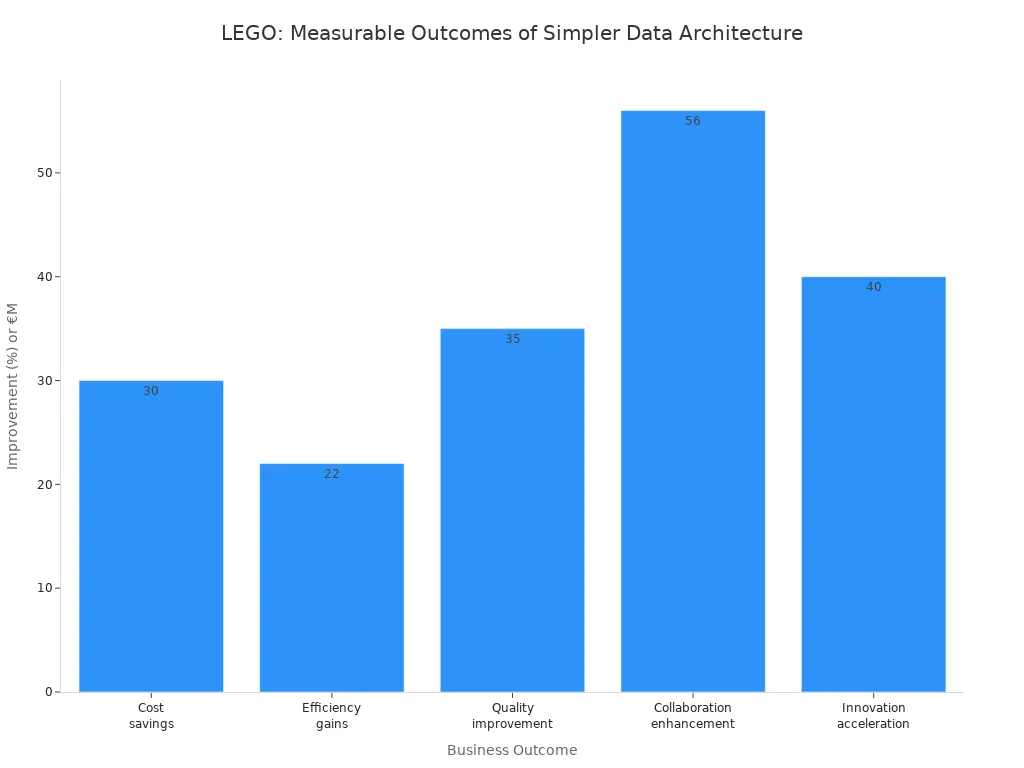
Simple systems are easier to manage and help you avoid mistakes. You can start by spotting complexity, refining features, and listening to feedback. Try small changes and measure what works. Bring your team together and focus on clear goals. If you make simplicity your priority, you unlock real business value and stay ahead of the competition.
FAQ
What is simple data architecture?
Simple data architecture means you use fewer tools and clear workflows. You keep your systems easy to understand. You make data accessible for everyone. You avoid extra steps and confusion.
How does simplicity help my team?
Simplicity lets your team move faster. You spend less time fixing problems. You focus on new ideas and business goals. You build trust with clear systems.
Can I scale my business with simple architecture?
Benefit | How It Helps You |
|---|---|
Easy Growth | Add users and data fast |
Less Downtime | Keep systems running |
Save Money | Cut extra costs |
What steps can I take to simplify my data stack?
Use ELT for faster workflows.
Set up a single source of truth.
Choose unified platforms.
Review your architecture often.
See Also
Grasping the Fundamentals of Cloud Data Design
Navigating Data Management Challenges in Modern Businesses
Exploring the Key Elements of Big Data Frameworks
Recognizing the Role of Lakehouse in Current Data Ecosystems