
Lakehouse vs. Traditional Data Warehouse: Key Differences
Lakehouse vs. Traditional: Compare data types, cost, scalability, and analytics to choose the best architecture for your business data needs.
You might ask what makes a lakehouse different from a traditional data warehouse. A lakehouse combines elements from both data lakes and traditional warehouses, allowing it to store a wide variety of data types. In contrast, a traditional data warehouse is optimized for structured and semi-structured data. Many businesses are now choosing lakehouses over traditional options for analytics and building AI models.
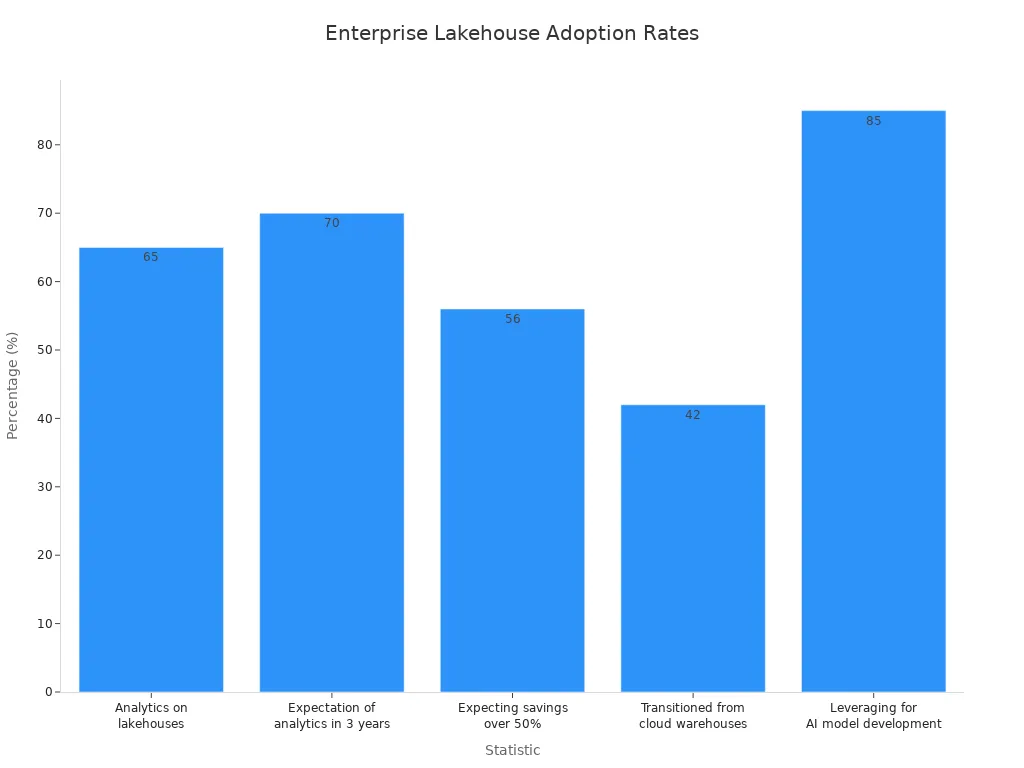
It’s important to understand these differences between lakehouse vs. traditional systems. Each architecture influences how you manage data and impacts your ability to achieve business objectives.
Statistic | Percentage |
|---|---|
Analytics on lakehouses | 65% |
Expectation of analytics on lakehouses in 3 years | 70% |
Expecting savings over 50% by moving to lakehouses | 56% |
Transitioned from cloud data warehouses to lakehouses | 42% |
Leveraging lakehouses for AI model development | 85% |
Lakehouse and traditional architectures each offer unique advantages. Understanding the lakehouse vs. traditional differences will help you determine which option is best suited for your needs.
Key Takeaways
A lakehouse mixes the best parts of data lakes and traditional warehouses. It lets you keep structured, semi-structured, and unstructured data together.
Lakehouses usually cost less than traditional data warehouses. They give cheaper ways to store data and let you grow without buying pricey hardware.
If a business wants advanced analytics and machine learning, lakehouses work better. They can handle many kinds of data and process things quickly.
Traditional data warehouses are great for giving high-quality, structured data. They help with business intelligence and reporting. This makes them good for groups that want steady data analysis.
Many companies use both lakehouses and traditional data warehouses. This helps them get the best from each system for what they need.
What Is a Lakehouse?

Definition
A lakehouse is a new way to store and use data. It mixes the best parts of data lakes and data warehouses. You can keep all kinds of data in one place. Here are some things to know about a lakehouse:
A lakehouse uses good ideas from both data lakes and data warehouses.
You get open formats, can grow easily, and save money like with data lakes.
You also get things like ACID transactions, versioning, schema checks, and fast business intelligence, which are found in data warehouses.
The lakehouse pattern lets you manage data in many ways.
This setup lets you keep raw and finished data together. When you look at Lakehouse vs. Traditional systems, you will see that a lakehouse works with more data types and jobs.
Features
A lakehouse is special because it has some cool features. These features help you store, use, and control your data better. The table below shows some of the top features:
Feature | Description |
|---|---|
Unified Storage Layer | You can keep structured, semi-structured, and unstructured data on one platform. |
Compute and Storage Separation | You can grow and save money by splitting compute from storage. |
Transactional Integrity | ACID-compliant transactions keep your data safe and correct. |
Schema Enforcement | The system checks data structure when you read or write, so your data stays right. |
Metadata Management | You can find, control, and search your data faster with built-in metadata tools. |
These features help you handle lots of data without worry. You can do analytics, reports, and even AI work without using many systems.
What Is a Traditional Data Warehouse?
Definition
A traditional data warehouse helps you organize lots of data. It takes information from many places and puts it together. This system is good for business intelligence and analytics. You can use it to keep all your data in one spot. The data warehouse is your main place for trusted data. It keeps old data safe, so you can make smart choices.
A data warehouse is made for questions and analysis. It stores huge amounts of old data. You can count on it to keep your information safe and correct.
Features
A traditional data warehouse has some key features. These help you handle and study your data well.
Feature | Description |
|---|---|
Subject-Oriented | Focuses on specific themes like sales or marketing, organizing data for analysis and decision-making. |
Integrated | Combines data from various sources into a consistent format for accurate analysis. |
Time-Variant | Stores data over different time periods for long-term analysis, preserving historical integrity. |
Non-Volatile | Data is read-only and not updated, allowing for trend analysis over time. |
Subject-Oriented: You sort data by topics like sales or marketing. This helps you see patterns and trends.
Integrated: You bring data from different places together. The warehouse makes it all the same format, so you can compare it.
Time-Variant: You keep data from many years ago. This lets you see how things change over time.
Non-Volatile: Once you put data in, it stays the same. You can always look back and trust your records.
A traditional data warehouse is different from a lakehouse. It works best with structured and semi-structured data. You get a strong system for reports and analytics. It helps you answer big questions and plan for your company.
Lakehouse vs. Traditional: Key Differences
Data Types
When you look at Lakehouse and Traditional systems, you notice they handle data differently. A lakehouse can keep structured, semi-structured, and unstructured data together. This means you can store things like spreadsheets and videos in one place. A traditional data warehouse works best with structured and semi-structured data. It has trouble with unstructured data like pictures or sound files.
Here is a simple table to help you see the differences:
Data Type | Description | Examples |
|---|---|---|
Structured Data | Data that is organized and easy to search. | SQL databases, Spreadsheets |
Semi-structured Data | Data with some structure but not as strict. | JSON, XML |
Unstructured Data | Data with no set format, harder to study. | Text files, Multimedia |
A lakehouse can work with all three types. A traditional data warehouse usually only works with the first two. If your business uses many kinds of data, a lakehouse gives you more choices.
Architecture
The way each system is built changes how you use your data. In a lakehouse, you have one storage layer for everything. You can keep all your data in one spot for different jobs. Storage and computing are separate, so you can make each bigger when you need. You can run batch and streaming jobs, which helps with real-time data.
A traditional data warehouse has a stricter setup. It puts data in tables and uses batch jobs. You often need to move data through steps before you can study it. This works well for regular reports but can be slow if your data changes a lot.
Here is a table that shows the main differences:
Feature | Lakehouse | Traditional Data Warehouse |
|---|---|---|
Data Storage | Mostly stores structured data | |
Processing Layers | Uses ETL or ELT; handles batch and streaming | Uses ETL; works in batches |
Analytics Capabilities | Good for AI and ML jobs | Best for regular analytics |
Cost | Cheaper, flexible, and easy to grow | Usually costs more |
Cost
Cost is important when picking Lakehouse or Traditional systems. A lakehouse often costs less to start and run. You can use cheap storage and free tools. You do not need to buy pricey hardware or software. It is cheaper to keep up because you can manage data in many ways.
A traditional data warehouse usually costs more. You pay for special hardware, software, and support. To grow, you must buy more equipment and licenses. This makes it hard to get bigger as your data grows.
Here is a table to compare costs:
Category | Data Warehouse (High) | Lakehouse (Medium/Low) |
|---|---|---|
Initial Setup | Expensive hardware, software, and lots of planning | Cheap storage, free tools, and easy setup |
Storage Costs | Special storage for structured data | Cheaper storage, lower cost per terabyte |
Maintenance | Needs lots of care and vendor help | Easier to manage, needs many tech skills |
Scalability Costs | Easy to grow with cloud and new tech |
Tip: If you want to save money and grow fast, a lakehouse might be better.
Performance
Performance is about how fast you get answers from your data. A traditional data warehouse is very fast for SQL questions and reports. It works best with structured data and gives quick answers for business needs.
A lakehouse is also fast, especially with many data types. You can do real-time analytics and handle both batch and streaming data. Lakehouses use ACID formats, so you get quick and safe queries even on raw data.
Here is a table to help you compare:
Feature | Data Lakehouse | Traditional Data Warehouse |
|---|---|---|
Query Performance | Fast for all data types, supports real-time | |
Scalability | Grows easily for big data sets | Harder to grow |
Real-time Processing | Can handle real-time data | Made for old data analysis |
Cost Efficiency | Cheap for lots of data | Costs more for storage and speed |
Data Types | Works with all data types | Mostly works with structured data |
Data warehouses are great for fast SQL and summaries.
Lakehouses let you ask questions on raw data and do many jobs at once.
Scalability
Scalability is about how well a system grows with your data. A lakehouse can handle huge amounts of data, no matter the type. You can add more storage or power as you need. Cloud features make it easy and cheap to scale up or down.
A traditional data warehouse can grow, but you need to buy more hardware and software. It works best with structured data, so you may hit limits if your data gets bigger or more varied.
Here is a quick comparison:
Architecture Type | Scalability Advantages | Scalability Limitations |
|---|---|---|
Lakehouse | N/A | |
Traditional Data Warehouse | Good for structured data, but limited for other types | Needs lots of money as data grows |
Lakehouses are easier to grow.
Traditional data warehouses can slow down as your data changes.
Complexity
Complexity is about how easy it is to run your data system. A traditional data warehouse has a clear setup. It is easy to manage and has strong rules for data. This makes it simple to use, especially if you only have structured data.
A lakehouse is more flexible but can be harder to manage. You need to handle different data types and tools. You may need experts who know both data lakes and data warehouses. But you can do more advanced analytics, AI, and machine learning.
Note: If you want a simple system for reports, a traditional data warehouse may be best. If you need to work with many data types and do advanced analytics, a lakehouse gives you more options.
When you compare Lakehouse and Traditional systems, think about your data, your budget, and how much you want to grow. Each has good points and trade-offs. Your choice will affect how you use data for your business.
Pros and Cons
Lakehouse Pros
There are many good things about using a lakehouse:
You do not have to copy data, so you save space.
You use your computer power better and spend less money.
You can control who sees data and check data quality in one place.
You follow rules and keep your data safe from people who should not see it.
You get new data fast, so you learn things in hours, not days.
You can look at both new and old data at the same time.
Data scientists can use both raw and finished data, so machine learning is faster.
You can use many kinds of data and sources without needing more systems.
You do not get stuck with one vendor because lakehouses use open formats.
You can change with new business needs and new tech easily.
Tip: Lakehouses help you move quickly, save money, and keep your data safe.
Lakehouse Cons
There are some hard parts to think about before using a lakehouse:
Moving your old data warehouse can take a lot of time and money. You might have problems or delays.
You need to plan well for growth and cost. If you do not, analytics can slow down.
Some vendors need special tools that may not work with what you have.
Setting up and running a lakehouse can be harder than a traditional warehouse.
The tech is new, so you may need to learn new things and use tools that are not as ready.
You might pay more at first for hardware, software, and people who know how to use it.
Note: Lakehouses are flexible, but you need good planning and skilled people to get the best results.
Data Warehouse Pros
A traditional data warehouse has strong benefits. The table below shows the main good points:
Benefit | Description |
|---|---|
You make data from many places the same, so you can trust it. | |
Historical Intelligence | You keep lots of old data, so you can see trends over time. |
Improved Business Intelligence | You use good data for choices, so you do not have to guess. |
High Return on Investment | Analytics projects often give a five-year ROI of 112%, so you make more money and save costs. |
Data Warehouse Cons
There are some problems with traditional data warehouses. The table below shows the main issues:
Drawback Description |
|---|
If you do not use the system for a while, your data can get old. |
Running the system can be hard and needs people with special skills. |
Licenses for database tools like SQL and Oracle cost a lot. |
The system is not flexible, so it can cost more and be slow to change. |
Taking care of the system and updates makes it cost more in the end. |
The system cannot change fast to keep up with new business needs and data sources. |
Remember: Traditional data warehouses are good for structured data and reports, but they may not work well with fast-changing data or new business needs.
When to Use Each
Lakehouse Use Cases
Pick a lakehouse if you need to work with many kinds of data. Lakehouses let you keep structured, semi-structured, and unstructured data together. If your business uses data from sensors, images, videos, or logs, a lakehouse is flexible for you. You can do advanced analytics, machine learning, and real-time reports.
Big companies use lakehouses to solve hard problems. Here are some examples:
Organization | Industry | Use Case |
|---|---|---|
Regeneron | Healthcare | Studied over 100 PB of genomic and clinical data, making drug discovery faster. |
Robinhood | Finance | Put fraud detection and customer analytics in one place. |
Swiss Re | Insurance | Made claims easier and joined data for risk checks. |
HubSpot | Technology | Mixed sales, support, and product data for better scores and pipeline views. |
GE Digital | Manufacturing | Used IoT sensor data to lower downtime with smart analytics. |
AstraZeneca | Pharmaceuticals | Joined real-world and trial data to get faster R&D insights. |
T-Mobile | Telecommunications | Brought together customer, billing, and network data to target users better. |
UK Ministry of Justice | Government | Linked court records and other data to use resources better. |
Stores use lakehouses to join sales, inventory, and customer data for quick supply chain fixes. Hospitals use lakehouses to mix different data types for better patient care.
Tip: Use a lakehouse if you have lots of different data and want to do AI or real-time analytics.
Data Warehouse Use Cases
Choose a data warehouse if your data is very organized and you need high data quality. Data warehouses are best for business intelligence, regular reports, and looking at old data. They help you keep your data clean and easy to trust.
Here are some times when a data warehouse works best:
Use Case Description | Reason for Preference |
|---|---|
Focus on business intelligence/reporting | Data warehouses are made for BI, so you get fast answers. |
Highly structured data | They are great for organized data and quick searches. |
Need for data quality control | They keep data quality high for good reports and analysis. |
Many fields use data warehouses. Hospitals join health records, bills, and lab data for analytics and rules. Banks watch trading and use models to predict things. Factories use data warehouses to make sales and operations reports the same everywhere.
Note: Pick a data warehouse if you want fast, trusted reports and your data is mostly organized.
Hybrid Approaches
Combining Both
You do not need to pick just one system. Many companies use both lakehouse and traditional data warehouse together. This way, you get the best parts of each. You can put raw, unstructured data in your lakehouse. You can keep clean, structured data in your warehouse for quick reports.
Using both systems means you must manage your data well. You need to keep private data safe and make sure your data is correct. Most companies do these things:
Establish role-based access controls. You choose who can see or change data. This helps keep your information safe.
Implement strong governance policies. You make rules for how people use and share data. This helps you follow laws and rules.
Enforce data quality checks. You use tools to check if your data is right. This stops mistakes from getting into your reports.
Tip: Using both systems helps you meet many business needs. You can do advanced analytics and keep your reports fast and trusted.
Trends
Hybrid data systems keep changing over time. You see new trends that help you work with data better. The table below shows some new trends and what they mean for you:
Trend Description | Implications |
|---|---|
Convergence of data lakes and data warehouses into lakehouse architectures | Mixes the flexibility and low cost of data lakes with the structure and speed of data warehouses. |
Introduction of Lakebase solutions for real-time data integration | Lets you sync data in real time, so you get answers faster and make your data pipelines simpler. |
Movement towards unified data platforms | Cuts down on moving data and makes things less complicated, so you get results and AI faster. |
You can see that the future will have more unified systems. These trends help you move data faster and make smarter choices. You spend less time moving data and more time learning from it. Hybrid approaches give you tools to grow and change as your business needs.
You need to pick between lakehouse and traditional data warehouse. Lakehouses can use all kinds of data. They are flexible and help with AI and machine learning. Traditional warehouses are good for organized data and quick reports. Lakehouses help you save money as your data gets bigger.
Think about what your business wants to do.
Check your system often to see if it can grow and is not too expensive.
Make sure people learn how to use it and keep your data safe.

Solution Type | Best For |
|---|---|
Data Warehouse | Fast reports, strict compliance, SQL skills |
Data Lakehouse | Mixed data, AI, long-term growth, cost savings |
Pick the system that fits your business plans and future needs. This helps you find better answers and get ready for changes.
FAQ
What is the main benefit of a lakehouse over a traditional data warehouse?
You can keep every kind of data together. This makes it easy to do analytics and machine learning. You do not have to move data to other systems.
Can you use a lakehouse for business intelligence reports?
Yes, you can use a lakehouse for business intelligence. You get quick answers and can use both raw and cleaned data.
Is a lakehouse more expensive than a data warehouse?
A lakehouse usually costs less money. You save on storage and can grow or shrink easily. You do not need special hardware to use it.
Do you need special skills to manage a lakehouse?
You need to learn new tools and ways to work. Lakehouses use open formats and cloud tech. You may need training if you only know data warehouses.
Which system is better for AI and machine learning?
A lakehouse is better for AI and machine learning. You can use many types of data and do advanced analytics faster.
Tip: Pick a lakehouse if you want to use AI or work with lots of different data.
See Also
The Significance of Lakehouse in Modern Data Management
How Iceberg and Parquet Revolutionize Data Lake Efficiency
Comparing Apache Iceberg with Delta Lake Solutions