
Smart Mine Safety Early Warning Solution
Based on Singdata Lakehouse, this solution unifies data from the six major subsystems of coal and non-coal mines, enabling cross-system correlation analysis and AI-driven proactive alerting — upgrading from "reactive alarming" to "predictive early warning," with PoC deployment completed in 6 weeks.
1. Business Background
China produces approximately 4.7 billion tons of raw coal annually, accounting for nearly 50% of global output. Mining is a high-risk industry — between 2001 and 2022, coal mine water hazard accidents caused 4,667 cumulative deaths, and a single major gas explosion can result in direct losses exceeding 50 million RMB — with 200 to 500 workers operating underground each shift, making early warning failures a matter of mass casualties.
The fundamental contradiction in current mine digitalization: sensors generate massive amounts of data every second, but the six major subsystems operate independently, data silos are severe, and cross-system correlation analysis is virtually nonexistent.
Mandatory Policy Requirements (Mandatory from 2025)
| Requirement | Regulatory Basis |
|---|---|
| CH₄ overrun: automatic power cutoff within 1 second, non-compliance results in shutdown | Coal Mine Safety Regulations, 2022 Edition |
| Safety monitoring data real-time reporting to provincial/national platforms | AQ 1029-2019 |
| Sensor historical data retained ≥ 1 year | GB 16423-2020 |
| Personnel underground location real-time queryable per shift | Smart Mine Construction Guidelines 2025 |
The global connected mine market is projected to reach $48.7 billion by 2033 (CAGR 13.4%). Among approximately 4,000 large-scale coal mines in China, only 30% have completed initial intelligentization — the data fusion layer is the largest gap.
Six Major Subsystems
| Subsystem | Core Metrics | Collection Frequency | Safety Weight |
|---|---|---|---|
| Ventilation System | CH₄, CO, Wind Speed, Temperature | 1–10s | ★★★★★ |
| Monitoring System | Personnel Location, Violation Behavior | 1s/person | ★★★★★ |
| Transport System | Belt Deviation, Rope Tension, Vehicle Position | 1–5s | ★★★★☆ |
| Power System | Three-Phase Voltage/Current, Power Factor | 50ms | ★★★★☆ |
| Excavation System | Cutting Current, Support Pressure | 100ms–1s | ★★★☆☆ |
| Dispatch System | Production Plans, Safety Events, Work Orders | Business-driven | ★★★☆☆ |
Ventilation + Monitoring carry the highest weights: gas outburst × personnel presence = mass casualties. Data from these two systems is completely isolated in traditional architectures — this is the core entry point of this solution.
2. Industry Pain Points
Quantified Accident Data
- From 2001 to 2022, China recorded 1,103 coal mine water hazard accidents with 4,667 deaths
- Roof collapse accidents account for approximately 30%–40% of total coal mine accidents, with underground mines being the hardest hit
- Gas accidents remain the greatest threat to coal mines, with frequent over-limit gas concentration incidents in outburst mines
Three Major Deficiencies of Traditional Solutions
① Data Silos — No Linkage
The six major subsystems are independently built by different vendors, with Modbus/OPC-UA/MQTT/proprietary protocols coexisting. Typical failure scenarios:
- ZONE-101 CH₄ concentration exceeds 1.0% alarm threshold → but power feeder switch does not automatically trip
- Personnel positioning shows 3 people in hazardous zone → but the ventilation system is unaware, and dispatch receives no notification
② Delayed Warning — Only Reactive
Existing systems only perform threshold alarming for the five major hazards (gas/fire/water/roof/dust) and have no trend prediction capability. CH₄ rising from 0.7% to 1.0% takes an average of 20–30 minutes — sufficient time to warn and evacuate — but traditional systems provide no proactive alerts.
③ Manual Dependency — Hard to Scale
Dispatch command relies on human experience; checking 2,000+ monitoring points per shift is impractical. Inspection personnel cannot cover the entire mine, and hazard identification is delayed.
Data Platform Pain Points
| Problem | Manifestation |
|---|---|
| Protocol Heterogeneity | Multi-vendor systems with non-unified protocols, high integration cost |
| Insufficient Real-time Capability | Safety warnings require second-level response; traditional batch architectures cannot meet this |
| Difficult AI Deployment | Model training and inference are separated, iteration cycles are long, no unified Feature Store |
| Lack of Standardization | Each system has a different data model; cross-system analysis relies on manual effort |
This core gap is precisely where Singdata Lakehouse excels — unified ingestion, real-time aggregation, SQL-embedded AI — one platform connecting six isolated islands.
3. Solution
Overall Architecture
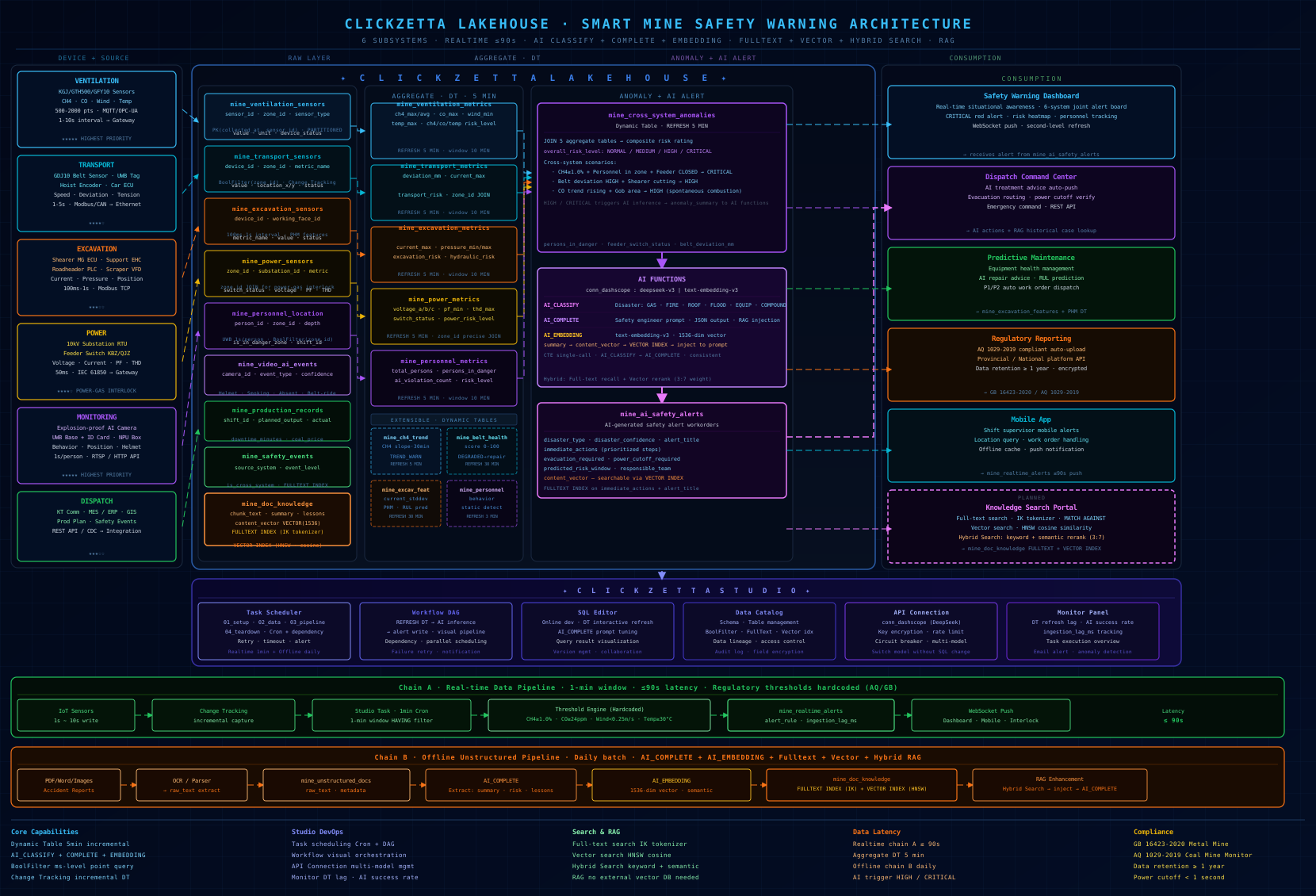
Data Model
Raw Layer (8 Tables)
Key Indexes
Three-Layer Data Pipeline
Layer 1: Aggregation-Layer Dynamic Table (one per subsystem, 5-minute refresh)
Layer 2: Cross-System Correlation Anomaly Detection Dynamic Table (core differentiator)
Layer 3: AI Classification + AI Alert Work Order Generation (CTE single-call)
Three Major Linkage Scenarios
| Scenario | Systems Involved | Trigger Condition | AI Response Recommendation |
|---|---|---|---|
| Gas-Personnel-Power Linkage | Ventilation + Monitoring + Power | CH₄ ≥ 1.0% + Personnel present + Feeder not tripped | Immediate power cutoff / evacuation / enhanced ventilation |
| Belt Failure — Production Chain Interruption | Transport + Dispatch | Belt deviation > 50mm + Shearer in operation | Shutdown for maintenance / adjust production plan |
| Goaf Spontaneous Combustion Warning | Ventilation + Dispatch | CO concentration trend rising (> 24ppm and rate > 2ppm/10min) | Grouting to seal / adjust ventilation mode |
Pipeline A: Real-Time Data Processing Pipeline
The existing 5-minute Dynamic Table refresh is sufficient for most scenarios, but some safety events (sudden CH₄ rise, sharp wind speed drop) need to be detected within 1 minute. The real-time pipeline adds a high-frequency bypass on top of the existing 5-layer pipeline:
Key Design Decisions:
- 1-minute window aggregation (not per-record triggering): avoids massive false positives from sensor jitter while keeping latency to ≤ 90 seconds
- Regulation thresholds hardcoded: CH₄ 0.75%/1.0%/1.5%, CO 24/50ppm, wind speed 0.25m/s, temperature 26/30°C are written directly into CASE logic, not dependent on external configuration
- ingestion_lag_ms monitoring: records the delay from sensor to database ingestion per record, used in Studio monitoring dashboards to detect collection pipeline health
- Division of responsibilities with Dynamic Table: the real-time pipeline handles single-point extreme value triggering; Dynamic Tables handle multi-sensor aggregation and cross-system correlation — the two are complementary
Pipeline B: Offline Unstructured Data Processing Pipeline
Mines have accumulated large amounts of unstructured data: historical accident investigation reports, equipment maintenance records, geological survey archives, and safety regulation training materials. These are the most valuable safety knowledge assets, but they have long been stored in isolation as PDFs, Word documents, or scanned files, inaccessible for AI retrieval.
The offline pipeline transforms these documents into a searchable structured knowledge base:
Supported Document Types:
| doc_type | Source | AI Extraction Focus |
|---|---|---|
| ACCIDENT_REPORT | Accident investigation reports | Incident process, root cause, lessons learned |
| MAINTENANCE_LOG | Equipment maintenance records | Failure modes, replaced parts, prevention recommendations |
| GEO_SURVEY | Geological survey archives | Stratum structure, fault locations, gas occurrence patterns |
| REGULATION | Regulations / standard documents | Applicable clauses, key thresholds, operational requirements |
| TRAINING | Training materials | Safe operating procedures, emergency response workflows |
RAG Enhancement: When a new alert occurs, historical accident experience from the same zone and disaster type can be retrieved from mine_doc_knowledge and injected into the AI_COMPLETE Prompt to make the generated response recommendations more targeted.
Complete Technical Implementation Matrix
The following covers the complete technical solutions for each business scenario, all implemented using Singdata Lakehouse native capabilities — no external frameworks required.
Ventilation System Extension: CH₄ Concentration Trend Prediction
The current real-time pipeline only performs single-point threshold evaluation. The following Dynamic Table adds trend prediction, providing 20–30 minutes of advance warning during slow CH₄ rise:
Transport System Extension: Belt Full Lifecycle Health Score
Calculate a health score of 0–100 per shift, weighted by deviation (40%), temperature (30%), and current overload (30%), to drive maintenance scheduling:
Monitoring System Extension: Personnel Abnormal Behavior Detection
Analyze trajectory for stationary duration to identify emergency states such as collapse or injury, linked with personnel risk rating to trigger search and rescue plans:
Power System Extension: Load Forecasting and Reactive Power Compensation Optimization
Use AI_COMPLETE to forecast the next hour's load based on historical same-period features (same weekday, same time slot), proactively scheduling reactive power compensation timing. Target power factor ≥ 0.92, saving 300,000–800,000 RMB per mine per year:
Excavation System Extension: Equipment Predictive Health Management (PHM)
Based on feature vectors of current fluctuation, overload count, and hydraulic pressure, AI predicts remaining useful life (RUL) and automatically dispatches P1/P2 maintenance work orders:
When overload_count >= 3, AI_COMPLETE RUL prediction is triggered, outputting {"rul_hours": value, "priority": "P1/P2", "advice": "..."} and automatically writing to mine_maintenance_orders.
Dispatch System Extension: Intelligent Ventilation Network Optimization
Ventilation network computation: back-calculate required airflow from CH₄ concentration in each zone, AI outputs local fan adjustment plans written to the dispatch table. Target ventilation power consumption reduction of 15–20%, while ensuring CH₄ < 0.5% in all zones.
Mine-Wide: Group-Level Safety Management
Group-level unified workspace, real-time safety score ranking for each mine, prioritizing intervention at the mine with the lowest safety score:
Knowledge Base Retrieval: Full-Text Search + Vector Search + Hybrid Search
The accident reports, maintenance records, and geological archives accumulated over the years in a mine are the most valuable safety knowledge assets. Singdata natively supports full-text search and vector search, transforming these unstructured documents into a machine-searchable knowledge base to provide RAG enhancement for real-time alerts.
Full-Text Search: Dispatchers quickly locate relevant cases using natural language keywords, supporting Chinese IK word segmentation:
Vector Search: Semantic similarity-based retrieval captures cases with "different wording but identical meaning," providing broader coverage than keyword search:
Hybrid Search: Full-text recall × vector re-ranking, optimizing both precision and recall:
All three retrieval capabilities are expressed directly in SQL — no separate search engine (Elasticsearch/Milvus) required.
4. Singdata Technical Advantages
Dynamic Table: Two-Level Real-Time Incremental Processing — Replacing the Flink + Batch Dual Stack
Mine sensors generate thousands of records per second; safety alerts cannot wait for batch processing windows. Singdata uses a single mechanism to cover both minute-level aggregation and second-level trend computation:
| Layer | Refresh Interval | Purpose | Traditional Equivalent |
|---|---|---|---|
| Real-time Pipeline | 1 min (Studio Cron) | Single-point threshold extreme value triggering | Flink CEP Rule Engine |
| Aggregation DT | 5 min | Multi-sensor rolling aggregation + risk rating | Spark Structured Streaming |
| Anomaly DT | 5 min | Cross-system correlation + composite rating | Independent correlation service |
| Trend Prediction DT | 5 min | CH₄ slope + 30min prediction | Independent time-series prediction service |
Change Tracking drives incremental computation — TB-scale historical data does not affect refresh performance. Traditional solutions require a separate stream processing cluster (Flink/Spark Streaming) plus a batch scheduling system. Singdata replaces both with declarative SQL.
AI_CLASSIFY + AI_COMPLETE: SQL-Embedded Two-Level AI Inference
Mine safety requires two fundamentally different AI capabilities, which Singdata chains together in a single CTE:
Level 1: AI_CLASSIFY Fast Classification (low latency, low cost)
Performs multi-class classification on anomaly summaries, outputting disaster type labels (GAS/FIRE/ROOF/FLOOD/EQUIPMENT/COMPOUND). Compared to using AI_COMPLETE to ask "what type of disaster is this," classification is faster, consumes fewer tokens, and is suited for high-frequency trigger scenarios:
Level 2: AI_COMPLETE Structured Response Plan Generation (deep reasoning)
Injects the disaster type + cross-system anomaly summary + RAG-retrieved historical accident experience together into the Prompt to generate a complete response plan. The CTE structure ensures each level is called exactly once, avoiding result inconsistencies from repeated calls:
Compared to a standalone AI platform: zero data movement, no additional latency, no ETL cost.
API Connection: Unified Multi-Model Management
All AI calls go through a single conn_dashscope connection entry, supporting runtime model switching, key rotation, and rate-limiting circuit breakers — without modifying any SQL logic:
Supports connecting to multiple LLMs (DashScope, DeepSeek, OpenAI-compatible interfaces), as well as domain fine-tuned mine safety proprietary models.
BloomFilter: Millisecond-Level Retrieval Across Tens of Millions of Monitoring Points
A single mine has 500–2,000 sensor points; medium-sized mine areas can reach tens of thousands; group-level can reach hundreds of thousands. BloomFilter indexes reduce point-query latency on zone_id/sensor_type/event_level from seconds to milliseconds — the foundation for high-frequency alert queries:
Full-Text Search: Fast Keyword Lookup in Accident Knowledge Base
Accident investigation reports, regulation clauses, and maintenance records accumulated over the years can be indexed with FULLTEXT INDEX, allowing dispatchers to search directly with Chinese keywords (e.g., "ZONE-101 gas power cutoff") — no separate Elasticsearch cluster required:
Why full-text search fits this scenario: Mine accident reports contain extensive industry terminology (e.g., "fully-mechanized mining face," "roof weighting," "goaf spontaneous combustion"). Exact keyword matching is more than 100× faster than LIKE fuzzy queries, with relevance ranking, helping dispatchers find the most relevant historical response plans in seconds.
Vector Search: Semantic Similarity Search and RAG Enhancement
Keyword search depends on exact vocabulary matching and cannot handle cases with "different wording but identical meaning." Vector search is based on semantic vectors generated by AI_EMBEDDING — even with completely different phrasing, semantically similar content can be retrieved:
RAG Three-Step Process (entirely within SQL):
Synergy with BloomFilter: Before vector search, use BloomFilter to filter by mine_id and doc_type to narrow the candidate set, then perform ANN search — reducing retrieval latency from seconds to hundreds of milliseconds.
Why a standalone vector database (Milvus/Pinecone) is not needed: Singdata natively supports the VECTOR field type and VECTOR INDEX. Vector search and structured filtering (mine_id, zone_id, doc_type) are completed in a single SQL statement, with no cross-system data synchronization required.
Lakehouse Unified Architecture: Eliminating Data Silos
Traditional mine six-system architectures are each independently operated; cross-system correlation analysis requires a custom integration layer. Singdata Lakehouse places all data in the same storage layer, making cross-system JOINs nearly indistinguishable in performance from single-table queries:
The same platform supports real-time streaming (Dynamic Table), batch processing (INSERT SELECT), AI inference (AI_COMPLETE), and unstructured processing (offline Pipeline B) — unified operations and unified access control.
Studio: End-to-End Operations Automation
Studio incorporates the entire data pipeline into unified scheduling — no external scheduling tools (Airflow/DolphinScheduler) required:
| Studio Capability | Usage in the Mine Solution |
|---|---|
| Task scheduled execution (Cron) | Real-time pipeline 1-min alerts + offline pipeline daily knowledge base updates |
| Workflow DAG orchestration | Dependency ordering for REFRESH DT → AI inference → alert write |
| API Connection management | DeepSeek key encrypted storage, runtime model switching |
| Runtime monitoring dashboard | DT refresh latency, AI inference success rate, ingestion_lag_ms visualization |
| SQL editor | Dynamic Table interactive debugging, AI_COMPLETE Prompt iteration |
Technical Advantages Comparison Summary
| Capability Dimension | Traditional Solution | Singdata Lakehouse |
|---|---|---|
| Real-time alert latency | 5–15 minutes (batch window) | ≤ 90 seconds (real-time pipeline) / 5 minutes (DT aggregation) |
| Cross-system correlation | Custom integration layer, months to deliver | SQL JOIN, delivered in days |
| AI response recommendations | Standalone AI platform + ETL sync | AI_COMPLETE embedded, zero data movement |
| Disaster type classification | Manual judgment / rule engine | AI_CLASSIFY millisecond-level classification |
| Historical knowledge retrieval | Manual archive search | Full-text search (IK segmentation) + vector search (HNSW) + Hybrid Search |
| RAG enhancement | Standalone vector DB (Milvus) + sync pipeline | SQL-embedded AI_EMBEDDING + VECTOR INDEX, zero external dependencies |
| Unstructured documents | Standalone document management, data isolated | Offline pipeline unified ingestion, knowledge accumulation |
| Operational complexity | Kafka + Flink + Spark + AI platform + ETL | Single Singdata + Studio |
| PoC delivery cycle | 6–12 months | 6 weeks |
5. Customer Value
ROI Estimation
| Metric | Before | After | Improvement |
|---|---|---|---|
| Major safety incidents | Baseline | -50%+ | Reduced compliance risk, fewer regulatory penalties |
| Unplanned downtime duration | Baseline | -40%+ | At coal price 820 RMB/ton, each 1h reduction avoids losses of 200,000–800,000 RMB |
| Violation detection rate | ~30% (manual inspection) | 90%+ | Violation-caused accident rate down 60% |
| Incident investigation cycle | 3–7 days | < 1 day | System automatically correlates multi-system logs |
| PoC construction cycle | Traditional 6–12 months | 6 weeks | SQL-first, no separate ETL + AI platform |
Operational Efficiency Improvement
| Direction | Improvement |
|---|---|
| Dispatch decisions | Data-driven replaces experience-based judgment; alert lead time increases from 0 to 15–30 minutes |
| Compliance reporting | Automatically generates regulatory-required reports; data retained ≥ 1 year |
| Maintenance planning | AI predicts remaining useful life of equipment, shifting from "emergency repairs" to "preventive maintenance" |
Construction Cost Comparison with Traditional Solutions
| Dimension | Traditional Solution (Distributed Systems) | Singdata Lakehouse |
|---|---|---|
| Number of systems | 6+ independent systems | 1 unified platform |
| Cross-system linkage | Requires custom integration layer | SQL JOIN natively supported |
| AI capability | Standalone AI platform + MLOps | AI_COMPLETE built-in |
| Operations staff | Dedicated ops required per system | Unified operations |
| Data retention cost | Distributed storage, high duplication cost | Unified Lakehouse, low storage cost |
Full Capability Overview
This solution covers the core capabilities for the current phase and includes the technical foundation for the following advanced scenarios:
| Scenario | Core Technology | Expected Value | Status |
|---|---|---|---|
| Six-system real-time early warning | Dynamic Table + cross-system JOIN | Alert lead time 15–30 min | Implemented |
| AI disaster classification + response recommendations | AI_CLASSIFY + AI_COMPLETE CTE | Response plans auto-generated | Implemented |
| Real-time pipeline (1-min window) | Change Tracking + Studio Cron | Latency ≤ 90s, regulation thresholds hardcoded | Implemented |
| Offline knowledge base + RAG | AI_COMPLETE + mine_doc_knowledge | Historical experience injected into Prompt | Implemented |
| Full-text search (accident knowledge base) | FULLTEXT INDEX + IK segmentation | Chinese keyword case lookup in seconds | Implemented |
| Vector search (semantic similarity) | VECTOR INDEX + AI_EMBEDDING + HNSW | RAG semantic enhancement, no standalone vector DB | Implemented |
| Hybrid Search | Full-text recall + vector re-ranking, weighted fusion | Optimized precision + recall | Implemented |
| CH₄ concentration trend prediction | Dynamic Table sliding window slope | Alert lead time +20–30 min | Extensible |
| Belt health scoring | Shift-aggregated weighted scoring | Unplanned downtime -40% | Extensible |
| Personnel abnormal behavior detection | Window function trajectory stationary analysis | Reduced search and rescue response time | Extensible |
| Power load forecasting | Historical features + AI_COMPLETE time-series prediction | Annual energy savings 300k–800k RMB/mine | Extensible |
| Equipment PHM (RUL prediction) | Feature engineering + AI prediction + auto work orders | Downtime reduced 50% | Extensible |
| Intelligent ventilation network optimization | Ventilation network computation + AI fan scheduling | Ventilation power consumption -15–20% | Extensible |
| Digital twin 3D visualization | 3D data interface + real-time view DT | Dispatch decision time reduced to seconds | Planned |
| Mine safety domain large model | Corpus construction + SFT fine-tuning | AI recommendation accuracy +30–50% | Planned |
| Automated compliance reporting | AQ 1029 format + Studio push | Zero manual effort, zero missed reports | Planned |
| Multi-mine group management | Cross-workspace sync + safety scoring | Group accident rate -30% | Planned |
6. Quick Start
Prerequisites
- Singdata Lakehouse workspace (schema already created)
- DashScope / DeepSeek API Key (for AI_COMPLETE)
Execution Order
Validation Queries
Re-validation (When Test Data Has Expired)
If the previously written test data was inserted more than 10 minutes ago, Dynamic Tables will return empty results. Reset steps:
Clean Up Environment
Related Documentation
AI Functions
| Document | Description |
|---|---|
| AI Functions Overview | General introduction to AI functions, model selection, invocation methods, and billing |
| AI_CLASSIFY | Multi-label classification function; used in this solution for rapid disaster type classification (GAS/FIRE/ROOF/FLOOD/EQUIPMENT/COMPOUND) at lower cost than AI_COMPLETE |
| AI_COMPLETE | General LLM inference function; used in this solution to generate structured response plans (evacuation/power cutoff/emergency commands) and supports RAG injection of historical incident experience |
| AI_EMBEDDING | Text vectorization function; used in this solution to convert accident reports and alert summaries to semantic vectors, powering vector search and RAG enhancement |
| CREATE API CONNECTION | Create API Connection for unified LLM credential management, supporting runtime model switching without modifying SQL |
Dynamic Table
| Document | Description |
|---|---|
| Dynamic Table Introduction | Dynamic Table core concepts, incremental refresh mechanism, and comparison with Flink/Spark Streaming |
| Dynamic Table Development Guide | End-to-end example of creating, refreshing, and viewing history |
| CREATE DYNAMIC TABLE | Table creation syntax reference, including REFRESH INTERVAL, change_tracking, and other parameter descriptions |
| Dynamic Table Refresh Scheduling | Scheduled refresh configuration, controlling refresh frequency for each aggregation layer (5 min), health score layer (30 min), and group dashboard (10 min) |
| Using Studio to Develop and Monitor Dynamic Tables | Monitor Dynamic Table refresh latency and multi-layer pipeline health via Studio |
Indexes
| Document | Description |
|---|---|
| Index Overview | Use cases and selection comparison for various index types (BloomFilter / Inverted / Vector) |
| BloomFilter Index | BloomFilter working principles; used in this solution to accelerate equality queries on high-cardinality columns such as zone_id / event_level / sensor_type |
| CREATE BLOOMFILTER INDEX | BloomFilter index creation syntax reference |
| Inverted Index | Inverted index overview, supporting full-text search and IK Chinese word segmentation |
| CREATE INVERTED INDEX | Full-text index creation syntax; used in this solution for Chinese keyword search in accident reports and response records (supporting mine-specific terminology) |
| Vector Index | Vector index overview, supporting HNSW approximate nearest neighbor search and cosine similarity |
| CREATE VECTOR INDEX | Vector index creation syntax; used in this solution for semantic similarity search, synergizing with BloomFilter to narrow the candidate set |
| Vector Search and RAG Applications in Practice | End-to-end RAG practice including vectorization, retrieval, and Prompt injection, directly corresponding to the RAG enhancement pattern in this solution |
| Best Practices for Full-Text + Vector Hybrid Search with RRF | Hybrid Search best practices, corresponding to the full-text recall + vector re-ranking weighted fusion pattern in this solution |
| Lakehouse Index Best Practices Guide | Combined usage strategies for partition pruning + BloomFilter + full-text + vector indexes |
Partitioned Tables
| Document | Description |
|---|---|
| Partitioning and Bucketing | Partition table design concepts, including PARTITIONED BY (DAYS(...)) time partitioning usage |
| Partitioned Table Usage Guide | Partition table guidelines, including the constraint that composite primary keys must include the partition key (the basis for collected_at/event_at being first in the primary key for each table in this solution) |
Window Functions
| Document | Description |
|---|---|
| Window Functions Overview | Window function syntax, including OVER (PARTITION BY ... ORDER BY ...) usage |
| lag | Lag function; used in personnel behavior detection in this solution to compare previous and current positions to determine if stationary |
JSON and Regular Expression Functions
| Document | Description |
|---|---|
| get_json_object | Extract specified path fields from JSON strings; used in this solution to parse $.label, $.advice, and other fields returned by AI_CLASSIFY and AI_COMPLETE |
| regexp_extract | Regular expression extraction function; used in this solution with DOTALL mode (?s)\{.*\} to strip markdown code fences that may appear in LLM responses |
Studio Tasks and Scheduling
| Document | Description |
|---|---|
| Studio Task Development and Operations | Studio Task creation, deployment, and Cron scheduling; used in this solution for real-time pipeline 1-minute window triggering and offline knowledge base daily batch updates |
| Studio Task Development and Operations Best Practices | Studio Task best practices, including DAG dependency orchestration and runtime monitoring alert configuration |