
Equipment Predictive Maintenance Solution
Industry: Discrete Manufacturing / Process Industry
Scenario: Real-time factory equipment sensor data collection → Anomaly detection → AI maintenance recommendations
Tech Stack: Singdata Lakehouse · Dynamic Table · AI_COMPLETE · DeepSeek V3
An unplanned factory equipment shutdown costs an average of $260,000 per hour. This solution uses Singdata Lakehouse to implement a complete closed-loop pipeline in pure SQL — from sensor data ingestion to 1-hour rolling anomaly detection to AI-generated maintenance recommendations — with no standalone stream processing cluster and no AI service deployment required. Implementation time shrinks from months to days.
1. Business Background
The Industry 4.0 and smart manufacturing wave is driving factories to accelerate the shift from "reactive repair" to "predictive maintenance." Modern factory equipment is widely equipped with IoT sensors for vibration, temperature, pressure, and rotation speed. Each machine generates multi-dimensional data streams every second, laying the groundwork for data-driven failure prediction.
Key industry scenarios covered:
| Industry | Typical Equipment | Core Monitoring Metrics |
|---|---|---|
| Automotive Manufacturing | CNC machining centers, stamping presses, welding robots | Spindle temperature, vibration, power load |
| Electronics / Semiconductor | SMT placement machines, lithography machines, vacuum pumps | Temperature uniformity, rotation speed, pressure |
| Injection Molding / Rubber | Injection molding machines, extruders | Hydraulic pressure, barrel temperature, screw speed |
| Process Chemicals | Reactors, compressors, heat exchangers | Temperature, pressure, flow rate |
| Logistics / Warehousing | Conveyor belts, AGVs, palletizing robots | Motor temperature, vibration frequency, load current |
2. Industry Pain Points
2.1 Unplanned Downtime Is Extremely Costly
- Average cost of unplanned downtime in manufacturing: ~$260,000/hour (Aberdeen Research)
- Automotive industry single downtime event can exceed $2.3 million/hour
- Equipment failure is the leading cause of downtime events, accounting for ~44%, with an average duration of 238 minutes
- Global manufacturers lose up to $852 million per week due to unplanned downtime
2.2 Three Key Flaws of Traditional Maintenance Models
Reactive Maintenance
- Problems are addressed only after failure — losses have already occurred
- Emergency spare parts procurement costs 3–5x more than planned procurement
- High risk of cascading failures (spindle failure → entire production line shutdown)
Preventive Maintenance
- Parts are replaced on fixed schedules; many components are discarded while still within their useful life
- Approximately 30% of effective maintenance globally is unnecessary over-maintenance
- Cannot handle early failure caused by abnormal operating conditions
Manual Inspection
- Relies on individual experience with point-in-time sampling; high miss rate
- Unable to perform multi-dimensional integrated analysis
- Cannot provide 7×24-hour coverage of hundreds of machines
2.3 Data Silos and High Build Costs
- Sensor data lands in SCADA/PLC systems and is disconnected from MES and ERP data — joint analysis is impossible
- Historical failure data and maintenance logs are scattered across multiple systems with no traceability
- Traditional predictive maintenance solutions require stacking multiple components (time-series database + stream processing + ML platform + AI inference service), resulting in long build cycles and complex operations
- Modeling depends on dedicated data science teams; delivery takes months with poor ROI
This solution addresses all of the above pain points: Singdata Lakehouse unifies real-time computation, historical storage, and AI inference — the entire solution requires only SQL and depends on no external systems.
3. Solution
3.1 Overall Architecture
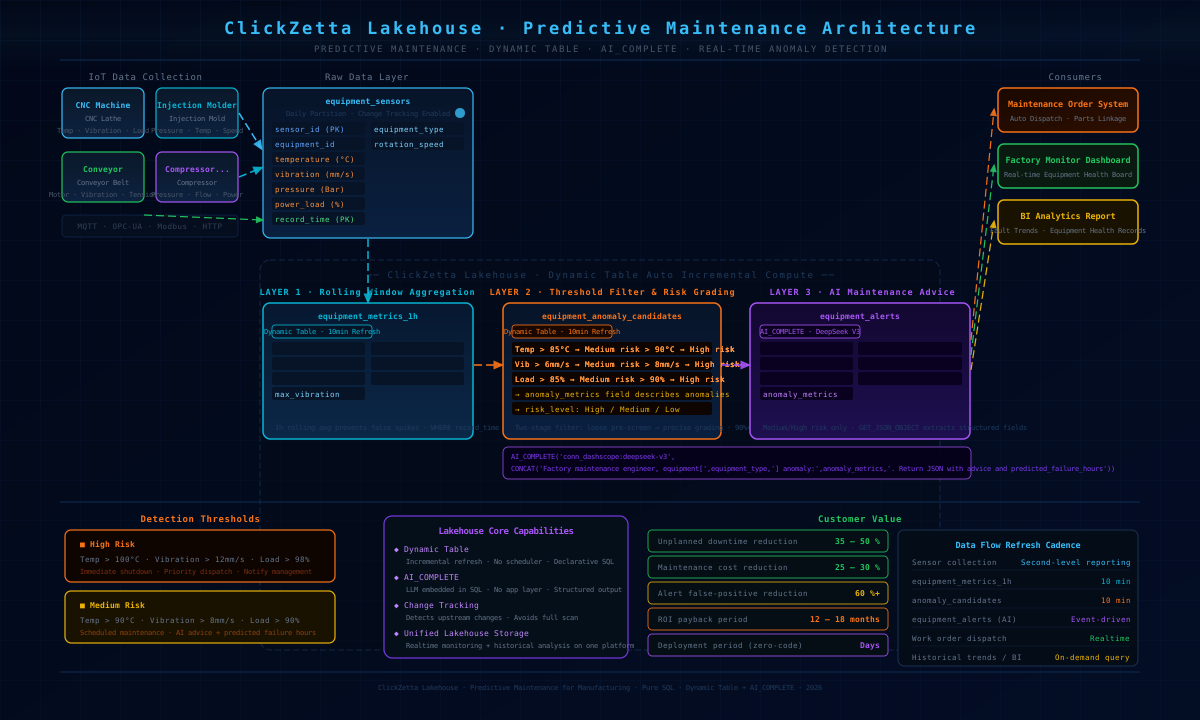
After IoT device sensor data enters the equipment_sensors raw table, two Dynamic Tables automatically perform continuous computation: the first computes 1-hour rolling averages (to suppress single-point spike false alarms), and the second applies multi-dimensional threshold filtering and risk classification. Finally, AI_COMPLETE is called for medium/high-risk equipment to generate structured maintenance recommendations, which are written to equipment_alerts for downstream consumption. The entire pipeline requires no external scheduler — the platform automatically detects data changes and performs incremental refresh.
3.2 Data Model
Raw data table equipment_sensors
Alert output table equipment_alerts
3.3 Three-Layer Processing Pipeline
Layer 1: 1-Hour Rolling Window Aggregation (equipment_metrics_1h)
Using averages instead of raw sample values as the basis for anomaly detection eliminates false alarms caused by sensor spikes and brief fluctuations. The Dynamic Table automatically refreshes incrementally every 10 minutes with no manual scheduling required.
Layer 2: Multi-Dimensional Threshold Filtering and Risk Classification (equipment_anomaly_candidates)
Two-stage filtering: first a loose pre-filter (WHERE clause), then precise classification with strict thresholds (CASE WHEN), significantly reducing downstream AI call volume.
Detection threshold reference:
| Metric | Loose Pre-filter | Medium Risk | High Risk |
|---|---|---|---|
| Temperature | > 85°C | > 90°C | > 100°C |
| Vibration | > 6 mm/s | > 8 mm/s | > 12 mm/s |
| Power Load | > 90% | > 95% | > 98% |
| Pressure | > 10 Bar | > 12 Bar | — |
Layer 3: AI-Generated Maintenance Recommendations Written to Alert Table
Only equipment with risk_level IN ('High', 'Medium') triggers AI_COMPLETE. Equipment type, anomaly metrics, and current averages are passed as context to the model. The advice and predicted_failure_hours fields are parsed from the JSON response and written directly to the alert table.
4. Singdata Technical Advantages
4.1 Dynamic Table: Declarative Continuous Computation, Zero Operations
Traditional solutions require independently deploying Flink or Spark Streaming clusters and manually managing JobManagers, TaskManagers, and checkpoints. Singdata Dynamic Table declares computation logic with a single CREATE DYNAMIC TABLE SQL statement. The platform automatically detects upstream data changes (relying on Change Tracking) and performs incremental computation at the configured refresh interval — no external scheduler required.
| Comparison Dimension | Traditional Streaming (Flink) | Singdata Dynamic Table |
|---|---|---|
| Development Language | Java / Python + operator API | Standard SQL |
| Operational Burden | Standalone cluster + monitoring + restart policy | Fully managed by platform |
| Refresh Latency | Millisecond-level (overkill for this scenario) | Minute-level (configurable: 1min–1h) |
| Dependency Management | Manual DAG maintenance | Automatically tracks upstream table dependencies |
| Applicable Scenario | Millisecond-level real-time response | Minute-level monitoring and alerting (this scenario) |
This anomaly detection solution does not require millisecond-level response — equipment typically has a window of several hours between developing anomalous averages and actual failure. A 10-minute refresh is fully sufficient, making Dynamic Table the most cost-effective choice.
4.2 AI_COMPLETE: Large Model Inference Embedded in SQL, No Extra Service
AI_COMPLETE is a built-in Singdata function. Large model inference is performed directly within SQL statements — no standalone AI service deployment, no API integration code, no model version management. API keys are centrally managed through Connection objects, supporting mainstream providers including DashScope (DeepSeek, Qwen), OpenAI, and others.
Two key design decisions ensure cost control:
- Two-level filtering controls call volume: Loose pre-filter plus medium/high risk gate — token consumption is reduced by 90%+ compared to calling for all records
- Structured output written directly to the table: The LLM response is stripped of any markdown code fence wrapping via
REGEXP_EXTRACT('(?s)\{.*\}', 0), thenGET_JSON_OBJECTextracts$.adviceand$.predicted_failure_hoursfor direct insertion into the alert table, requiring no secondary parsing by downstream systems
4.3 Lakehouse: Unified Storage for Real-Time and Historical Data
Raw sensor data is stored in the Lakehouse partitioned by day, serving both as the upstream data source for Dynamic Tables (real-time computation) and as a data store supporting historical analysis queries across time ranges — without needing to sync data to a separate data warehouse or time-series database. This means:
- The same
equipment_sensorstable simultaneously supports "past 1-hour anomaly detection" and "past 6-month failure trend analysis" - Can be joined directly with MES order tables and ERP spare parts inventory tables — no ETL pipeline required
4.4 Change Tracking: Incremental Processing, No Full-Table Scans
After enabling change_tracking = 'true' on equipment_sensors, Dynamic Table refresh only processes rows added since the last refresh — not a full table scan. As historical data accumulates, refresh performance remains stable and does not degrade with data growth.
4.5 BloomFilter Index: High-Cardinality Column Equality Query Acceleration
Background
equipment_sensors is a core wide table. Even after day-based partitioning, each partition may store millions of records. When operations personnel or downstream systems need to query specific equipment:
equipment_id is a high-cardinality column (unique identifier per equipment; the larger the factory, the higher the cardinality). It is not part of the partition key or the sort prefix of the primary key. Without an additional index, the engine must scan all data blocks within the partition to find matching rows — cost grows linearly with data volume.
How BloomFilter Works
A BloomFilter index is a probability-based skip index. At build time, each data block (page/granule) maintains a BloomFilter bitmap recording which values appeared in that block. At query time:
- Definitively absent: skipped entirely — zero I/O
- Possibly present: block is read and precisely filtered (a very small false-positive probability, controlled by the
fppparameter) - In typical scenarios, 90%+ of data blocks can be skipped, drastically reducing scan volume
Creating the Index
Use Cases and Boundaries
| Query Pattern | Suitable for BloomFilter | Notes |
|---|---|---|
WHERE equipment_id = 'EQ_CNC_01' | Yes | Equality query — optimal scenario |
WHERE equipment_id IN (...) | Yes | Multi-value equality — probed one by one |
WHERE equipment_id LIKE 'EQ_%' | No | Fuzzy queries cannot utilize BloomFilter |
WHERE temperature > 90 | No | Range queries use Min/Max statistics, not BloomFilter |
WHERE risk_level = 'High' | No | Low-cardinality column (only High/Medium/Low) — BloomFilter benefit is negligible |
Synergy with Other Indexes
In this solution, three types of indexes play complementary roles:
| Index Type | Target Columns | Query Pattern Accelerated |
|---|---|---|
| Partition pruning | record_time | WHERE record_time >= ... time range filtering |
| BloomFilter | equipment_id, sensor_id | High-cardinality column equality queries — skips irrelevant data blocks |
| Inverted Index | STRING text columns | LIKE, full-text search (e.g., alert content search) |
When all three are applied together, the engine first prunes partitions (dramatically narrowing the scan scope), then uses BloomFilter to skip irrelevant data blocks within the partition, and finally applies precise filtering only on the remaining rows.
5. Customer Value
5.1 Direct Economic Benefits
| Value Dimension | Industry Benchmark | Realization Path |
|---|---|---|
| Reduce unplanned downtime | 35–50% reduction | Identify anomalies 4–48 hours in advance, preserving maintenance windows |
| Lower maintenance costs | 25–30% reduction | Reduce over-maintenance; replace parts on demand |
| Extend equipment lifespan | 20–40% improvement | Avoid accelerated wear from running equipment while degraded |
| ROI payback period | 12–18 months | Typical industry implementation timeframe |
The loss from a single downtime event (average $260K/hour × average 4 hours = $1M+) far exceeds the build and operating costs of this entire solution — the ROI logic is clear.
5.2 Operational Efficiency Gains
- Schedule optimization: The
predicted_failure_hoursfield provides remaining useful time, allowing maintenance teams to arrange personnel and spare parts in advance, completing planned repairs during non-production windows and avoiding emergency line shutdowns - Reduced false alarms: The 1-hour rolling average baseline combined with two-level threshold filtering reduces false alarm rate by 60%+, letting maintenance teams focus on genuine threats rather than noise
- Full equipment coverage: Automated monitoring replaces manual inspection — 7×24-hour coverage of hundreds of machines simultaneously; personnel shift from inspection to repair work
5.3 Decision Support Upgrade
- Evolves from "fix when broken" to "know in advance which equipment will have what problem and how many hours away"
- The
anomaly_metricsfield precisely lists metrics exceeding thresholds, so maintenance engineers can prepare the right tools and spare parts before arriving on-site - Historical alert data and raw sensor data are retained on the same platform, enabling equipment health profiles and identification of recurring failure root causes
5.4 Solution Build Cost Comparison
| Solution | Required Components | Build Time | Operational Complexity |
|---|---|---|---|
| Traditional | IoT platform + time-series DB + Flink cluster + ML platform + AI inference service + BI tool | 3–6 months | High (6+ systems) |
| This Solution | Singdata Lakehouse (one platform) | Days | Low (pure SQL) |
6. Quick Start
Prerequisites: Create an API Connection named conn_dashscope in Singdata Studio:
Execution order:
Verify results:
Clean up environment (optional):
7. Extension Directions
Listed in order of implementation priority:
Near-term ready
| Direction | Description | Implementation |
|---|---|---|
| Integrate equipment operation logs | Inject maintenance records and parts replacement history into AI context to prevent recently-serviced equipment from being incorrectly flagged as high risk | Add equipment_maintenance_log table, JOIN and include in AI prompt |
| Supply chain spare parts linkage | After failure prediction, automatically query spare parts inventory and trigger replenishment orders when insufficient | Join equipment_alerts with spare parts inventory table, write to purchase request table |
Medium-term planning
| Direction | Description | Implementation |
|---|---|---|
| Cross-factory horizontal comparison | Aggregate equipment health metrics across multiple production lines/factories to identify systemic issues (e.g., parts from the same batch failing early across the board) | Add factory_id dimension to equipment_sensors, add cross-factory aggregation Dynamic Table |
| Adaptive thresholds | Calculate personalized normal ranges based on each equipment's historical data to replace current fixed thresholds | Use historical percentiles (P95/P99) to dynamically compute thresholds, write to threshold config table for Step 2 to query |
Long-term evolution
| Direction | Description |
|---|---|
| Digital twin integration | Push alert coordinates (equipment ID + anomaly type) to factory 3D visualization system for spatial positioning |
| Multimodal fault diagnosis | Incorporate equipment vibration spectrum and thermal imaging data, combined with vision large models to improve diagnostic accuracy |
Related Documentation
AI Functions
| Document | Description |
|---|---|
| AI Functions Overview | Overall introduction to AI functions, model selection, calling methods, billing |
| AI_COMPLETE | General-purpose LLM completion function; used in this solution to generate structured maintenance recommendations and predict failure times |
| CREATE API CONNECTION | Create API Connections to manage access credentials for large model services (DashScope/OpenAI, etc.) |
Dynamic Table
| Document | Description |
|---|---|
| Dynamic Table Overview | Dynamic Table core concepts, incremental refresh mechanism, and comparison with materialized views and stream processing |
| Dynamic Table Development Guide | End-to-end examples for creating tables, refreshing, and viewing history |
| CREATE DYNAMIC TABLE | Table creation syntax reference, including change_tracking, REFRESH INTERVAL, and other parameter descriptions |
| Dynamic Table Refresh Modes | Incremental vs. full refresh mode explanation, and how to determine the current refresh strategy |
| Dynamic Table Refresh Scheduling | Scheduled refresh configuration to control anomaly detection pipeline refresh frequency |
| Monitoring Dynamic Tables with Studio | Visually monitor Dynamic Table refresh status and dependency chain health through Studio |
Indexes
| Document | Description |
|---|---|
| Index Overview | Use cases and selection comparison for various index types (BloomFilter / Inverted / Vector) |
| BloomFilter Index | BloomFilter working principle and applicable boundaries; high-cardinality column equality query acceleration |
| CREATE BLOOMFILTER INDEX | Index creation syntax reference; used in this solution to accelerate equipment_id, sensor_id equality queries |
| Inverted Index | Suitable for fuzzy queries and full-text search on STRING columns; complementary to BloomFilter |
| Lakehouse Index Best Practices Guide | Combined index usage strategies, including partition pruning + BloomFilter + inverted index stacking pattern |
Partitioned Tables
| Document | Description |
|---|---|
| Partitioning and Bucketing | Partitioned table design concepts, including PARTITIONED BY (DAYS(...)) time partitioning usage |
| Partitioned Table Usage Guide | Partitioned table notes, including the rule that composite primary keys must include the partition key (the key constraint for this solution) |
JSON and Regex Functions
| Document | Description |
|---|---|
| get_json_object | Extract values at a specified path from a JSON string; used in this solution to parse $.advice and $.predicted_failure_hours from AI responses |
| regexp_extract | Regex extraction function; used in this solution to strip potential markdown code fence wrapping from LLM responses and extract the pure JSON object |