
Turning operational metadata into AI-driven actions
Learn how live lineage, policy-as-code, and a governed semantic layer turn operational metadata into safe, automated AI actions for your data platform.

Think of metadata as the nervous system of your data platform: it tells you what data exists, where it came from, who owns it, how fresh it is, and who is allowed to use it. For years it was treated as documentation — a catalog humans consulted when something broke. That view is no longer enough.
Operational metadata is turning into live, actionable context that AI agents read and act on in real time. It is the difference between a platform that reports an incident and one that understands it, isolates it, and often fixes it without a human opening a ticket. For data leaders, this shift lands on three familiar pressures: faster time to repair, analytics you can actually trust, and a platform that is genuinely ready for AI rather than merely compatible with it.
Architecture and control plane
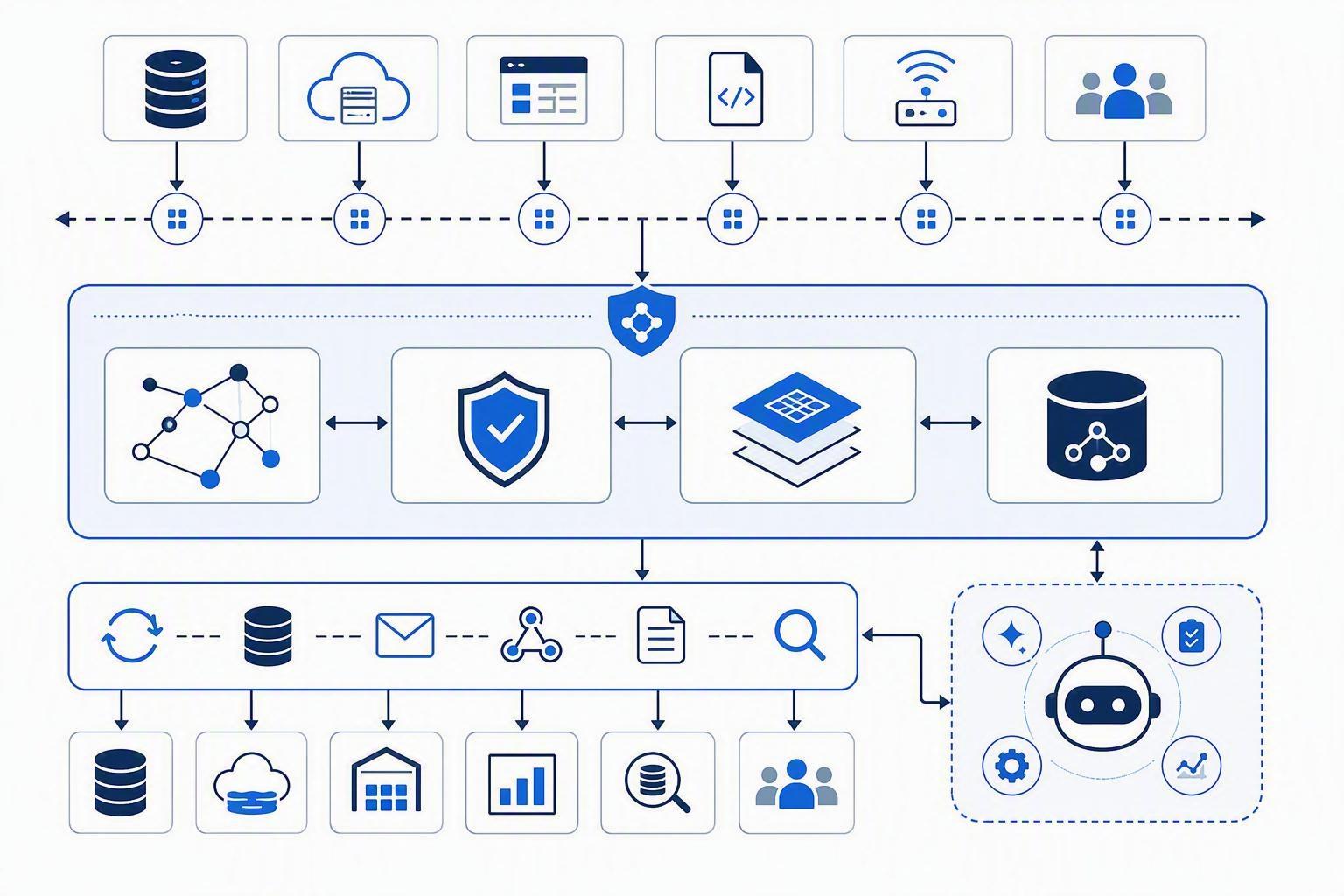
The mechanism underneath all of this is a control plane. Instead of metadata living as static text scattered across catalogs, dashboards, and spreadsheet policies, it is pulled into one coordinated layer that governs what agents may see and do at runtime. This is the mental model worth carrying through the rest of this post: sources emit events, a control plane turns those events into governed context, and that context is what decides the shape of the action an agent takes.
Control-plane foundations
A control plane is not another database. It is the coordination layer that unifies governance, orchestration, observability, and metadata so that every consumer — human or agent — reads from one machine-readable source of truth. Its job is to keep asking the same set of questions that were previously answered by hand: What data exists? Where does it live? Who owns it? Which policies apply? How fresh is it? What business meaning does it carry?
What changed recently is that these answers are now expected in near real time. Atlan's 2026 guide to active metadata makes the case bluntly: "The failure mode for AI agents in data environments is not model quality. It is context quality." An agent fed a stale catalog column will answer confidently and be confidently wrong. Active metadata — metadata that updates as events happen — keeps that context current rather than a snapshot of the last crawl.
Live lineage and write-back
Lineage is what turns a control plane from descriptive into operational. When a schema change occurs upstream, live lineage shows which models, dashboards, and data contracts sit downstream of that change within minutes. That is the difference between discovering a broken report after a stakeholder calls it out and knowing the blast radius the moment the change lands.
The second half of the loop is write-back. A control plane should not only tell agents about the world; it should let agents write corrections and observations back into the metadata graph. When an agent detects a data quality problem, it can flag the asset, update its freshness signal, and open the right remediation path. That feedback loop is what closes the distance between a platform that observes and a platform that acts.
Policy-as-code and semantics
Context without policy is just information. To act safely, agents need rules they cannot talk their way around. Policy-as-code encodes access boundaries, PII and sensitivity tags, certification status, and allowed use cases as machine-readable rules that are enforced at runtime, not by asking an agent to behave.
This is where the semantic layer earns its place. A governed semantic layer defines what terms actually mean — how a metric is calculated, which fields map to a concept like gross revenue, and which definitions are certified. When an agent reasons from those definitions instead of guessing at raw column names, its queries and actions become far more reliable. Meaning and permission travel together: the agent inherits governance simply by consuming governed context.
High-impact use cases
Three use cases consistently justify the investment in an operational metadata control plane. Each one reuses the same loop — detect, understand impact, act within policy — but targets a different outcome.
Drift remediation and impact
Schema and metric drift are quiet killers. A column renames, a field becomes nullable, a source adds a stage — and suddenly reports break or AI features return nonsense. A control plane catches the change at the source, classifies its severity, and uses lineage to rank which downstream consumers are actually at risk.
Armed with that picture, the action becomes proportionate. A safe, additive change can be propagated automatically and logged. A breaking change that would corrupt a critical downstream model can pause the pipeline, quarantine the affected data, and route the decision to the asset owner. The platform does the triage; people make the judgment calls that matter.
SLA enforcement and governance
Operational metadata already holds the signals that define a service level agreement: expected freshness, row counts, error rates, and schedule completion. A control plane treats those as live checks rather than weekly reports. The moment a core pipeline misses its freshness window or a load drops below its expected volume, the platform knows before anyone asks.
The same signals feed governance. PII and sensitive tags attached to assets, change history, and owner records give compliance teams an audit-ready view without chasing information across tools. Automated enforcement means the guardrails hold even when volume and staff do not scale together.
AI assistants with context
The most visible payoff is conversational: give an AI assistant governed context and its answers stop being plausible guesses. Because the assistant queries through the semantic layer and reads active lineage and freshness flags, it knows whether a number is current, what it means, and whether the requester is allowed to see it. It flags uncertain or stale data instead of asserting it.
The result is measurable. Better context raises the share of agent queries that succeed the first time, and those gains compound because every governance decision is logged and defensible. Assistants become a front door to trusted analytics rather than a source of new risk.
Implementation and guardrails
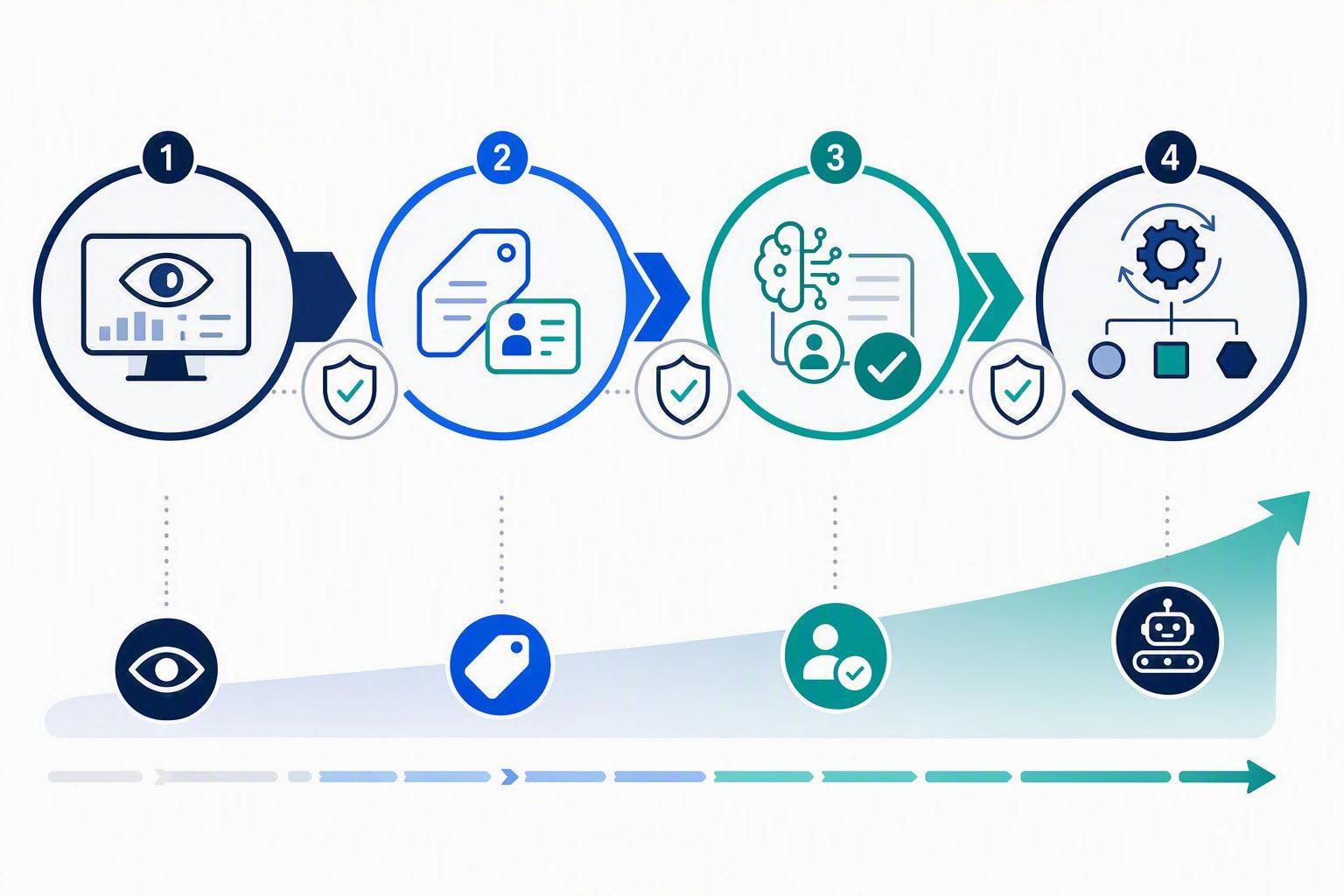
None of this has to be built all at once. The safest path mirrors how most mature platforms have introduced automation generally: start read-only, earn trust with observation, then widen the scope of autonomy gradually.
Reference rollout pattern
A pragmatic sequence moves through four stages. First, stand up read-only observability: capture lineage, freshness, and quality signals and show them in one place. Second, enrich the metadata graph — apply PII and sensitivity tags, attach owners, and encode the highest-value policies as code. Third, allow AI-assisted actions behind explicit approval gates, so the agent proposes and a person disposes for the highest-risk changes. Only then extend to risk-based automation for classes of work that are well understood.
This staged approach is precisely where an AI-ready data platform shows its value. A platform that couples its storage and compute engine with a governed metadata and semantic layer, as Singdata does with its semantic layer for AI, gives you the control plane and the AI capabilities in the same system — so you are not wiring governed metadata from one vendor to agents from another. The infrastructure decision and the governance decision collapse into one, which shortens the runway to the automation stage.
Risk-based automation
The guiding principle for autonomy is risk, not enthusiasm. Rules determine how much latitude an agent gets based on what could go wrong and how reversible the failure is. A freshness fix on a low-risk internal table may run automatically. A change touching customer-facing data, a regulated metric, or an approval-mandated pipeline stops at a person.
Treat reversibility as a design requirement. Every action an agent takes should be recorded with its inputs, the agent identity that performed it, and the reasoning behind it, so any step can be inspected and rolled back. Automation is safe when it is visible, bounded, and auditable — not when it is merely fast.
KPIs and value tracking
Measure the program on three levels so progress is legible to both engineering and the executive floor. On speed, track the classic incident cluster — time to detect, time to acknowledge, time to restore, and time to remediate root cause — and watch the reopen rate so you know the fix is real. On adoption, track automation coverage and acceptance rate: what share of eligible work the agent handles and how much of its output is accepted without rework. On control, track policy adherence and the share of actions that required human override — the guardrails working is a success signal, not a failure.
Resist the temptation to report raw automation volume. The useful numbers are the ones that pair what the platform did with how much trust it earned while doing it.
Conclusion
Operational metadata is no longer a byproduct of data engineering; it is the substrate that lets automated, governed actions happen safely. When lineage, freshness, semantics, and policy live in one live control plane, agents can detect drift, enforce SLAs, and answer questions with context they can defend — and every action stays inside guardrails a human defined.
For teams starting out, do not overreach on day one. Pick a bounded, high-signal problem and prove the loop on it: an incident that repeats, a PII-tagging task that is currently manual, or a drift pattern that keeps breaking downstream reports. Expand iteratively from there, widening autonomy only as approval rates and policy adherence justify it. The infrastructure for AI-ready operations is mostly already in the room — the work is turning metadata from a report into the thing that decides what happens next.