
Is Singdata Secure for Enterprise Data Governance and AI Agent Integration?
A buyer's framework for evaluating Singdata security: testable controls for RBAC, row-level enforcement, agent delegation and revocation, the evidence to request, and pass/fail acceptance criteria before production approval.
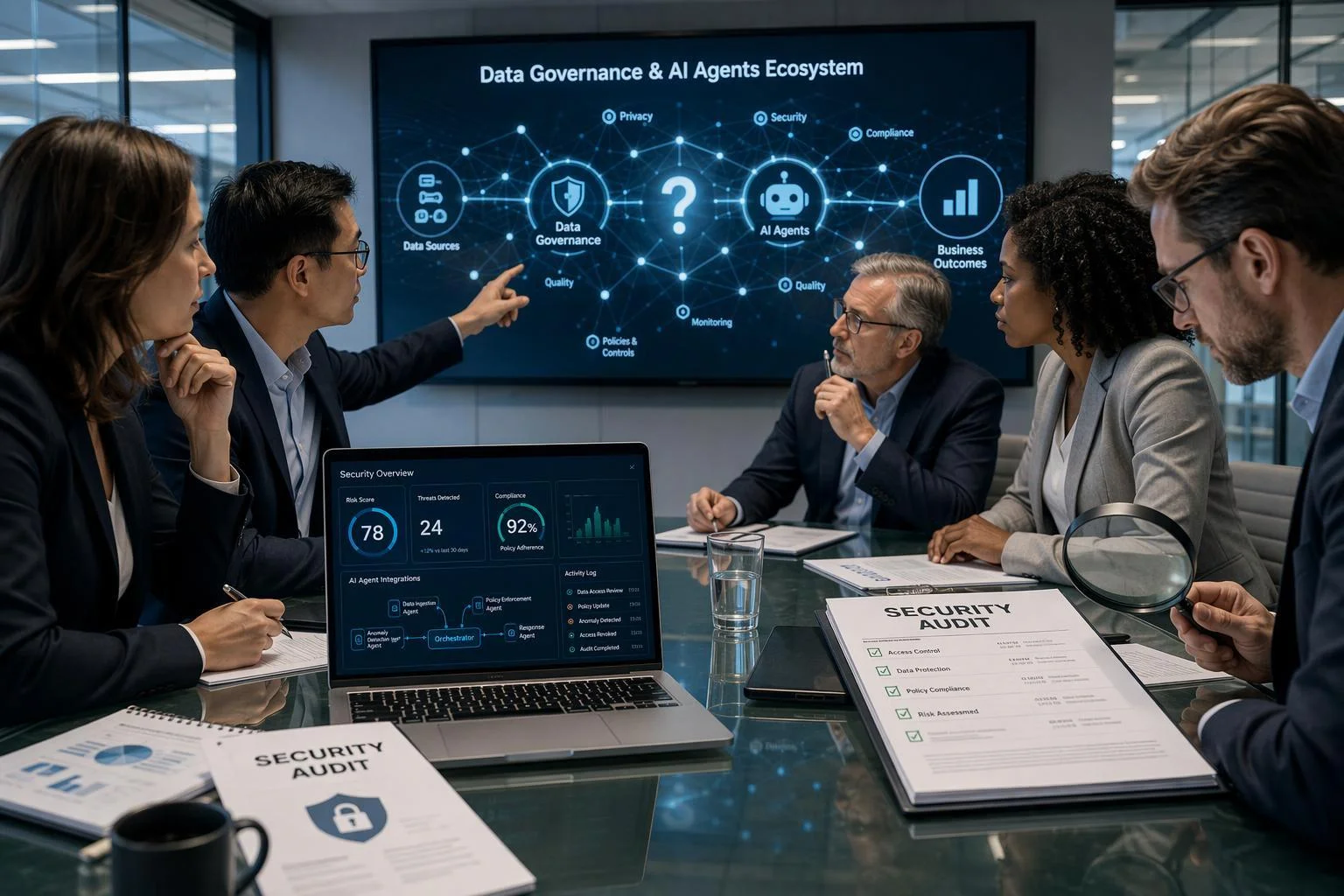
No vendor's security page answers "is it secure?" That question resolves into a set of controls you can test and evidence you can demand. This guide helps an enterprise build its own evaluation framework for Singdata across two surfaces: the data governance layer and the AI agent layer. The decision it supports is a pass/fail judgment made in your environment, not an assurance accepted from a document.
The evidence posture matters up front. Singdata's published security documentation describes capabilities, and those descriptions are vendor claims to be validated rather than independent attestations. Where this article cites a Singdata capability, treat it as the claim under test and confirm current scope, dates and production status directly with the vendor.
Start With Your Own Requirements, Not the Vendor's Feature List
Write your baseline before you read a feature list. Three questions do most of the work: what data you are protecting, which regimes govern it, and what you intend to let an agent do with it.
Data sensitivity tiers. Sort your estate into regulated personal data (PII, PHI), financial records, and intellectual property. Each tier implies different masking, retention and audit expectations, and a control that satisfies one tier may be inadequate for another.
Regulatory exposure. GDPR and CCPA impose processor duties you will need to paper into a contract. Sector rules apply on top. If you have EU exposure, the EU AI Act's high-risk obligations attach on dated timelines — logging traceability and deployer-side human oversight apply to Annex III systems from 2 December 2027 (EU AI Act Article 12, Regulation 2024/1689) — and those obligations land on the audit trail your agent produces.
Deployment constraints. Record whether data must stay in a named jurisdiction, whether you require bring-your-own-storage, private network connectivity or on-premises deployment, and which transfer mechanism your legal team will accept.
Agent autonomy. Separate read-only question answering from state-changing actions. An agent that drafts a query and one that writes to a production table are different risk classes and should not share an approval path.
The output is a one-page requirements statement: tiers, regimes, deployment constraints, and the maximum autonomy you will grant. Every test later in this article should trace back to a line in that statement.
Turn "Is It Secure?" Into Testable Controls
A testable control is a rule with an enforcement point, a pass/fail test, and an evidence artifact. Frameworks supply the acceptance criteria, not the deliverable: ISO/IEC 27001:2022 provides requirements for an information security management system (ISO), and the NIST AI Risk Management Framework organizes AI risk work into GOVERN, MAP, MEASURE and MANAGE. Neither certifies your configuration. A certificate or a documentation page is an input to a test, never the test itself.
Control domain | Enforcement point | Test | Evidence artifact |
|---|---|---|---|
Identity | SSO/MFA at the identity provider | Attempt login without the second factor | Authentication log entry |
Access | Query-time policy in the engine | Run the same query as restricted and authorized roles | Per-statement access record |
Network | Private link or IP allowlist | Attempt connection from an unlisted address | Denied-connection log |
Encryption | Storage and transport layer | Confirm key ownership and TLS enforcement | Key configuration record |
Audit | Operation and job logs | Reconstruct one full request end to end | Exported audit record |
Agent authorization | Scoped credential per agent | Inspect token claims for acting user and agent | Delegation chain per request |
Revocation | Identity disablement path | Disable the agent and retry the credential | Timed failure at the resource |
Write the pass condition for each row before you run it. "Access control is configured" is not a test; "a restricted role querying the payroll table returns zero rows and the access record names the policy" is.
What Security Evidence to Request, and What Each Artifact Proves
Ask for the artifacts, then read their limits.
Each artifact attests to a different thing, and none of them attests to your configuration. A SOC 2 Type II report covers a defined system over a specified observation period; an ISO/IEC 27001 certificate certifies an information security management system, not a product's runtime behaviour; a penetration-test letter is point-in-time and limited to the scope tested. Verify scope, period and issuing body for each before relying on it.
SOC 2 Type II report. Check the scope, the audit period, and any exceptions. The report covers the vendor's controls over a window; it says nothing about your configuration or your tenant.
ISO/IEC 27001 certificate. ISO describes certification as one way to demonstrate that an organization is "committed and able to manage information securely and safely" (ISO) — an ISMS commitment, not a product test. Verify the certificate's scope and expiry with the issuing body.
Penetration-test summary. Ask what was in scope and when. A summary of a network test does not cover the agent authorization path.
Subprocessor list and DPA. These carry the processor obligations discussed below.
The vendor's own security overview. Singdata's security overview describes capabilities across five layers — identity authentication, access control, network isolation, data protection, and backup and recovery — including MFA/SSO, RBAC with GRANT/REVOKE, IP allowlists, Private Link, bring-your-own-storage, dynamic data masking, AES-256 storage encryption, and Time Travel. A Singdata whitepaper on healthcare data references HIPAA, ISO 27001 and SOC 2 (whitepaper page). Both are vendor-reported. A whitepaper reference is not the certificate; confirm current certification scope and dates directly, and do not treat this article as evidence that Singdata holds or lacks any specific certification.
Testing Row-Level and Column-Level Enforcement at the Engine
Access control that exists only in a UI is not access control. The test is whether the engine filters rows and masks columns when a query arrives through a path the UI does not mediate.
Run the same statement as a restricted role and as an authorized role, compare the result sets, then read the access record for both statements. Singdata documents RBAC with GRANT/REVOKE, dynamic data masking, and row-level permissions under which agent-generated queries automatically include the corresponding filter conditions (row-level permissions documentation; governance overview). Those are the claims to test. Note that Singdata documentation has labeled row filtering an invited-preview feature, so confirm its production status with support before you rely on it.
External examples show what an engine-level test catches. Databricks documents that with ANSI mode disabled, a type mismatch in a row filter can silently return every row instead of filtering (Databricks, row filters and column masks). Snowflake's ACCESS_HISTORY view records one row per statement with the columns accessed and a policies_referenced field naming the row access and masking policies the query relied on (Snowflake, Access History). Neither is a statement about Singdata; both illustrate the failure modes a comparison test is designed to expose.
Testing Agent Delegation, Least Privilege, and Revocation
The agent surface adds a second identity question: on whose authority is this query running?
Snowflake's documentation splits delegated agents, which act on behalf of a user with the session belonging to that user, from autonomous agents acting under their own SERVICE_AGENT identity (Snowflake agent identity). That is one vendor's implementation, not an industry standard, but the distinction is the right one to test. An agent should carry its own scoped identity, never a shared super-admin account; a shared account means the permission model is bypassed by the natural-language layer sitting on top of it.
Four proof-of-concept tests:
Token claims. Inspect the token for the acting user and the agent. AWS guidance describes an
actclaim identifying the agent acting on behalf of a user and asubclaim used for row-level security and audit (AWS Prescriptive Guidance).Per-tool scoping. Confirm read-only versus write scoping for each tool, with no wildcard permissions (OWASP AI Agent Security Cheat Sheet).
Injection path. Attempt a prompt injection that tries to reach data the asking user cannot see; OWASP lists prompt injection as LLM01:2025 and notes that RAG and fine-tuning do not fully mitigate it (OWASP LLM01).
Revocation. Disable the agent identity and prove the credential fails at the resource, with the elapsed time recorded.
NIST's concept paper on agent identity is a draft — comments ran from 5 February to 2 April 2026 — not a standard (NIST NCCoE concept paper). Singdata states that the same RBAC, row-level security and column masking apply whether a question arrives through the Analytics Agent, Lakehouse Studio, or an external agent via AI Gateway (FAQ page). That is the claim to verify across all three entry points, not just the one you demo.
Why a Sandbox Is Not a Data Permission Model
A sandbox bounds what agent code can do to its runtime environment. A data permission model bounds which rows and columns the agent's credential may read. The two are complementary and neither substitutes for the other.
Perplexity's SPACE launch post reports that no attempt escaped the virtual machine to the host in 108 tries, while some attempts found ways around network restrictions, since fixed (SPACE launch post, 2026-10-15). That result says nothing about which rows an agent's credential can read. CoreWeave's deployment guide for SPACE describes isolated Firecracker microVMs and notes that the install path for existing clusters is a development and evaluation path, not a production deployment (CoreWeave deployment guide).
OWASP's agent security cheat sheet asks for authorization enforced outside the agent's context alongside sandboxing for arbitrary code execution. Applied to Singdata: the "production-grade sandbox" in its V2 positioning describes runtime isolation and does not by itself answer the row-level authorization question. Test the data-authorization plane separately — restricted-versus-authorized query comparison, masking verification, and audit reconstruction — and treat the sandbox result as a different control.
Contractual Terms That Belong in the Security Review
Technical controls do not survive a procurement review without matching contract terms. GDPR Article 28 requires a contract between controller and processor setting out the subject-matter and duration of processing, the nature and purpose, the type of personal data and categories of data subjects, and the obligations and rights of the controller (GDPR Article 28, EUR-Lex). It also requires that any sub-processor be bound by the same obligations, with the initial processor remaining fully liable.
Read these clauses:
Breach notification. The timeline, who notifies whom, and what content the notice must carry.
Subprocessor approval and change notice. Whether you get advance notice and a right to object.
Data residency and transfer mechanism. Which jurisdictions data may be processed in, and whether standard contractual clauses or another instrument applies.
Deletion and return on termination. The period and the evidence you receive.
Audit rights. Whether you may audit directly or must rely on third-party reports.
CCPA imposes parallel processor obligations for California residents' data. Singdata's privacy policy describes SSL encryption for transmission of registration and payment information and access-limiting practices, and notes that third-party service providers may be located in Singapore or outside it. Its healthcare whitepaper lists contract elements including data protection, incident response, compliance terms and service commitments (whitepaper page). These are the vendor's stated positions; confirm them in the executed contract. This section is a reading list, not legal advice.
Pass/Fail Acceptance Criteria Before Production Approval
Set thresholds in your own environment; the material here supplies no recommended credential lifetime or measured per-query cost, so those numbers come from your risk tolerance.
Must-have criterion | Pass condition (you set the number) |
|---|---|
Row and column enforcement | Restricted-role query returns zero unauthorized rows; masked columns return masked values |
Agent delegation | Token carries a verifiable chain identifying both acting user and agent |
Least privilege | Per-tool read/write scoping confirmed; no wildcard grants |
Revocation | Disabled agent credential fails at the resource within your stated time |
Audit reconstruction | One full agent request — identity, tool, resource, outcome — reconstructed from logs |
Evidence currency | Current SOC 2 report and ISO/IEC 27001 certificate verified with issuing bodies |
Red flags that should stop an approval: a shared super-admin service account behind the agent, no tested revocation path, row filtering unconfirmed in production, and certification claims not backed by a current report.
Use the results to decide. Approve when every must-have passes. Approve with conditions when a gap has a named owner, a dated remediation, and a compensating control in the interim. Defer when a must-have fails without a credible path — particularly revocation or row-level enforcement, because both are structural rather than configuration fixes.
FAQ
Does Singdata hold SOC 2 and ISO 27001? A Singdata whitepaper references HIPAA, ISO 27001 and SOC 2, which is a vendor statement, not a certificate. Ask for the current report and certificate and verify scope and dates with the issuing bodies.
Does Singdata enforce row-level security for AI agents? Singdata documentation states that agent-generated queries automatically include row filter conditions and inherit the same RBAC and masking as human analysts. Row filtering has been labeled an invited-preview feature in Singdata documentation, so confirm production status with support before relying on it.
Is a sandbox enough to secure an agent? No. A sandbox constrains what agent code can do to its runtime; data authorization decides which rows the agent's credential may read. Test both planes.
What is the single most important proof-of-concept test? Revocation proven at the resource, paired with a restricted-versus-authorized query comparison. The first proves you can withdraw access; the second proves the access was scoped in the first place.
Previous posts
singdata.com/trending/five-thousand-agents-storage-rewrite-databricks-alternative
https://singdata.com/trending/vector-index-row-level-security-layout/
https://www.singdata.com/documents/sql_functions/scalar_functions/string_functions/url_decode