What We Learned from Deploying Product Layout Strategy Across 5 Industries

Deploying a product layout strategy across multiple industries reveals valuable lessons that can transform business operations. You learn that adaptability drives success, especially when modern manufacturing facilities use distributed layouts.
Distributed layouts save costs significantly, as shown in manufacturing studies.
Savings grow with larger production volumes, even as the percentage decreases.
Facilities with overlapping machine capabilities benefit the most.
Data-driven decisions also play a critical role. When businesses prioritize customer requirements, satisfaction levels improve dramatically. This approach ensures products align with what users value, closing gaps where competitors fall short. You gain insight into optimizing efficiency and delivering superior quality that fosters loyalty.
Key Takeaways
Being flexible is important. Change your product layout to match new trends and what customers want for better results.
Using data helps you make better choices. Look at numbers to learn how customers act and improve your layout.
Mixing good looks with usefulness makes customers happy. Design spaces that look nice and are simple to move through.
Making work smoother saves time. Find problems and fix steps to work faster and spend less money.
Check and change your layout plan often. Always improving keeps you ahead and makes customers satisfied.
Product Layout Strategy in the Retail Industry
Optimizing Store Layouts for Customer Flow
A well-designed store layout can transform how customers interact with your retail space. By analyzing visitor flow patterns, you can identify high-traffic zones and strategically position products to maximize visibility and sales. Tools like heat mapping allow you to track customer movement in real time, highlighting areas where shoppers linger the most. This data helps you place high-margin or impulse items in these zones, increasing the likelihood of purchases.
Clear pathways also play a critical role in improving customer satisfaction. When shoppers can navigate your store without congestion, they are more likely to enjoy their experience and spend more time browsing. Additionally, understanding peak shopping times through performance metrics enables better staffing and inventory management, ensuring a seamless experience for your customers.
Key benefits of optimizing customer flow include:
Identifying high-traffic areas for strategic product placement.
Enhancing customer engagement and dwell time.
Improving conversion rates through better navigation and accessibility.
Balancing Aesthetics with Functionality
Striking the right balance between aesthetics and functionality is essential in retail environments. While visually appealing displays attract customers, they must also serve a practical purpose. Overemphasizing aesthetics can lead to cluttered layouts that confuse shoppers, while focusing solely on functionality may weaken your brand's visual identity.
For example, a free-flow layout can create a relaxed shopping atmosphere, but it requires careful organization to guide customers effectively. Similarly, incorporating seating areas can enhance the shopping experience, especially for families or elderly customers. By aligning your layout with your brand's identity and customer needs, you can create a space that is both inviting and efficient.
Benefits of balancing aesthetics and functionality:
Improved customer retention through a cohesive brand experience.
Increased sales by making products more accessible and appealing.
Enhanced usability without compromising visual appeal.
Results: Boosted Sales and Enhanced Customer Experience
Retailers who implement effective product layout strategies often see measurable improvements in both sales and customer satisfaction. Metrics like Net Promoter Score (NPS) and Customer Satisfaction Rating (CSAT) reveal how well your layout meets customer expectations. For instance, a higher NPS indicates that customers are more likely to recommend your store, reflecting their positive experience.
Sales figures also validate the impact of a well-planned layout. Conversion rates and sales per square foot provide insights into how efficiently your space generates revenue. Additionally, adapting layouts to accommodate new trends, such as Buy Online, Pick Up In-Store (BOPIS), can further enhance customer convenience and loyalty.
Metric | Description |
|---|---|
Net Promoter Score (NPS) | Measures customer loyalty and satisfaction based on their likelihood to recommend the business. |
Customer Satisfaction Rating (CSAT) | Indicates how satisfied customers are with a product or service. |
Conversion Rates | Shows the percentage of visitors who make a purchase, reflecting the effectiveness of sales strategies. |
Sales per Square Foot | Evaluates the sales generated per square foot of retail space, indicating store efficiency. |
By focusing on customer flow, balancing aesthetics with functionality, and leveraging data-driven insights, you can create a product layout strategy that not only boosts sales but also enhances the overall shopping experience.
Product Layout Strategy in the Manufacturing Industry
Streamlining Production Lines for Maximum Efficiency
Streamlining production lines is essential for improving efficiency in manufacturing. You can achieve this by analyzing workflows and identifying areas where processes slow down. Tools like simulation software allow you to test different factory layouts virtually, helping you find the most effective design without disrupting operations. Value Stream Mapping (VSM) provides a detailed view of your workflows, enabling you to pinpoint inefficiencies and eliminate waste.
Key strategies for streamlining production lines include:
Automating repetitive tasks to reduce human error and save time.
Reorganizing workflows to minimize unnecessary movement of materials.
Continuously analyzing and refining processes to adapt to changing demands.
A well-designed production layout not only enhances productivity but also reduces risks. By streamlining workflows, you can lower the chances of lost inventory and worker accidents, creating a safer and more efficient environment.
Technique | Description |
|---|---|
Simulation Software | Enables virtual testing of various factory layouts to identify optimal designs based on data. |
Value Stream Mapping (VSM) | Provides a comprehensive view of workflows to identify inefficiencies and reduce waste. |
Addressing Bottlenecks and Space Utilization Challenges
Bottlenecks and poor space utilization can significantly hinder manufacturing efficiency. You can address these challenges by tracking utilization trends and making real-time adjustments to your layout. For example, Avalign Technologies used advanced monitoring tools to achieve a 25-30% increase in Overall Equipment Effectiveness (OEE). This improvement translated into millions of dollars in increased capacity without the need for additional equipment.
To optimize space, consider implementing the 5S Framework. This method helps you organize physical spaces, uncover constraints, and resolve them effectively. Value Stream Mapping also plays a crucial role in visualizing processes and eliminating bottlenecks by focusing on steps that add value.
Benefits of addressing bottlenecks and optimizing space:
Reduced costs by repurposing underutilized areas.
Improved portfolio management through better space planning.
Enhanced efficiency by resolving constraints and streamlining operations.
Metric | Description |
|---|---|
Overall Equipment Effectiveness (OEE) | A measure of manufacturing efficiency calculated by multiplying availability, performance, and quality. |
On-time Delivery (OTD) | A critical metric indicating the percentage of orders delivered on time, with a target of at least 95% for competitiveness. |
Production Line Efficiency | Calculated as (Actual Output / Maximum Potential Output) × 100, indicating how effectively a production line operates. |
Results: Cost Reduction and Increased Output
Implementing an effective product layout strategy in manufacturing leads to measurable results. By addressing bottlenecks and optimizing workflows, you can significantly reduce costs and increase output. For instance, reorganizing your facility layout can help you repurpose underutilized spaces, saving money on unnecessary expansions. Automation and streamlined workflows further enhance productivity, allowing you to meet higher demand without additional resources.
Metrics like Overall Equipment Effectiveness (OEE) and Production Line Efficiency provide clear indicators of success. A higher OEE reflects better utilization of equipment, while improved efficiency metrics demonstrate the effectiveness of your production line. On-time Delivery (OTD) rates also improve, ensuring customer satisfaction and maintaining your competitive edge.
By focusing on these strategies, you can create a manufacturing environment that maximizes efficiency, reduces costs, and drives growth.
Product Layout Strategy in the E-commerce Industry
Designing User-Friendly Digital Product Layouts
Creating a user-friendly digital product layout is essential for engaging your audience and driving conversions. A well-structured layout ensures that users can easily find what they need, improving their overall experience. Responsive design plays a critical role here. Nearly half of users expect a website’s layout to remain consistent across devices, making it vital to optimize for both desktop and mobile platforms. Additionally, fast loading times are non-negotiable. More than half of mobile users will abandon a site if it doesn’t load within three seconds, directly impacting your engagement metrics.
To enhance usability, you should focus on intuitive navigation and visually appealing designs. Studies show that 38% of users will disengage if a website’s layout is unattractive. By prioritizing aesthetics and functionality, you can create a seamless experience that keeps users coming back. Tools like heat maps and usability testing can help you identify areas where users struggle, allowing you to make targeted improvements.
Statistic | Impact on User Engagement |
|---|---|
More than half of mobile users will abandon a site if it doesn’t load within 3 seconds. | Highlights the critical importance of fast loading times in retaining users. |
45% of people want a website’s layout to remain the same across different devices. | Emphasizes the necessity of responsive design for consistent user experience. |
38% of users will disengage if the content or layout is unattractive. | Indicates that layout aesthetics significantly affect user retention. |
Overcoming Challenges in Personalization and Scalability
As your e-commerce business grows, personalizing the customer experience becomes increasingly challenging. Scaling personalization efforts requires analyzing vast amounts of customer data and implementing systems that can handle the load. Without scalable solutions, you risk slow load times and irrelevant recommendations, which can frustrate users and reduce satisfaction.
To address these challenges, you should invest in advanced technologies like AI-driven recommendation engines. These tools analyze user behavior in real time, delivering personalized experiences without compromising speed. Additionally, simplifying your backend processes can help maintain efficiency as your product offerings expand. By overcoming these hurdles, you can ensure that your platform remains user-centric and adaptable to growth.
Results: Improved User Engagement and Conversion Rates
Implementing an effective product layout strategy in e-commerce delivers measurable results. Conversion rates, add-to-cart rates, and cart abandonment rates provide clear indicators of success. For example, mobile conversion rates average 2.8%, while desktop rates reach 3.2%. Optimizing your layout can help close this gap and improve overall performance.
Metric | Mobile | Desktop | Overall |
|---|---|---|---|
Conversion rate | 2.8% | 3.2% | 2.9% |
Add-to-cart rate | 6.4% | 6.2% | 6.8% |
Cart abandonment rate | 79.0% | 68.1% | 76.2% |
By focusing on user-friendly designs, addressing personalization challenges, and leveraging data-driven insights, you can create an e-commerce platform that not only engages users but also drives higher conversion rates.
Product Layout Strategy in the Hospitality Industry
Structuring Menus and Service Workflows
A well-structured menu and efficient service workflow can significantly enhance your hospitality operations. By regularly reviewing supplier performance, you ensure that your ingredients and materials meet quality standards. Establishing systems to monitor vendor compliance helps maintain consistency in your offerings. Technology integration also plays a vital role. Tools like reservation systems and waitlist management software streamline operations, reducing no-shows and improving table turnover.
In the kitchen, a Kitchen Display System (KDS) improves communication between staff and ensures order accuracy. Predictive analytics can further optimize table turnover by analyzing guest behavior and peak dining times. High-quality equipment enhances back-of-house processes, ensuring durability and efficiency. These strategies not only improve operational workflows but also elevate the guest experience.
Tip: Collecting and analyzing customer feedback allows you to identify areas for improvement and make data-driven decisions to refine your service.
Balancing Customer Preferences with Operational Efficiency
Balancing guest preferences with operational efficiency requires a data-driven approach. Metrics like RevPAR (Revenue Per Available Room) and NPS (Net Promoter Score) provide insights into financial performance and guest satisfaction. By analyzing booking patterns and service requests, you can personalize guest experiences, such as offering tailored dining options or room preferences.
Operational metrics like labor cost percentage and energy consumption per occupied room help you optimize resource allocation. For example, forecasting occupancy rates allows you to adjust staffing levels, ensuring smooth operations without overstaffing. Sentiment analysis from reviews and social media also highlights areas where you can improve, helping you stay competitive in the market.
Metric Type | Examples |
|---|---|
Financial Metrics | RevPAR, GOPPAR, TRevPAR, Flow-through percentage |
Guest Experience Metrics | NPS, Guest satisfaction indices, Sentiment analysis |
Operational Metrics | Labor cost percentage, Inventory turnover ratios, Maintenance response times |
Results: Higher Guest Satisfaction and Revenue Growth
Implementing an effective product layout strategy in hospitality leads to measurable results. Revenue growth often correlates with gross operating profit, moving 1.5 to 2.0 times more with any revenue change. Markets like New Delhi and Bali have shown revenue recovery post-pandemic, validating these strategies.
New metrics like RevPAG (Revenue Per Available Guest) complement traditional ones like RevPAR, allowing you to tailor experiences and maximize profitability. With 65% of APAC regions returning to pre-pandemic tourism levels, leveraging these insights can unlock new revenue opportunities.
Focusing on guest satisfaction also drives growth. Metrics like NPS and guest satisfaction indices reveal how well your services meet expectations. By aligning your operations with customer preferences, you create memorable experiences that encourage repeat visits and positive reviews.
Product Layout Strategy in the Healthcare Industry
Organizing Medical Facilities for Optimal Patient Care
Organizing medical facilities effectively can significantly improve patient care. A well-planned layout ensures that patients receive timely attention while staff can perform their duties efficiently. For example, placing diagnostic equipment near treatment rooms reduces patient movement and speeds up care delivery. Similarly, creating clear pathways for emergency cases minimizes delays during critical situations.
Evidence supports the impact of thoughtful layouts on patient outcomes. Facilities that adopt evidence-based practices report a 15% reduction in patient length of stay and a 12% decrease in mortality rates. Additionally, 94% of these facilities experience a positive return on investment, proving that strategic layouts benefit both patients and healthcare providers.
Evidence-Based Practice Outcomes | Percentage |
|---|---|
Length of Stay | 15% |
Mortality | 12% |
Positive Return on Investment | 94% |
Navigating Compliance and Space Management Challenges
Compliance and space management present unique challenges in healthcare. You must ensure that layouts meet strict regulations while optimizing available space. For instance, infection control requires maintaining proper pressure relationships, temperature, and humidity to prevent the spread of diseases. Worker safety also demands adherence to OSHA standards, including the use of personal protective equipment (PPE) and staff training.
Space constraints further complicate facility design. Balancing patient comfort with operational efficiency often requires creative solutions. For example, modular designs allow you to adapt spaces for different needs, such as converting general wards into isolation units during outbreaks. However, enforcing and documenting risk mitigation measures can become difficult, especially during low manpower situations.
Compliance Issue | Description |
|---|---|
Infection Control | Ensuring proper pressure relationships, temperature, and humidity to prevent infection spread. |
Worker Safety | Compliance with OSHA requirements, including PPE and training for staff. |
Construction Safety | Risk assessments and management plans to ensure safety during construction projects. |
Documentation of Mitigation | Challenges in enforcing and documenting risk mitigation measures during low manpower situations. |
Public Scrutiny | Increased focus on visible sanitation efforts post-COVID-19, potentially overshadowing effective measures. |
Results: Enhanced Patient Outcomes and Staff Productivity
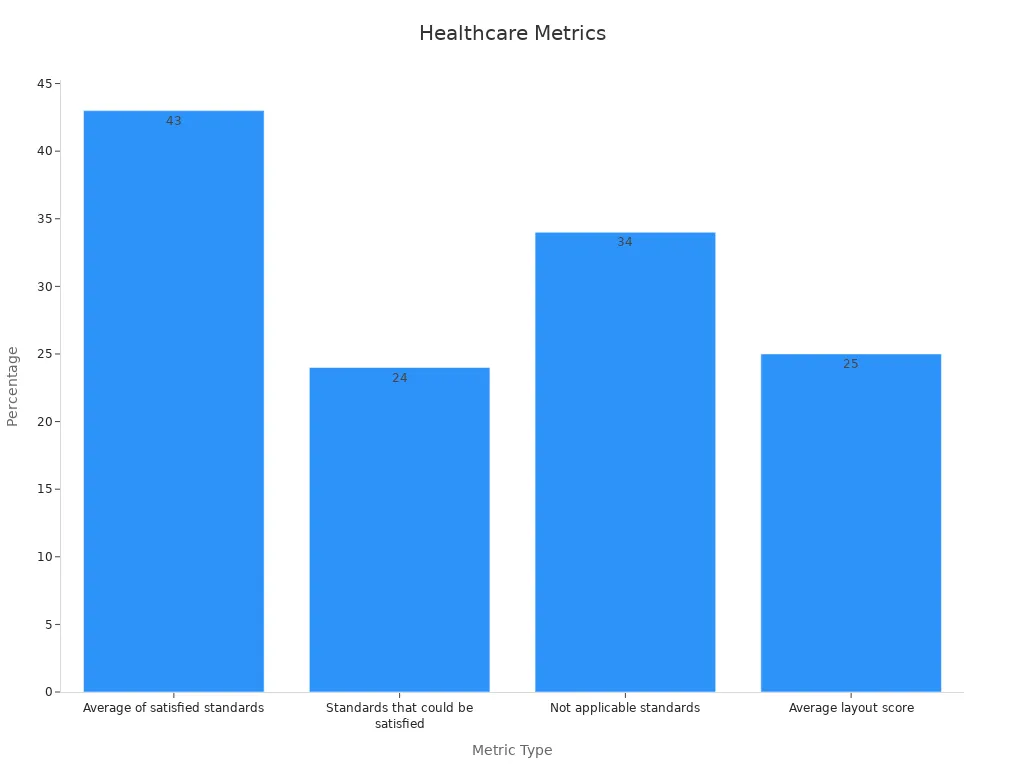
Implementing an effective product layout strategy in healthcare leads to measurable improvements. Facilities with optimized layouts report higher patient satisfaction and better staff productivity. Metrics like the average layout score and satisfied standards validate these outcomes. For example, facilities achieve a 43% satisfaction rate for standards, while 24% of standards remain achievable with further adjustments.
Metric Type | Value |
|---|---|
Average of satisfied standards | 43% |
Standards that could be satisfied | 24% |
Not applicable standards | 34% |
Average layout score | 25% |
By addressing compliance challenges and optimizing space, you can create a healthcare environment that prioritizes patient care and operational efficiency. This approach not only enhances outcomes but also fosters a safer and more productive workplace for staff.
Comparative Analysis of Product Layout Strategies Across Industries
Common Principles of Effective Product Layout Strategies
Across industries, certain principles consistently lead to successful product layout strategies. First, prioritizing customer-centric design ensures that layouts align with user needs. Whether you're organizing a retail store or a healthcare facility, understanding how people interact with the space helps you create a more intuitive experience. Second, leveraging data-driven insights allows you to make informed decisions. Metrics like customer flow, production efficiency, or patient outcomes provide actionable feedback for continuous improvement. Finally, adaptability remains crucial. Industries evolve, and your layout must accommodate new trends, technologies, and consumer behaviors.
For example, in retail, placing high-demand items in easily accessible areas boosts sales. In healthcare, positioning diagnostic tools near treatment rooms reduces patient movement. These examples highlight how universal principles can be tailored to specific contexts, ensuring both efficiency and satisfaction.
Industry-Specific Differences and Their Implications
While common principles exist, each industry faces unique challenges and opportunities in product layout strategies. For instance, in retail, healthier product placement—such as displaying fruits and vegetables prominently—has increased sales and supported public health goals. Conversely, reducing the visibility of unhealthy items like confectionery has decreased their sales, showing how layouts can influence consumer behavior. In healthcare, strict compliance requirements shape layouts to prioritize safety and infection control. Meanwhile, government policies, such as proposed bans on unhealthy food placement, further emphasize the role of regulation in shaping layouts.
Evidence Type | Findings | Implications |
|---|---|---|
Healthier Layout | Promotes healthier choices and public health outcomes | |
Unhealthy Item Placement | Reduced sales of confectionery | Encourages strategic layouts to influence behavior |
Government Policy | Proposed ban on unhealthy food placement | Aims to improve diets and curb childhood obesity |
These differences underline the importance of tailoring strategies to meet industry-specific needs while considering broader societal impacts.
Lessons on Adaptability, Innovation, and Cross-Industry Learning
Adaptability and innovation drive success in product layout strategies. Case studies reveal how organizations foster creativity through design thinking, agile methods, and cross-functional collaboration. For example, Wes-Tech's collaboration with a tool manufacturer demonstrates adaptability. By developing a semi-automation solution, they improved product quality and productivity, showcasing how expertise from one industry can solve challenges in another.
Key lessons include the value of cross-industry learning. Industries differ in their regulatory environments, technological disruptions, and consumer behaviors. For instance, some sectors face rapid innovation cycles, while others prioritize sustainability. Understanding these variations helps you adopt best practices and remain competitive.
Examples of cross-industry insights:
Design thinking and agile methodologies enhance creativity.
Cross-functional teams overcome barriers to innovation.
Sustainability practices influence layout strategies differently across sectors.
By embracing these lessons, you can refine your product layout strategy to meet evolving demands and maintain a competitive edge.
Tailoring a product layout strategy to your industry’s unique needs ensures better outcomes. Universal principles like customer-centric design and data-driven decisions drive success across sectors. You can enhance performance by adopting innovative practices from unrelated industries, improving user experience and customer satisfaction. Continuous improvement is vital. Testing prototypes with real users and understanding their pain points help align strategies with expectations. Embracing flexibility and benchmarking against other sectors fosters strategic innovation, keeping your business competitive in a dynamic market.
Tip: Regular audits and leveraging technology can uncover hidden opportunities for growth.
FAQ
What is a product layout strategy?
A product layout strategy organizes physical or digital spaces to improve efficiency and user experience. It focuses on optimizing workflows, customer interactions, and resource allocation. This approach ensures better outcomes, whether in retail, manufacturing, or healthcare.
Why is adaptability important in product layout strategies?
Adaptability allows you to respond to changing trends, technologies, and customer needs. A flexible layout ensures your business stays competitive and relevant. For example, adapting to e-commerce trends like mobile-first design can boost user engagement.
How can data-driven decisions improve product layouts?
Data-driven decisions help you identify inefficiencies and opportunities. Metrics like customer flow, production efficiency, or conversion rates provide actionable insights. By analyzing this data, you can make informed changes that enhance performance and satisfaction.
Are product layout strategies industry-specific?
Yes, each industry has unique requirements. Retail focuses on customer flow, while manufacturing emphasizes efficiency. Healthcare prioritizes compliance and patient care. Tailoring strategies to your industry ensures better results and aligns with specific goals.
What tools can help optimize product layouts?
Tools like heat maps, simulation software, and value stream mapping assist in optimizing layouts. These tools provide insights into user behavior, workflow inefficiencies, and space utilization. Using them ensures data-backed improvements for better outcomes.
Tip: Regularly review your layout strategy to adapt to new challenges and opportunities.
See Also
Utilizing Computer Vision Heatmaps for A/B Testing Layouts
Creating A Stage-Gate Process Based on Retail Data Insights
Five Effective Attribution Models for Retail Marketing Budgeting