
What CTOs Miss When Evaluating Inventory Demand Forecasting Capabilities
CTOs miss key factors in inventory demand forecasting, like external trends, demand variability, and scalability. Learn how to address these blind spots.

In the fast-paced world of inventory demand forecasting, there are critical evaluation factors that CTOs miss, which can cost you more than just money. Ignoring external market trends or underestimating demand variability can cripple operational efficiency. Studies highlight that even experts falter in long-term forecasting without the right tools and cognitive strategies. For instance, research on 260 superforecasters revealed their success stemmed from enriched environments, task-specific skills, and statistical rigor. To avoid these pitfalls that CTOs miss, you must adopt a strategic approach, focusing on accurate data, adaptability, and cross-functional collaboration. This ensures your forecasting capabilities align with long-term business goals.
Key Takeaways
Don't just use old data for predictions. Mix it with new trends and smart tools to make better guesses.
Add outside factors like the economy to your prediction models. This helps you see changes in what people want and improves guesses.
Make sure forecasting tools can grow and work with other systems. They should handle more data and connect easily.
Check how good your predictions are using tools like MAPE and WAPE. These help you fix mistakes and make better choices.
Work together with different teams. This way, you get more ideas for better and useful predictions.
Common Blind Spots CTOs Miss in Forecasting Evaluation

Overreliance on Historical Data
Relying solely on historical data for inventory demand forecasting can lead to significant inaccuracies, especially in dynamic markets. While past trends provide valuable insights, they fail to account for sudden shifts caused by external factors like economic changes or unexpected disruptions. Traditional forecasting methods often result in errors ranging from 20% to 50%, contributing to an estimated $1.1 trillion in global supply chain waste annually.
To mitigate these risks, you should adopt a comprehensive approach that combines historical data with current trends and future indicators. For example, integrating predictive analytics tools can help you identify emerging patterns and adjust forecasts accordingly. Experts recommend blending historical data with real-time market signals to enhance accuracy and reduce waste.
Tip: Avoid overreliance on static data models. Instead, explore dynamic forecasting systems that adapt to evolving market conditions.
Ignoring External Market Factors
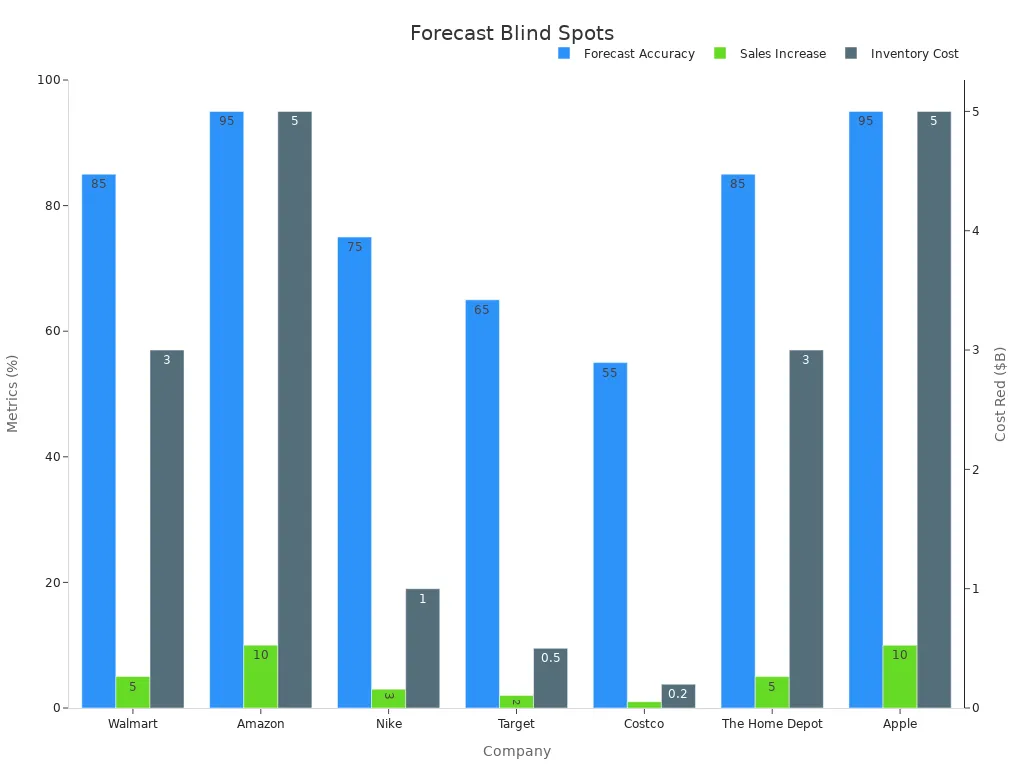
External market factors play a crucial role in shaping demand, yet many CTOs miss their impact during forecasting evaluations. Economic indicators like GDP growth, inflation, and unemployment rates directly influence consumer behavior and purchasing patterns. Ignoring these variables can lead to forecast inaccuracies, resulting in missed sales opportunities and increased inventory costs.
Consider the following data:
Economic Indicator | Impact on Forecasting |
|---|---|
GDP Growth | Affects consumer spending patterns |
Inflation | Influences pricing strategies and costs |
Unemployment Rates | Impacts overall market demand |
Competitive Benchmarks | Provides insights into market shifts |
Retailers incur $1.75 trillion in losses annually due to stock management issues stemming from forecast errors. To avoid these pitfalls, you should incorporate external indicators into your forecasting models. Tools that analyze competitive benchmarks and macroeconomic trends can provide a clearer picture of market dynamics, enabling more accurate predictions.
Underestimating Demand Variability
Demand variability is another blind spot that often goes unnoticed. Factors like seasonality, promotions, competitor actions, and external events can cause significant fluctuations in demand. Companies that fail to account for these variations risk overstocking or stockouts, both of which negatively impact operational efficiency and customer satisfaction.
For instance, tools like buffer-based planning and Demand Driven methodologies can help align inventories with actual demand. These approaches capture historical data patterns while allowing for quick responses to market changes. Additionally, variability in lead times and sales promotions can distort baseline demand, making it essential to use multivariate forecasting techniques.
Note: Companies with diverse product portfolios face unique challenges in forecasting demand for each product and location. Tailored solutions are critical to addressing these complexities effectively.
Neglecting Scalability and Integration Needs
Scalability and integration are critical components of forecasting systems, yet they often go unnoticed during evaluations. As your business grows, forecasting tools must adapt to increasing data volumes and complexity. Neglecting scalability can result in operational bottlenecks, especially during peak demand periods. For example, a small online retailer failed to account for scalability during a promotional campaign. The unexpected spike in traffic caused website crashes, leading to lost sales and negative customer feedback. This scenario underscores the long-term risks of overlooking scalability requirements.
Integration challenges also pose significant risks. Forecasting systems must seamlessly connect with existing enterprise resource planning (ERP) tools, customer relationship management (CRM) platforms, and supply chain management software. Without proper integration, data silos emerge, reducing the accuracy and efficiency of forecasts. You should prioritize solutions that offer robust APIs and compatibility with your current tech stack.
Tip: Evaluate forecasting tools not just for their current capabilities but for their ability to scale and integrate with future systems. This ensures your forecasting infrastructure remains resilient as your business evolves.
Overlooking Metrics for Forecast Accuracy
Forecast accuracy is the backbone of effective inventory management. When you overlook accuracy metrics, the financial implications can be staggering. Inaccurate forecasts lead to overstocks and stockouts, costing retailers $1.77 trillion globally due to inventory distortion. Stockouts alone account for $1.2 trillion in losses, with a typical 4% sales loss for retailers. For every $1 billion in sales, this equates to $40 million in annual lost revenue.
Improving forecast accuracy can yield substantial benefits. A 15% increase in accuracy boosts pre-tax profit by 3% or more. Consumer goods companies can achieve a 2–3% revenue increase with a 10–20% improvement in accuracy. These metrics highlight the importance of investing in advanced forecasting tools that leverage machine learning and AI to refine predictions.
To measure forecast accuracy effectively, you should track key performance indicators (KPIs) such as Mean Absolute Percentage Error (MAPE), Weighted Absolute Percentage Error (WAPE), and Forecast Bias. These metrics provide actionable insights into the reliability of your forecasting models.
Note: Regularly review and refine your forecasting metrics to ensure alignment with business goals. Accurate forecasts not only reduce costs but also enhance customer satisfaction by ensuring product availability.
Key Criteria for Evaluating Forecasting Capabilities

Data Quality and Accessibility
High-quality and accessible data form the backbone of effective inventory demand forecasting. Without reliable data, even the most advanced forecasting tools fail to deliver accurate results. Research from MIT’s Total Data Quality Management group defines data quality as "fitness for use," emphasizing that the value of data depends on how well it meets the needs of its users. This principle underscores the importance of tailoring data collection and management practices to your specific forecasting requirements.
To ensure data accessibility, you should focus on:
Archiving data streams and samples for future analysis.
Understanding data collection methods and maintaining quality metrics.
Leveraging open science initiatives to enhance agility and speed in decision-making.
Key Findings | Description |
|---|---|
Improved PDA | Better public data accessibility improves analyst earnings forecast accuracy. |
Regional Impact | High-quality public data has stronger effects in areas with fewer alternatives. |
Forecast Metrics | Enhanced timeliness, reduced forecast dispersion, and increased revision frequency. |
By prioritizing data quality and accessibility, you can create a robust foundation for accurate and actionable forecasts.
AI and Machine Learning for Predictive Insights
Artificial intelligence (AI) and machine learning (ML) have revolutionized demand forecasting by enabling predictive insights that go beyond traditional methods. These technologies analyze vast datasets, identify patterns, and generate forecasts with unparalleled precision. Companies leveraging AI-driven forecasting tools report a 15–20% improvement in ROI and greater profitability.
Tracking metrics like Mean Absolute Percentage Error (MAPE) and forecast bias ensures the reliability of AI-powered models. These metrics help you measure the accuracy of predictions and refine your strategies accordingly. By integrating AI and ML into your forecasting processes, you can achieve:
Enhanced forecast accuracy through real-time data analysis.
Reduced forecast errors, leading to better inventory management.
Improved decision-making with data-backed insights.
Adopting AI and ML tools not only boosts accuracy but also positions your business to respond dynamically to market changes.
Scenario Planning and Probabilistic Modeling
Scenario planning and probabilistic modeling allow you to prepare for uncertainty by simulating various outcomes. These methods help you evaluate risks and make informed decisions under different market conditions. For instance, decision trees visually map out key variables and their probabilities, while Monte Carlo simulations estimate the likelihood of uncertain outcomes through random sampling.
Other effective techniques include:
Bayesian Networks: These models depict relationships between variables using conditional probabilities.
Probabilistic Sensitivity Analysis: This approach evaluates how changes in input parameters affect model outputs.
By incorporating these advanced statistical models, you can anticipate potential disruptions and adjust your strategies proactively. Scenario planning ensures your forecasting remains resilient, even in volatile markets.
Real-Time Adjustments and Dynamic Forecasting
Real-time adjustments in forecasting allow you to respond quickly to market changes, ensuring your inventory aligns with current demand. Dynamic forecasting tools leverage live data to refine predictions, reducing the risk of overstocking or stockouts. These tools analyze incoming information, such as sales trends or supply chain disruptions, and adjust forecasts instantly. This adaptability ensures your business remains agile in volatile markets.
AI-powered analytics play a pivotal role in dynamic forecasting. By integrating historical trends with live data, AI enhances forecast accuracy and enables immediate updates. Businesses using these technologies have reported:
A 90% improvement in cash flow accuracy.
A 40% decrease in forecasting errors.
For example, real-time updates can adjust cash flow projections when significant customer payments occur. This capability ensures your forecasts remain relevant and actionable, even as conditions change.
Tip: Choose forecasting tools that offer real-time data integration. This feature allows you to make informed decisions quickly, minimizing risks and maximizing efficiency.
Dynamic forecasting not only improves accuracy but also strengthens your ability to adapt to unexpected events. By embracing these tools, you can maintain a competitive edge in an ever-changing market.
Cross-Functional Collaboration
Effective demand forecasting requires input from multiple departments. Collaboration between teams such as sales, marketing, and supply chain ensures forecasts reflect a comprehensive view of your business. Each department provides unique insights that enhance the accuracy and reliability of predictions.
For instance, sales teams contribute knowledge about customer behavior and upcoming promotions. Marketing teams share insights on campaign impacts, while supply chain managers highlight logistical constraints. When these perspectives align, your forecasts become more robust and actionable.
Note: Establishing regular cross-functional meetings fosters communication and ensures all stakeholders contribute to the forecasting process.
Collaboration also helps identify potential bottlenecks and streamline operations. By involving all relevant teams, you create a unified approach to demand forecasting, leading to better decision-making and improved business outcomes.
Actionable Steps for CTOs to Improve Evaluation
Conducting a Needs Assessment
A thorough needs assessment is the cornerstone of effective forecasting evaluation. It helps you identify gaps in your current processes and align forecasting tools with your business objectives. Without this step, you risk investing in solutions that fail to address your unique challenges.
To conduct a comprehensive needs assessment, consider employing the following methodologies:
Surveys and Questionnaires: Quickly gather data from a broad audience to identify common pain points.
Interviews: Gain deeper insights through one-on-one discussions with key stakeholders.
Focus Groups: Facilitate group discussions to uncover shared challenges and opportunities.
Observation: Identify specific areas for improvement by directly observing workflows.
Document Analysis: Review existing records to extract valuable information about past forecasting performance.
Methodology Type | Description |
|---|---|
Metrics scientifically tested to ensure objectivity and relevance. | |
Systems-based approach | A holistic view that considers all components of the operational ecosystem. |
Incorporation of qualitative data | Insights gathered from stakeholders to inform the assessment process. |
By leveraging these methods, you can uncover critical insights into your forecasting needs. For example, analyzing operational efficiency metrics can reveal how improved forecasting minimizes waste and optimizes resource use. This approach ensures your evaluation process is both data-driven and aligned with your strategic goals.
Tip: Regularly revisit your needs assessment as your business evolves. This ensures your forecasting tools remain relevant and effective.
Prioritizing Advanced Analytics Tools
Advanced analytics tools have become indispensable for modern demand forecasting. These tools enable you to analyze large datasets, uncover patterns, and generate precise forecasts. By prioritizing advanced analytics, you can significantly enhance your forecasting accuracy and operational efficiency.
Benefit | Description |
|---|---|
Predictive analytics and AI tools generate precise demand forecasts. | |
Enhanced Efficiency | Precise forecasts streamline operations and reduce waste. |
Data-driven insights improve strategic decision-making. | |
Increased Responsiveness | Operations adapt quickly to market trends and customer demands. |
Better Return on Investment | Optimized resource allocation leads to higher ROI. |
For instance, predictive analytics tools allow you to proactively manage inventory by aligning stock levels with demand fluctuations. This reduces excess inventory costs and enhances customer satisfaction. Additionally, establishing data governance policies ensures high-quality data collection and maintenance, further improving forecasting reliability.
Note: Regular audits and validations of your sales data can help identify inaccuracies, ensuring your forecasts remain dependable.
Incorporating Market Trends and External Indicators
Incorporating external market trends into your forecasting models is essential for staying competitive. Factors such as economic indicators, weather patterns, and labor market statistics can significantly impact demand. Ignoring these variables often leads to forecast inaccuracies and missed opportunities.
Evidence Description | Impact on Forecasting Accuracy |
|---|---|
Integration of weather patterns, economic indicators, and labor market statistics | Reduced error rate from 20% to 6% |
Inclusion of non-US market data and US personal consumption expenditure | Enhanced predictive accuracy |
Impact of crude oil index as a leading indicator | Improved trade volume predictions |
For example, integrating weather data can help retailers anticipate seasonal demand spikes, while economic indicators like GDP growth and inflation provide insights into consumer spending behavior. Tools that analyze these external factors enable you to make more informed decisions and adapt to market changes effectively.
Tip: Choose forecasting tools that support external data integration. This capability ensures your forecasts remain accurate and actionable in dynamic market conditions.
Testing Tools in Real-World Scenarios
Testing forecasting tools in real-world scenarios is essential to ensure their effectiveness and reliability. A tool might perform well in controlled environments but fail to deliver accurate results when exposed to the complexities of real-world operations. You need to validate these tools under conditions that mimic your business environment as closely as possible.
Start by identifying specific scenarios that reflect your operational challenges. For example, simulate peak demand periods, unexpected supply chain disruptions, or seasonal fluctuations. These tests will reveal how well the tool adapts to varying conditions and whether it can handle the nuances of your business.
Tip: Use historical data from past events to create realistic test scenarios. This approach helps you evaluate the tool's ability to replicate and predict actual outcomes.
During testing, focus on key performance indicators (KPIs) such as forecast accuracy, response time, and scalability. For instance, measure how quickly the tool adjusts forecasts when new data becomes available. Tools that can integrate real-time data and provide dynamic updates will prove invaluable in fast-changing markets.
Additionally, involve cross-functional teams in the testing process. Sales, marketing, and supply chain teams can provide valuable insights into the tool's performance and usability. Their feedback will help you identify potential gaps and areas for improvement.
Note: Testing tools in real-world scenarios not only validates their capabilities but also builds confidence among stakeholders. A well-tested tool ensures smoother implementation and better adoption across your organization.
Establishing Feedback Loops for Continuous Improvement
Establishing feedback loops is critical for refining your forecasting systems over time. A feedback loop allows you to monitor performance, identify weaknesses, and implement improvements. Without this mechanism, forecasting models can become outdated and less effective.
To create an effective feedback loop, start by setting up regular review processes. Weekly review meetings, for example, enable your sales team to share insights on customer behavior and market trends. These discussions provide valuable context that can enhance your forecasting accuracy.
Automated alerts are another powerful tool for maintaining a feedback loop. These alerts notify you of deviations between actual sales and forecasts, prompting immediate investigation. By addressing these discrepancies, you can refine your models and improve their reliability.
Machine learning (ML) models also benefit from feedback loops. Retrain your ML models quarterly using the latest data to ensure they remain accurate and relevant. Residual analysis, which examines differences between predicted and actual values, can help you identify patterns and adjust your models accordingly.
Metric | Description |
|---|---|
Weekly Review Meetings | Sales team shares insights on customer behavior and market trends. |
Automated Alerts | Investigate deviations of actual sales from forecasts. |
Model Retraining | ML model is retrained quarterly using the latest data. |
Residual Analysis | Examines differences between predicted and actual values for patterns. |
Model Selection | Regular evaluation of alternative forecasting models through A/B testing. |
Parameter Tuning | Optimization of model parameters based on historical performance. |
Callout: Regularly evaluate alternative forecasting models through A/B testing. This practice ensures you are using the most effective model for your business needs.
Parameter tuning is another essential aspect of feedback loops. By optimizing model parameters based on historical performance, you can enhance the precision of your forecasts. This iterative process ensures your forecasting system evolves alongside your business and market conditions.
Incorporating feedback loops into your forecasting strategy not only improves accuracy but also fosters a culture of continuous improvement. By consistently refining your models, you can stay ahead of market changes and maintain a competitive edge.
Overlooking critical blind spots in inventory demand forecasting can have far-reaching consequences. Inefficiencies increase costs, frustrate employees, and erode customer trust. Misaligned operations also hinder growth, making scalability a challenge. For example:
Impact Type | Description |
|---|---|
Inefficiencies lead to wasted time, resources, and opportunities. | |
Lower Morale | Employees frustrated by cumbersome processes may disengage. |
Customer Attrition | Slow response times and errors can erode trust and satisfaction. |
Stifled Growth | Misaligned operations make scaling exponentially harder. |
To avoid these pitfalls, you must prioritize advanced tools and strategic evaluation. Tools powered by AI and real-time data integration enhance forecasting accuracy and adaptability. Strategic evaluation ensures your systems align with business goals, driving operational efficiency.
Effective forecasting is more than a technical process; it is a cornerstone of business success. By addressing what CTOs miss, you can optimize resources, improve customer satisfaction, and position your organization for sustainable growth.
FAQ
What is the most critical factor in evaluating forecasting tools?
The most critical factor is forecast accuracy. Without accurate predictions, your inventory management suffers, leading to overstocking or stockouts. Prioritize tools that use advanced analytics, such as AI and machine learning, to refine predictions and adapt to real-time changes.
How can you ensure forecasting tools integrate with existing systems?
Choose tools with robust APIs and compatibility with your ERP, CRM, and supply chain software. Integration ensures seamless data flow, eliminating silos and improving forecast reliability. Always test the tool’s integration capabilities during the evaluation phase.
Tip: Consult your IT team to assess integration requirements before purchasing.
Why is cross-functional collaboration important in demand forecasting?
Collaboration ensures forecasts reflect insights from sales, marketing, and supply chain teams. Each department contributes unique data, creating a comprehensive and accurate prediction model. This alignment improves decision-making and operational efficiency.
How do external market factors impact demand forecasting?
External factors like economic trends, weather, and competitor actions directly influence demand. Ignoring these can lead to inaccurate forecasts. Incorporate tools that analyze external indicators to stay ahead of market shifts.
What metrics should you track to measure forecast accuracy?
Track metrics like Mean Absolute Percentage Error (MAPE), Forecast Bias, and Weighted Absolute Percentage Error (WAPE). These provide insights into your model’s reliability and help identify areas for improvement.
Note: Regularly review these metrics to ensure alignment with your business goals.
See Also
Understanding Short-Term Demand Forecasting: Techniques And Challenges
Effective Weekly Strategies for Retail Demand Forecasting
Analyzing Consumption Trends: Insights From Data-Driven Retail Examples
Creating Feedback Mechanisms for Dynamic ETA And Capacity Planning