CTOs Evaluation of Weather and Holiday Restocking Strategies Capabilities

CTOs Evaluation often starts with clear goals for inventory management. They use advanced technology and accurate data to predict demand during weather changes and holidays. CTOs focus on fast decision-making, strong system integration, and real-time monitoring.
They set up teams to track supply chain performance.
They review customer feedback to adjust restocking plans.
This approach helps companies meet customer needs and boost business results.
Key Takeaways
CTOs use smart tools to guess how weather and holidays change what people buy. This helps companies not run out of products and waste less.
Good guessing and live data help stores manage stock better. This means more sales and happy customers when it gets busy.
Restocking systems that can change and grow help stores react fast. They can handle market changes, shipping problems, and sudden high demand.
Machines and live tools make orders faster and cut mistakes. They also help people make quick choices when things get busy.
Teams get better at restocking by using feedback and clear reports. This helps them keep doing well and serve customers better.
CTOs Evaluation Criteria for Weather and Holiday Restocking

Data Integration and Quality Assessment
CTOs Evaluation begins with a close look at how well systems bring together data from many sources. High-quality data helps teams make better decisions about restocking during weather events and holidays. When companies use a unified framework that combines sensor data, customer tracking, and environmental monitors, they see big improvements in forecast accuracy and inventory management.
A multi-agent deep reinforcement learning system that integrates different types of sensor data can improve forecast accuracy by 15.1% over basic models.
This approach processes many data streams in one place, making integration easier for retail teams.
The model also reduces training time and supports quick decision-making, which is important for real-world retail operations.
Attention mechanisms in these systems help teams understand which data sources matter most for inventory decisions.
By combining demand forecasting and inventory management, companies close gaps in their supply chain.
Retailers who use real-time, hyper-local weather data can better predict changes in customer demand. They often report up to a 25% increase in sales for weather-sensitive products. Adjusting stock based on weather forecasts also cuts down on inventory waste. Dynamic supply chain adjustments can reduce weather-related disruptions by up to 30%. Targeted promotions linked to weather events can boost sales by 20-25%. Optimized inventory management lowers overstock and markdowns by 15-20%, which improves profits. Real-time data integration also makes operations more efficient and keeps customers happy.
Predictive Analytics and Forecasting Accuracy
CTOs Evaluation also focuses on how well predictive analytics tools forecast demand during holidays and weather events. These tools use sales history, supplier performance, and market trends to build models with time series analysis, regression, and machine learning. These models spot seasonal demand changes and outside factors like weather or promotions. Retailers use these insights to adjust stock levels quickly, which helps avoid costly mistakes.
For example, AI-driven forecasting lets retailers change inventory levels during busy times, reducing inventory distortion costs that reached $1.77 trillion worldwide in 2023. This approach improves accuracy, cuts down on both overstock and stockouts, and makes the supply chain more efficient. Predictive analytics also helps prevent lost sales during high-demand events. If a retailer underestimates demand for a popular product during Black Friday, they can lose thousands of dollars in missed sales. By using predictive models, companies can avoid these losses and keep customers satisfied. Historical sales patterns, like a 50% spike in seed sales every March at a garden supply store, help teams plan ahead and avoid running out of stock or having too much inventory. These models also adjust for holiday sales spikes and weather-related demand changes, making forecasting more reliable during critical periods.
Scalability and Flexibility of Restocking Systems
CTOs Evaluation must include a review of how restocking systems handle changes in market conditions. Scalable and flexible systems let retailers respond to shifts in demand, congestion, and transport options. Demand models measure factors like restocking trip generation, supplier location, and transport service choice.
Retailers often use their own vehicles for 79% of restocking trips, giving them more control and flexibility.
Delivery services account for 21% of trips, showing a mix of push and pull logistics.
Over half of retailers claim to have dedicated loading bays, but most load or unload on public roads, which shows real-world constraints.
Delivery vehicles spend more time unloading and often use dedicated bays, highlighting differences in logistics.
Market share shifts when travel time to a major market increases, showing system flexibility under congestion.
Adding more establishments to a market increases its dominance, which demonstrates scalability.
Vehicle ownership and the presence of traditional markets affect restocking decisions and transport choices.
Statistical tools like chi-square tests compare actual stock levels with expected quantities. High values show new trends or seasonal shifts, prompting quick changes in procurement and restocking. Low values confirm that current strategies work well. Using these tests helps reduce stock-outs and waste, supporting flexible and scalable restocking systems that adapt to changing market needs.
Automation and Real-Time Response Capabilities
Automation and real-time response capabilities form the backbone of modern inventory management, especially during peak demand periods like holidays or sudden weather events. Automated systems track inventory levels, process orders, and trigger restocking without manual intervention. These systems use real-time data to adjust stock levels instantly, reducing the risk of stockouts or overstocking.
Tip: Real-time analytics dashboards help teams monitor inventory across multiple locations at once. This visibility allows for quick decisions and rapid adjustments.
Cloud-based workforce management platforms give centralized control. Advanced forecasting algorithms analyze historical data to predict future needs. Mobile technology supports fast communication and enables staff to respond quickly to changes. Automated notification systems alert stakeholders to issues as they arise, ensuring no delay in response.
Key metrics validate the effectiveness of automation and real-time response. The table below summarizes important benchmarks:
Metric | Definition/Description | Benchmark/Target | Impact on Inventory Management and Peak Demand Handling |
|---|---|---|---|
Inventory Turnover Rate | Frequency of stock replacement | 7-10 times/year (retail example) | Higher turnover reduces carrying costs and improves cash flow |
Demand Forecast Accuracy | Precision of inventory demand predictions | 90-95% accuracy | Enhances stock optimization, reduces overstock and stockouts, improves responsiveness |
Order Accuracy Rate | Percentage of orders correctly fulfilled | 98%+ | Minimizes errors, improves customer satisfaction |
Stockout Rate | Percentage of demand not met due to inventory shortages | Under 2% | Indicates strong replenishment and supply chain optimization |
GMROI | Financial return on inventory investments | >1.5 | Measures profitability impact of inventory decisions |
Real-time inventory tracking and automated reordering reduce human error. These systems enable quick adjustments to fluctuating demand. Demand forecasting accuracy, supported by machine learning, helps maintain optimal inventory levels. Regular inventory audits, such as cycle counts, ensure data accuracy and support reliable automation. These practices improve operational efficiency, reduce stockouts, and enhance customer satisfaction during high-demand times.
Teams also benefit from formal escalation protocols and cross-trained emergency resource pools. Integrated communication platforms allow for quick coordination and decision-making. These features ensure that companies can handle unexpected demand spikes with confidence.
Reporting and Actionable Insights
Effective reporting systems transform raw data into actionable insights. Sales reports provide metrics like total sales, sales growth, average order value, and product performance. These numbers help teams spot purchasing patterns and evaluate sales strategies. Inventory reports track stock levels, turnover rates, and costs. This information supports restocking plans and helps avoid both stockouts and overstocking.
Sales reports reveal trends and highlight which products perform best.
Inventory reports monitor stock status and guide restocking decisions.
Interpreting these reports uncovers demand patterns, detects anomalies, and validates strategies through historical comparisons.
Tools like Prokip automate data consolidation, track inventory in real time, set reorder thresholds, and predict future needs.
Prokip also integrates sales, inventory, CRM, POS, and accounting data into one system, making performance evaluation easier.
Using these reports and tools enables businesses to optimize restocking and inventory management by making data-driven, proactive decisions.
Note: Actionable insights from these reports help teams respond quickly to changes in demand. This agility supports better customer service and higher profitability.
CTOs Evaluation of reporting systems should focus on how well these tools deliver timely, accurate, and relevant information. When teams receive clear, actionable insights, they can make informed decisions that improve inventory management and business outcomes.
CTOs Evaluation of Technology Stack and Infrastructure

Compatibility with Existing Systems
CTOs Evaluation often begins with a review of how new technology stacks fit with current systems. Teams look for seamless integration to avoid disruptions. They use an API-first approach to connect new tools with existing workflows. This method improves interoperability and scalability. Proof-of-concept deployments help teams test performance and integration before full rollout. For example, running a small workload on AWS Lambda can reveal strengths and weaknesses early.
The table below shows real-world scenarios where companies improved performance by integrating new technology stacks with existing systems:
Scenario | Technology Stack Change | Measurable Performance Improvement | Compatibility/Integration Approach |
|---|---|---|---|
E-commerce client migration | Migrated backend to Azure Functions (serverless architecture) | 40% reduction in maintenance costs; improved uptime and auto-scaling | High-level architecture review; seamless integration with infrastructure |
Logistics client data pipeline | Implemented Power BI Online and Azure Data Factory | 50% reduction in decision-making timelines; better route optimization | Intermediary data transformation layer for legacy and modern systems |
Fintech client optimization | Adopted Haystack framework for IoT data standardization | 60% improvement in response times; fewer transaction failures | Standardized data for interoperability; fixed legacy inefficiencies |
Teams also measure integration time and adoption rates. Automation reduces manual work, making systems more efficient. Regular audits and feedback loops help maintain compatibility as technology evolves.
Security and Compliance Considerations
Security and compliance play a critical role in technology stack evaluation. CTOs focus on protecting sensitive data and meeting regulatory standards. They use strong encryption for data in transit and at rest. Employee cybersecurity training reduces human error and strengthens awareness. Third-party vendors must follow strict security policies and undergo regular assessments.
Key compliance metrics include system uptime, transaction speeds, patch compliance rates, access request violations, and incident response times. IT management software helps centralize enforcement and monitor compliance. Teams review policies quarterly, especially for high-impact areas, to keep up with new threats and regulations.
Tip: Collaboration across departments ensures that security policies cover all workflows and technical needs.
Data analytics guide policy management by tracking violations and response times. Continuous improvement cycles help organizations stay compliant and secure, supporting reliable restocking strategies.
CTOs Evaluation of Vendor Solutions and Industry Benchmarks
In-house Versus Third-party Solutions
CTOs Evaluation often starts with a decision between building restocking solutions in-house or choosing third-party vendors. In-house solutions give companies full control over customization and data privacy. Teams can tailor features to match unique business needs. However, these projects require significant time, skilled staff, and ongoing maintenance. Third-party solutions offer faster deployment and access to proven technology. Vendors provide regular updates, support, and integration with industry standards. Many companies choose third-party platforms to reduce risk and speed up implementation.
Tip: CTOs should compare the total cost of ownership, including hidden costs like training and support, before making a decision.
A hybrid approach sometimes works best. Companies may use third-party tools for core functions and develop custom modules for special requirements. This strategy balances flexibility with reliability.
Case Studies and Performance Benchmarks
Industry benchmarks and real-world case studies help CTOs measure the success of restocking strategies. One national retail chain improved its inventory turnover rate by 25% in one year. The company used targeted promotions and better demand forecasting. This change lowered carrying costs and increased profit margins. An e-commerce business raised its fill rate from 85% to 97% after adding real-time inventory tracking and advanced forecasting. The result was higher customer satisfaction and more repeat purchases.
The Inventory Management 2024 Benchmark Report shows clear differences between top and low performers. The table below summarizes key findings:
Performance Level | Understocking Rate | Overstocking Rate |
|---|---|---|
Stars (Top) | 2-3% | 25-30% |
Stragglers (Low) | 13-24% | 47-59% |
These numbers show that strong restocking strategies can reduce both understocking and overstocking. CTOs Evaluation of vendor solutions should include a review of these benchmarks to set realistic goals and track progress.
CTOs Evaluation of Implementation and Continuous Improvement
Change Management Strategies
Change management plays a vital role in successful restocking strategy implementation. Leaders often start by listening to employees and customers. Walmart improved its holiday restocking by restructuring scheduling practices after collecting feedback through surveys and town hall meetings. This approach led to a 15% increase in customer satisfaction during peak shopping seasons. When teams feel heard, they adapt faster and deliver better service.
Retailers also use proven methods like Lean Six Sigma to improve restocking processes. A project manager at a retail company applied these methods and reduced restocking time by 25%. Inventory loss dropped by 15%. These results show that focusing on process improvement and tracking key performance indicators leads to measurable gains.
Effective change management includes:
Gathering feedback from staff and customers.
Setting clear goals and tracking progress.
Training employees on new systems.
Communicating changes and celebrating wins.
Change management strategies help teams adjust quickly and keep operations running smoothly during busy periods.
Establishing Feedback Loops for Ongoing Optimization
Continuous improvement depends on strong feedback loops. Companies like Netflix, Adobe, and Zappos have shown that regular feedback sessions and open communication drive better results. Netflix saw a 75% increase in employee engagement after replacing annual reviews with ongoing feedback. Adobe improved employee retention by 30% and increased revenue by 21% after adopting real-time feedback systems. Zappos achieved a 90% customer satisfaction rate by analyzing customer feedback and making quick adjustments.
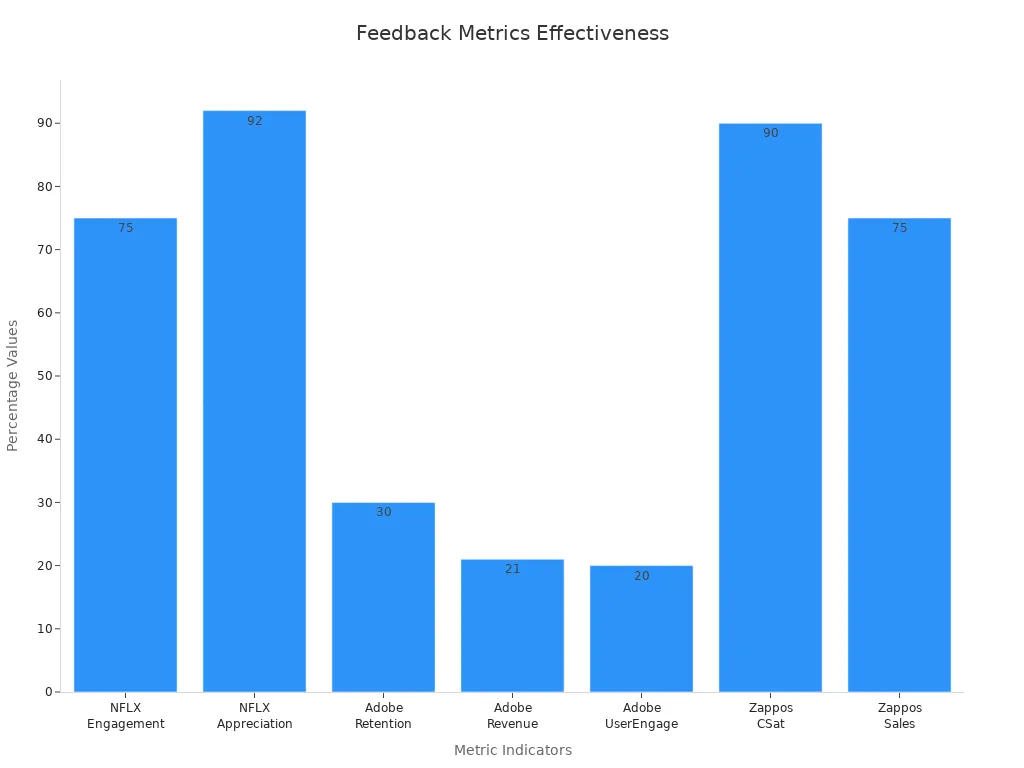
The table below highlights key metrics from these companies:
Company | Metric / Feedback | Impact / Result |
|---|---|---|
Netflix | 75% increase in employee engagement | Higher satisfaction and adaptability |
Adobe | 30% improvement in employee retention | Stronger team connection and value |
Zappos | 90% customer satisfaction rate | Greater loyalty and product refinement |
CTOs Evaluation should include regular reviews of feedback data. Teams must communicate changes back to employees and customers to build trust. Tracking metrics like Net Promoter Score, Customer Satisfaction Score, and customer retention helps measure success. By closing the feedback loop, companies can adapt quickly and stay ahead in a changing market.
CTOs drive success by regularly reviewing restocking strategies and adopting advanced technology. They align business goals with data-driven systems to boost performance. Key benefits include:
AI-driven forecasting combines real-time weather and market data, improving demand predictions.
Companies like Amazon use these tools to optimize stock, reduce waste, and meet customer needs during holidays and weather events.
Dynamic inventory management lowers costs and prevents lost sales.
Continuous evaluation and adaptation help organizations stay competitive in a changing market.
FAQ
What role does a CTO play in restocking during holidays and weather events?
A CTO leads the technology strategy for inventory management. They select tools, oversee data integration, and ensure systems respond quickly to demand changes. Their leadership helps companies avoid stockouts and meet customer needs during busy or unpredictable periods.
How does predictive analytics improve restocking accuracy?
Predictive analytics uses past sales and real-time data to forecast demand. This process helps teams order the right amount of stock. Companies reduce waste and avoid running out of popular items.
Why is real-time data important for inventory management?
Real-time data gives teams instant updates on stock levels. They can react quickly to sales spikes or supply chain issues. Fast decisions help prevent lost sales and keep customers satisfied.
What are the main benefits of automation in restocking systems?
Reduces manual errors
Speeds up order processing
Improves inventory accuracy
Frees staff for higher-value tasks
Automation helps companies handle large order volumes, especially during holidays or weather disruptions.
How can companies measure the success of their restocking strategies?
Metric | What It Shows |
|---|---|
Inventory Turnover | How often stock is replaced |
Stockout Rate | Frequency of shortages |
Order Accuracy | Correct orders delivered |
Tracking these metrics helps teams spot problems and improve performance.
See Also
Effective Weekly Retail Demand Prediction Techniques
Common Approaches And Challenges In Short-Term Demand Forecasting
Reasons Static Delivery Schedules Don’t Work For Same-Day Retail
Impact Of Weather Changes On Demand Across Different Categories