AI Budgets Overshot Plan by 2.5x Because Finance Meters Seats, Not Completed Work
Why AI budgets overran plan by roughly 2.5x: seat-based pricing no longer tracks agent consumption, and how to meter, price, and reconcile cost per completed unit.
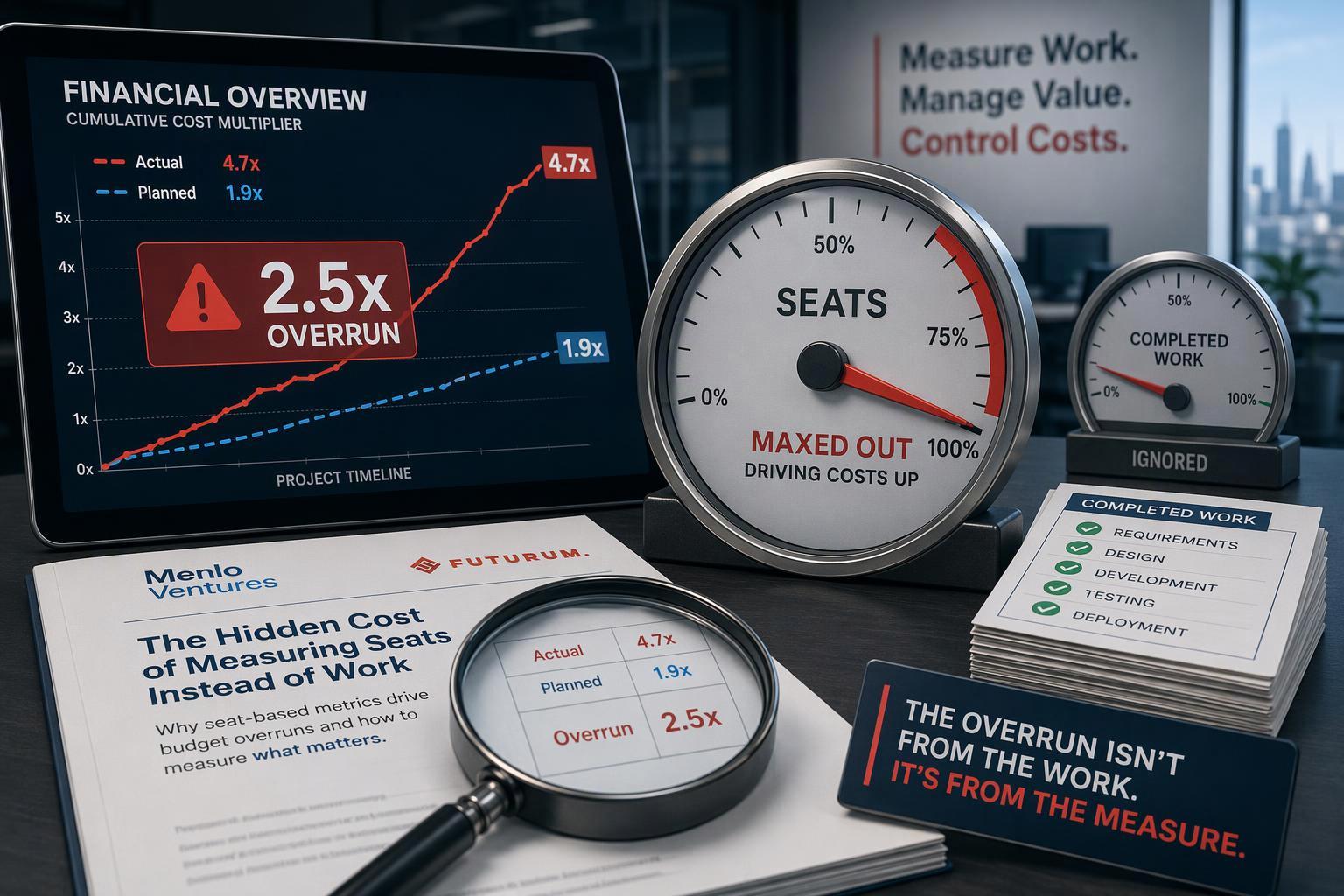
The 2.5x overrun is not a forecasting error. It is a metering error, and it will repeat every budget cycle until finance stops counting people and starts counting finished work.
The numbers agree across independent surveys. Menlo Ventures reports that reported enterprise AI spending averaged 4.7x the prior year's level against a planned 1.9x — roughly 2.5x plan — while median spend reached 2.2x against a 1.8x expectation (Menlo Ventures, 2026 State of Enterprise AI). The Futurum Group's survey of 1,636 global enterprise technology decision makers found 46.9% reporting AI spend above plan, against just 5.6% below (Futurum Group). The gap between average and median matters: Menlo attributes it to a "fat head" of power users who account for a disproportionate share of spend — which is what you would expect when a few teams let agents run unattended.
The conventional explanation is that AI is simply more expensive than expected. The cost was always going to scale with work performed. What failed is the instrument finance used to predict it. A seat is a proxy for human attention. Agents do not consume seats, and they do not stop when the person who owns the seat goes home. Menlo's own reading of its data is that agents explain the gap between actual and planned spend, because spending scales with work rather than headcount. When the unit of prediction and the unit of consumption diverge, the budget becomes a guess with a variance measured in multiples.
The rest of this article works through what follows: why the seat decoupled from AI cost, what a defensible unit of completed work requires, where to instrument it, how to price and reconcile it against the invoice, what procurement should ask for, and how to test whether the meter actually works.
The seat was a good meter for software and a bad meter for work
Per-seat licensing worked because human attention was the scarce, measurable input. You bought a license for a person, and the person's capacity bounded consumption. The model was crude but directionally correct: more seats meant more work, and the price tracked the headcount that did it.
AI breaks that link in three places.
First, consumption scales with tasks, not people. Menlo reports that agents now generate 80% of all tokens on OpenRouter — 130.9 trillion per week, roughly 7x human-driven usage — and that agent traffic has grown 37x since early February against 5x for human usage. Menlo is explicit about the scope: OpenRouter is one channel, and its users skew toward individual developers and startups rather than the enterprise buyers in Menlo's survey. Treat the ratio as a directional signal, not an enterprise benchmark. The direction is unambiguous: machine-initiated work is becoming the dominant consumption pattern.
Second, a single task chains many billable calls. CloudZero, citing Anthropic's production data, reports agents consuming roughly 4x the tokens of chat interactions and multi-agent systems about 15x, because each step re-sends accumulated context and failed steps are billed in full (CloudZero). The FinOps Foundation makes the same point structurally: token consumption is non-linear with respect to user-facing activity, which it names as the principal reason traditional cost forecasts have proven unreliable for AI workloads (FinOps Foundation).
Third, the vendor side is already moving off pure seats. GitHub's Copilot is shifting to usage-based billing with credits consumed by token usage, noting that a quick chat question and a multi-hour autonomous coding session currently cost the same (GitHub Blog). The shift is partial: Copilot's base plan and per-user seat prices remain unchanged, with credits layered on top. Bain finds that pattern across the market — most vendors adding AI pricing layer new meters on top of seats rather than replacing them, and about four in five vendors introducing AI pricing choose capacity commitments rather than true consumption pricing (Bain & Company).
So the buyer's budget is built on a unit the seller has already begun to supplement. Finance forecasts headcount growth, procurement negotiates per-seat rates, and the invoice increasingly arrives denominated in tokens and credits. The 2.5x is the arithmetic of that mismatch.
A unit of completed work must be observable, attributable, and contractible
Not every unit qualifies. Bain's three conditions for outcome-based pricing are the right starting filter: the outcome must be observable, uniquely attributable to the AI, and contractible between buyer and seller. Bain also draws the distinction the whole argument rests on: a recommended lead is an output, a qualified lead is an outcome; an updated record is an output, a completed business process is an outcome. Under an output model the vendor is paid whether or not the output created value. Under an outcome model, payment depends on the result.
For internal metering — which is what a budget forecast actually needs — add three more criteria:
Stable definition. The unit must mean the same thing in January and November. If "resolved ticket" quietly changes to include abandoned conversations, the cost-per-unit trend is fiction.
Bounded cost variance. A unit whose token cost varies by an order of magnitude across instances is a poor forecasting primitive unless you also track the variance. Track both the count and the cost distribution.
Reconcilable to the ledger. Every unit must carry enough identifiers to tie back to a line on the cloud or vendor invoice. A unit that cannot be reconciled is a metric, not a meter.
The FinOps Framework's unit economics capability frames this as connecting what an organization spends on technology to the value that spending creates, and lists business unit metrics such as cost per case resolved alongside technical metrics like cost per token. It is candid about maturity: early practice is mostly technical, resource-efficiency metrics, with business-outcome correlation arriving later (FinOps Foundation). For generative AI specifically, it describes the path as starting with cost per token and expanding toward cost per assist, cost per agent action, or cost per case deflected. Most enterprises are still near the start of that path, which is precisely why the budget conversation and the engineering conversation do not connect.
One caution on attribution. "Uniquely attributable to the AI" is a high bar that many internal workflows will fail, because a human reviewer or a downstream system also contributes to the result. Where attribution is shared, record the split rather than assigning the whole outcome to the agent; a unit credited entirely to the model inflates the apparent cost per unit and distorts the forecast in the other direction.
Instrument completion at the boundary where work becomes a fact
The worst place to instrument completion is the model gateway. The gateway sees calls, not work. A task that takes twelve calls and one that takes two look identical at the gateway if both eventually succeed, and a task that fails after eleven calls looks like eleven calls of progress.
Instrument at the boundary where the system's output is accepted by whatever consumes it: the ticket closed in the helpdesk, the invoice matched in accounts payable, the pull request merged, the record written to the system of record. That boundary is where an output becomes an outcome, and it is usually owned by an application team rather than the AI platform team — which is why the instrumentation is a cross-team project, not a logging change.
A completion record should carry, at minimum:
A stable work-unit identifier and the unit type, versioned so definition changes are visible in the data.
A terminal state distinguishing completed, failed, abandoned, and escalated. Failed and abandoned runs are not free; they must be counted as cost without being counted as work.
Attribution fields: requesting team, cost center, use case, and the identity of the agent or workflow version that produced the result.
Cost fields: token counts by type (input, output, cached), tool and retrieval call counts, and the priced amount at the rate in effect at execution time.
Timestamps for start, completion, and any human acceptance step.
A correlation identifier linking to the vendor invoice or cloud billing line.
The terminal-state taxonomy is not hypothetical. Intercom's published billing rules for its Fin agent show what a defensible definition looks like in production: a resolution is billed when the customer confirms the answer or exits without asking for more help, while escalations, procedure failures, spam, abandoned conversations, and unanswered clarifying questions are not billed as outcomes (Intercom). Whether or not you buy that vendor's product, the structure is the model: states are enumerated, the boundary conditions are written down, and the unbilled states are named explicitly.
The FinOps Foundation's guidance on experimental AI spend makes a related point about attribution discipline: issue API keys per experiment at the gateway so spend is attributed from the first call, and at the decision point measure results against the original success criteria and a target unit cost (FinOps Foundation). The same discipline applies in production, with the completion record replacing the experiment key as the attribution anchor.
Price the unit, then reconcile it against the ledger
Pricing a completed unit is arithmetic, not modeling. Take total attributable spend for a period, divide by completed units in the same period, and report the distribution alongside the mean. The mean alone hides the fat tail that Menlo's average-versus-median gap describes.
Here is an illustrative inference, not observed data. Suppose a support agent completes 40,000 resolutions in a month, and model and tool spend attributable to that agent totals $120,000. The mean cost per resolution is $3.00. Now suppose the distribution is skewed: 10% of resolutions consume 45% of spend because they trigger long retry chains. The median cost per resolution might be $1.80 while the mean is $3.00. A forecast built on the median will undershoot by 40% the moment volume shifts toward the expensive tail. Report both, and report the share of spend consumed by the top decile of runs.
Reconciliation is the step that converts this from a dashboard into a control. Three checks:
Completeness. The sum of completion-record costs should approximate the attributable invoice lines within a stated tolerance. A persistent gap means uninstrumented spend — shadow keys, orphaned agents, or traffic routed outside the metered path.
Direction. If recorded cost exceeds invoiced cost, you are double-counting retries or pricing at stale rates. If invoiced exceeds recorded, work is happening you cannot see.
Stability. Cost per unit should move for explainable reasons — model mix, prompt changes, caching adoption — and each movement should be attributable to a change someone made.
The FinOps forecasting capability is explicit that forecast models should be maintained by the owners of the systems and adjusted as those systems change, combining rolling, trend-based, and driver-based approaches (FinOps Foundation). A cost-per-completed-unit series is a driver-based forecast input. A seat count is not a driver of anything an agent does.
One practical note on the denominator: count only units that reached a completed terminal state. Dividing spend by all attempts — including failed and abandoned runs — produces a cost per unit that falls whenever the system gets worse, which is the opposite of the signal finance needs.
Contracts must move payment from access to outcomes
The uncomfortable finding for anyone expecting a clean shift to outcome pricing: it has not happened at scale. AlixPartners analyzed 65 major SaaS and AI-native companies and found only 4 had fully adopted outcome-based pricing, while of the remaining 60, more than half still rely primarily on per-seat models; 72% have a hybrid approach that incorporates consumption through AI credits or usage metering (AlixPartners). Bain puts outcome-based meters at about 10% of AI-native and hybrid vendors, with effort-based meters around 35% and output-based around 55%.
Bain's analysis of publicly available pricing across roughly 200 B2B SaaS companies (June 2026) covers only vendors introducing a hybrid AI meter, and reports the share using each meter type. AlixPartners' separate review of 65 major SaaS and AI-native companies reports each company's primary pricing model; its outcome figure counts 4 of 65 companies. The two datasets use different samples and different definitions, so they are shown side by side rather than combined.
Bain's explanation for the narrowness is the useful part: outcome pricing works where the outcome is observable, attributable, and contractible, and customer support is the category where all three hold. Marketing attribution is disputed, HR decisions span systems and people, and software engineering productivity remains hard to measure consistently. AlixPartners makes the same diagnostic point — the binary ticket close is contractible in a way that generated code, which may or may not be correct or valuable, is not. Both analyses also note that even where the conditions hold, outcome deals are complex and slow to negotiate and difficult to bill at scale.
For buyers, the practical contract posture is a hybrid with three components:
A capacity commitment for budget predictability, sized from the cost-per-completed-unit series rather than from seat count. Bain notes capacity models are the majority choice precisely because CFOs can approve a defined commitment more easily than open-ended variable spend — but it also notes that unused capacity is typically not refunded, so size the commitment from measured unit demand, not from an optimistic adoption curve.
A completion-based true-up for the workloads where the unit passes the three-condition test. Pay per completed unit above or below the committed band, with the unit definition and terminal-state rules written into the schedule.
A visibility clause requiring the vendor to expose per-unit consumption data at the same granularity the buyer meters internally. Without it, reconciliation is impossible and the overrun simply moves to the vendor's invoice.
Where the unit fails the test — most knowledge work, most engineering tooling — do not force outcome pricing. Meter effort, but meter it at the task level and forecast from the task distribution. The failure mode is pretending a unit is contractible when it is not, which produces disputes rather than alignment.
The strongest objection is that completion metering is too hard to be worth it
The serious objection is not that seats are accurate. It is that completion metering is expensive to build, easy to game, and arrives too late to help the current budget cycle. Capacity commitments, the argument goes, already give finance a fixed number, and the vendor absorbs the variance. Why build a metering pipeline?
Three responses.
First, capacity commitments do not eliminate the variance; they relocate it. If the committed capacity is exhausted early, the buyer faces a mid-year request for more budget with no unit data to justify the number. RSM, citing press reports of public enterprise reversals, describes one Fortune 500 company that exhausted its annual AI tools budget in four months (RSM). The overrun still happens; it just happens as a supplemental purchase order.
Second, the build cost is lower than it appears because the instrumentation boundary is usually an existing system. The helpdesk already records resolution. The ERP already records invoice match. The work is joining those events to cost data, not building a new observability stack. The FinOps Foundation's maturity guidance is relevant here: unit economics start modest and technical, and business-outcome correlation arrives as the practice matures. Start with one workload where the unit is clean.
Third, gameability is a governance problem, not a metering problem. Any meter can be gamed — seat counts were gamed by unused licenses for two decades. The defense is the same in both cases: audit the terminal-state definitions, sample the completion records against ground truth, and make definition changes require sign-off from both the engineering owner and finance. A meter with a known definition and an audit trail is strictly better than a proxy with neither.
The honest concession: completion metering will not rescue this year's budget. It changes next year's forecast, and it changes the contract you sign after that.
An acceptance checklist for the metering system
Do not trust a completion meter until it passes these checks:
Unit definition is written and versioned. The definition of a completed unit, including terminal states, is documented and changes are dated.
Failed and abandoned runs are counted as cost, not work. The record distinguishes completed from failed, abandoned, and escalated, and the cost report includes all four.
Attribution is complete. Every completion record carries team, cost center, use case, and agent version. Unattributed spend is reported as a separate line, not distributed silently.
Reconciliation closes within tolerance. Recorded cost and attributable invoice lines agree within a stated percentage for two consecutive periods.
Distribution is reported, not just the mean. Cost per unit is reported with median and top-decile share so the fat tail is visible to forecasters.
A sample audit passes. A random sample of completion records is traced to ground truth in the system of record, and the match rate is documented.
The forecast uses the unit. The budget model's driver is completed units and cost per unit, with seat count retained only as a secondary input where it still explains something.
Contract terms match the meter. Where the unit passes the observability, attribution, and contractibility test, the vendor agreement prices it; where it does not, the agreement prices effort at task granularity and requires per-unit visibility.
The position is straightforward. The 2.5x overrun is what happens when the unit finance forecasts and the unit the system consumes are different things. Seats measured attention; agents consume work. Until the budget is built on completed units — defined, instrumented at the boundary where work becomes a fact, priced with the distribution visible, and reconciled to the ledger — the overrun is not a surprise. It is the expected output of a meter that was never measuring the thing that costs money.