


How Synagie rebuilt its retail analytics on one engine — and cut data lag from a full day to 5 minutes

Summary
Synagie runs e-commerce operations for around 600 global retail brands across Southeast Asia. Their analytics platform — a stack of multiple AnalyticDB instances feeding Power BI — worked, but it was complex to run, slow to update, and expensive to scale. By moving to Singdata Lakehouse and its Single-Engine architecture, Synagie pulled data freshness from T+1 down to 5 minutes, cut operations overhead by 70%, and sped up pipeline development by 50% — all on one unified platform instead of a patchwork of products.
Background
Synagie at a glance
Founded in 2014, Synagie is one of Southeast Asia’s leading e-commerce enablers. They offer brands end-to-end commerce services: digital transformation, channel management, supply chain, brand growth, and analytics. Today they work with more than 600 global retail brands, helping each one run a consistent customer experience across the region’s major marketplaces and social platforms.
Analytics sits at the center of that work. Brands depend on Synagie to tell them what’s selling, where inventory is running short, and how campaigns are landing — across many channels at once.
The architecture they started with
To cover offline computation, online analysis, and BI reporting all at once, Synagie’s original platform stitched together several products: multiple AnalyticDB instances with Power BI on top. As the number of brands grew and data volumes climbed, the seams in that design started to show.
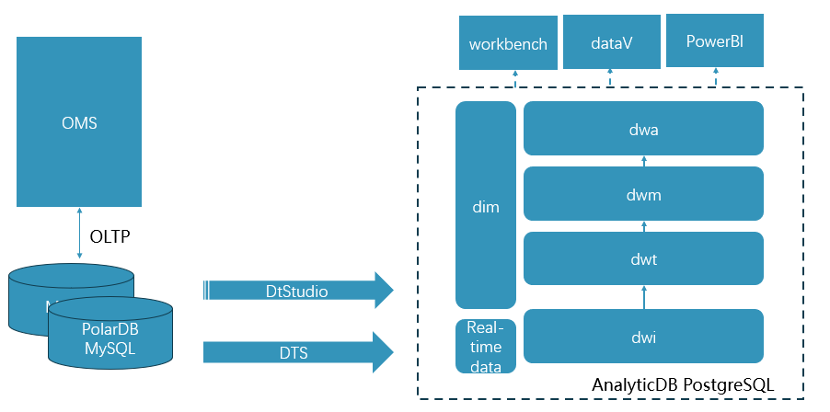
Synagie’s original architecture: OMS and PolarDB/MySQL sources syncing through DtStudio and DTS into multiple AnalyticDB instances, with workbench, dataV, and Power BI on top
The problems they were trying to solve
Four issues kept getting worse as the business scaled.
First, too many moving parts. Covering batch, online analysis, and BI meant running several engines and products side by side. The architecture was fragmented, and keeping it all healthy ate up a lot of engineering and operations time.
Second, the wrong tool for offline work. The online analytics engine wasn’t built for large-scale batch computation. It couldn’t deliver the performance those jobs needed, and the cost of running them through it was hard to contain.
Third, long sync chains and stale data. A multi-product stack means data hops between systems and lands on disk repeatedly along the way. The result was T+1 freshness at best — too slow for a retail business that needs to react to inventory and sales in near real time.
Fourth, slow development. Building and maintaining pipelines across several different tech stacks was inefficient. It was hard to keep up with the fast-changing needs of hundreds of brands across dozens of channels.
Why they chose Singdata Lakehouse
When Synagie planned its next-generation platform, the team weighed two things: fixing today’s problems and building room to grow. That led to a clear set of requirements.
They wanted one engine that could handle both offline computation and online BI, instead of a product combination. They wanted minute-level freshness rather than T+1. They wanted unified BI and self-service analytics, so internal teams and brand customers worked from the same numbers. They wanted real cost headroom — better performance without a bigger bill. They wanted elastic scaling to ride out retail’s sharp peaks and troughs. And they wanted a foundation that could extend into data intelligence and AI down the road.
After evaluating several options — including a fully open-source, self-built stack and various multi-engine combinations — Synagie chose Singdata Lakehouse as the core of its new platform.
The fit was close on every point that mattered to them:
- Single-Engine architecture — one engine covers both offline computation and online BI, removing the complexity of a multi-product stack.
- Unified real-time and offline — the same data and engine deliver minute-level visibility, no separate streaming system required.
- One tech stack, one operations model — far less to maintain, and far lower operations cost.
- Fast BI — interactive queries return in about 2 seconds.
- Room to scale — the platform grows with data volume and new business scenarios.
The solution
On top of Singdata Lakehouse, Synagie built an integrated platform from three components: Lakehouse + Studio + Insight.
- Lakehouse is the unified storage and compute foundation, handling real-time and offline data together.
- Studio is the single environment for data development and job management, which streamlines both building and operating pipelines.
- Insight is the unified BI and self-service analytics layer, serving the same analytics to internal teams and to retail brand users.
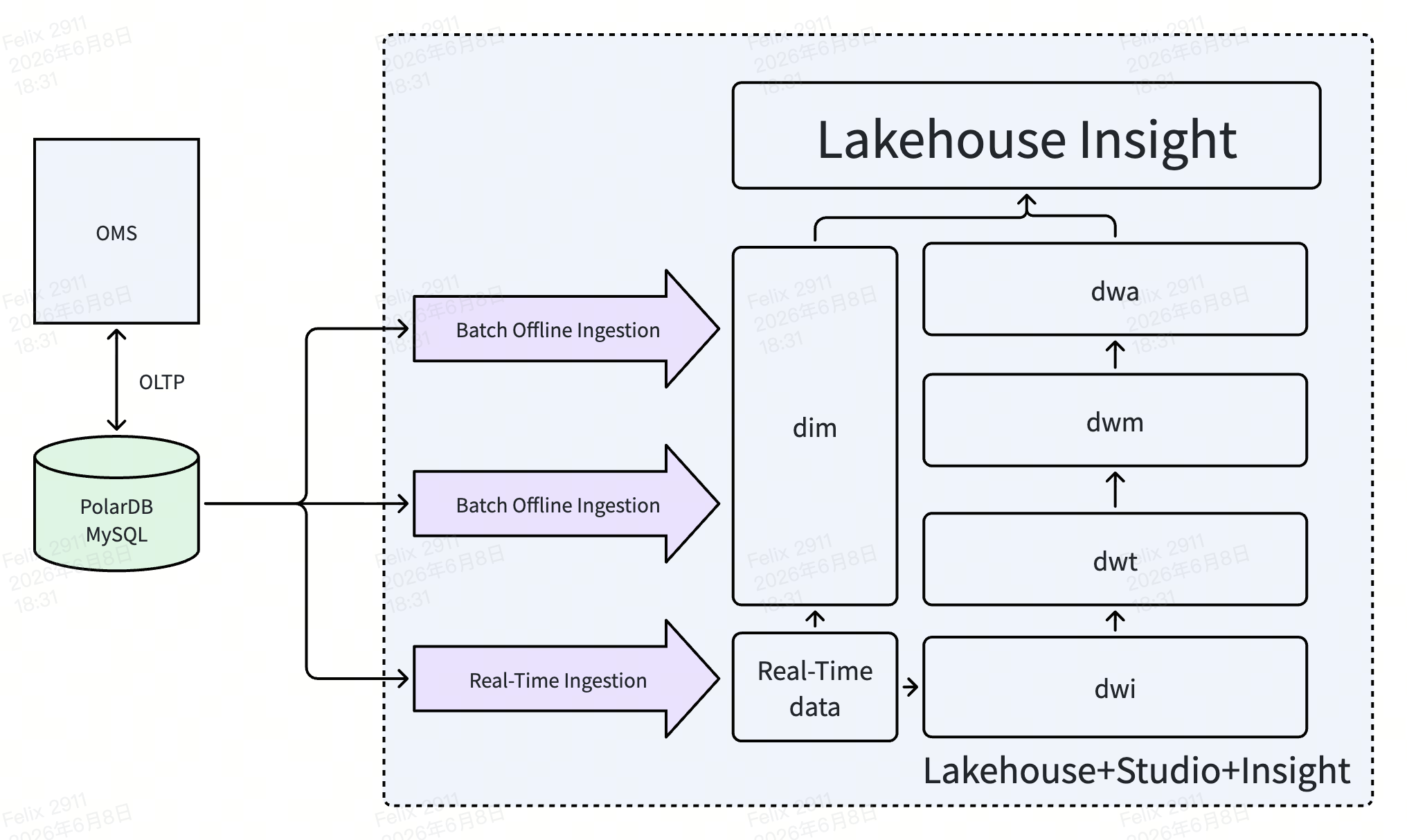
Synagie’s new architecture on Singdata Lakehouse: batch and real-time ingestion flowing into a single Lakehouse + Studio + Insight platform, with Lakehouse Insight as the unified BI layer
With Single-Engine, the platform went from a multi-product mix of AnalyticDB instances plus Power BI to a single unified architecture. There are no more separate ADB instances or a standalone BI tool to keep in sync. The data path is much shorter, and the whole system is cleaner, steadier, and easier to evolve.
Scaling is automatic. During peak periods the platform scales out to match the load; when demand drops it releases resources, keeping performance and cost in balance.
Results
Faster development, faster queries
A single tech stack and one development entry point cut a lot of cross-system work. Pipeline development is now 50% faster. On the analytics side, BI queries return in about 2 seconds, a noticeable improvement for everyone using the dashboards day to day.
Fresher data
Overall freshness went from T+1 to 5 minutes. That’s what makes near-real-time inventory, sales, marketing, and operations analysis possible — the kind of timeliness a fast-moving retail business actually needs.
Lower cost
Retiring the multi-engine stack cut operations cost by 70%. Replacing the old product combination with Single-Engine brought overall compute and platform cost down by 30%.
Business impact
The platform now gives 600+ retail brands unified, real-time analytics from one source of truth. It supports fine-grained, personalized operations across many brands and channels, and it strengthens data-driven decision-making — a durable foundation for growth.
What comes next
Rebuilding the analytics foundation was the first step. Synagie plans to keep expanding what it does with data on the same unified platform, moving further into Data + AI.
The next move is DataGPT, Singdata Lakehouse’s conversational analytics layer. Built on Synagie’s existing data assets and unified semantic layer, it aims to:
- Let people ask questions in plain language. Business users query the data directly in natural language, and the system generates the queries, charts, and findings — dropping the barrier to using data.
- Upgrade self-service. The bar shifts from “knows how to use a BI tool” to “can ask a business question” — releasing more value from the data.
- Keep answers consistent and trustworthy. A unified data and metrics layer keeps conversational results aligned and explainable.
- Speed up Data + AI. It lays the groundwork for intelligent operations analysis, forecasting, and AI-driven decisions.
With Lakehouse + Insight + DataGPT evolving together, Synagie is moving its analytics from tool-driven to business-driven and AI-driven — creating longer-term, more forward-looking value for the retail brands it serves.
See what Singdata Lakehouse can do for your data platform — request a demo or start a free trial.
