
Unified Search and Analytics Platform vs. Standalone Vector Database for AI
A criteria-by-criteria comparison of unified search and analytics platforms and standalone vector databases for enterprise AI retrieval, covering hybrid search, filtering, governance, freshness, cost and latency, with self-selection guidance and a proof-of-concept checklist.
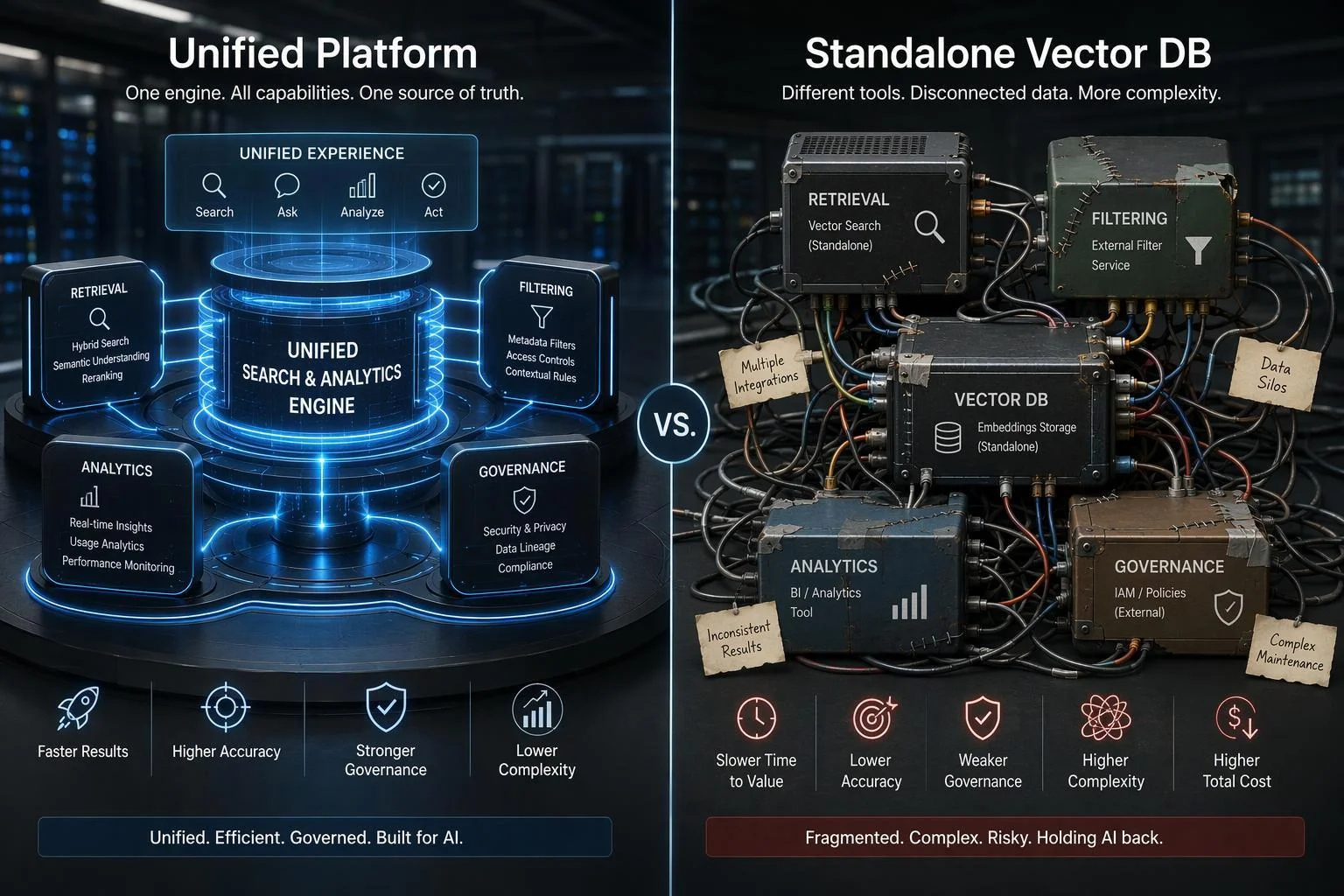
The decision in front of most enterprise teams is not whether to use a vector database. It is whether retrieval, structured filtering, analytics and access control should live in one engine or be stitched together across several. That choice determines how many systems you synchronize, how many permission models you maintain, and whether relevance tuning becomes a routine loop or a separate data-engineering project.
Our position is conditional but plain. For most enterprise AI retrieval workloads, a unified search and analytics platform is the better default, because it collapses three surfaces that are expensive to keep aligned: synchronization between stores, authorization between the retrieval layer and the source of truth, and measurement of retrieval quality. A standalone vector database remains the right engineering call under conditions we can name: a narrow semantic workload, a bounded and slowly changing corpus, hard p99 latency targets, or an existing analytics stack that already covers logs and governance well.
The sections that follow work through this side by side. A summary matrix gives the fast verdict, seven criteria follow in the same order, then self-selection guidance, a profile-based mapping, a verdict and a proof-of-concept checklist.
Summary Comparison Matrix
Read the table as a set of judgments, not a feature inventory. Each cell reflects the discussion in the matching section below, and each is written to be defensible from that section rather than from a vendor datasheet.
Criterion | Unified search and analytics platform | Standalone vector database |
|---|---|---|
Retrieval modes | Full-text, vector and hybrid fusion in one query request, tunable per corpus | Dense similarity is the core; keyword and hybrid exist in some products and are absent in others |
Structured filtering | Native filters combinable with vector and keyword clauses; pre- and post-filter modes | Metadata filtering is supported, often with flatter metadata models and fewer combination options |
Analytics and feedback loops | Query logs, feedback signals and outcomes analyzable in the engine that serves retrieval | Logs and metrics are exposed; analytics over them usually means exporting to a warehouse |
Governance and permissions | One identity integration and one audit trail; security filters applied against the same principals | Namespaces and access controls exist, but authoritative permission data lives elsewhere and must be synced |
Freshness and sync | Fewer synchronization surfaces; propagation delay still exists | Every source change must be propagated separately to the retrieval store |
Operational footprint | One system to upgrade, capacity-plan and staff | One system, but it sits alongside the analytics and governance stack you already run |
Latency ceiling | Adequate for typical enterprise RAG and mixed query types; benchmark at the extreme end | Purpose-built engines can be tuned for very high throughput and tight p99 targets |
Best fit | Enterprise AI retrieval that must combine semantic and exact matching, enforce permissions and improve through measurement | Narrow, latency-bound, bounded-corpus semantic retrieval |
Retrieval Modes: Hybrid, Keyword and Vector in One Query
Retrieval quality is not a pure-similarity problem, and the evidence for that is corpus-specific rather than universal. A 2026 benchmark of ten retrieval strategies on a financial QA set of 23,088 queries over 7,318 documents with mixed text and table content found that BM25 outperformed state-of-the-art dense retrieval on every metric except Recall@20, and that a two-stage pipeline combining hybrid retrieval with cross-encoder reranking reached Recall@5 of 0.816 and MRR@3 of 0.605, beating all single-stage methods. The authors state their own limits: the corpus is financial only, all answers are numerical, and retrieval is whole-document rather than chunked. Treat it as a finding about text-and-table financial documents, not a law about retrieval.
A second study points the same way from a different domain. On a cystic fibrosis scientific retrieval benchmark, sparse and dense models performed roughly equivalently, while a hybrid of the two yielded significantly better results. Again the scope is a specialized medical corpus.
What follows for a buyer is structural rather than statistical. If the winning mode depends on the corpus, you need to run and tune several modes against your own documents. A unified platform issues full-text and vector queries in a single request and merges the rankings with Reciprocal Rank Fusion, so comparing modes is a configuration change. Fusion itself needs care: OpenSearch documents that BM25 and vector scores use different scales and should be normalized before combination, and that different normalization techniques produce different rankings from identical input.
The gap is narrowing. Some vector databases now offer hybrid and full-text search; Pinecone, for example, states that a single index can serve full-text search, semantic search and sparse-vector search together. Check the specific product rather than the category.
Structured Filtering and Metadata
AI retrieval almost always needs value-based constraints alongside similarity: tenant, date range, region, permission group, document type. The question is not whether a system can filter, but how expressively it can combine filters with retrieval clauses and where in the query pipeline the filter is applied.
Unified search platforms treat filtering as a first-class query component. In Azure AI Search, a filter provides value-based criteria for including or excluding content, applies to nonvector fields, and can be applied before or after vector query execution, with prefilter, postfilter and strict postfilter modes. The search filters documentation notes that filtering reduces the recall set of the subsequent search, which is the practical trade-off: a restrictive prefilter can improve latency and precision while removing candidates a post-filter would have ranked.
Standalone vector databases support metadata filtering too, and the constraint is often the metadata model rather than the filter language. Pinecone's documentation specifies that metadata fields must be key-value pairs in a flat JSON object, with nested objects unsupported. Where the authoritative metadata lives in a separate operational store, filtering becomes a join across systems, and the join has to be kept current.
For acceptance, test filter expressiveness against your real query mix and measure both recall and latency under each placement mode. Which placement fits is an empirical question about your data, not a default you can assume.
Analytics, Query Logs and Evaluation Feedback
This is the criterion teams skip, and it is the one that determines whether retrieval quality improves after launch. You cannot tune what you do not measure, and measuring requires joining three things: the queries users issued, the results the system returned, and what happened next, whether a click, a follow-up rephrase, an accepted answer or an escalation.
In a unified platform, those three datasets live in the engine that serves retrieval, so the evaluation loop is a query rather than a pipeline project. You establish a baseline against a judgment list, add a signal such as a reranker or a new field, and re-measure. Elastic's search labs walk through exactly this discipline: they used rank_eval to establish a reproducible baseline, then added a semantic field and re-ran the evaluation, reporting that hybrid search improved recall from 0.43 to 0.75 while preserving precision on exact-match queries, with the caveat that the margin depends on the query mix.
A standalone vector database typically exposes logs and operational metrics but not an analytics layer over them. Building the loop means exporting to a warehouse, modeling the joins, and maintaining that pipeline as schemas change. That is ordinary engineering reasoning, not a benchmark claim: the cost is real and recurring, and it lands on the data team rather than the search team.
Ranking-evaluation tooling exists in search platforms, but the tool matters less than the discipline. Baseline, measure, add one signal, re-measure, keep or revert.
Governance: One Permission Model, One Audit Trail
Two systems mean two identity integrations, two authorization models and two audit trails. The risk is not that either system is insecure in isolation; it is that the retrieval layer's permissions drift from the source system's as documents move, groups change and indexes rebuild.
A unified platform can apply security filters against the same principals used elsewhere. Azure AI Search documents a security-trimming pattern that filters results by group or user identity, and is explicit about its limits: the pattern simulates document-level authorization using a regular filter, with no authentication or authorization through the security principal itself. The application must authenticate users, obtain trusted principals, apply filters to every query and prevent bypasses. Neither a permission field name nor a document key proves that grants are authorized for the associated content. That caveat applies to any platform offering application-managed trimming, including a unified one.
A standalone vector database offers namespaces and access controls, and Pinecone notes that multitenancy through namespaces allows users to partition indexes into isolated partitions. But the authoritative permission data usually lives in the identity provider or the source system, so you synchronize it, and synchronization is where drift enters.
For framework reference rather than certification, NIST's generative AI profile treats governance and content provenance as first-class concerns, recommending that inventory entries carry data provenance information such as source, signatures, versioning and watermarks. Fewer systems means fewer places for that provenance to break.
Freshness and Synchronization Cost
When retrieval and analytics are separate, every source change must propagate to both, and the consistency window between them becomes a design parameter you now own. The mechanics matter more than the slogan.
Batch reloads ask what a table looks like right now on a fixed schedule. Change data capture flips the question to what just changed and answers it continuously. Redis's engineering write-up describes the difference concretely: log-based CDC reads the database transaction log, captures deletes, and needs no schema changes, while query-based polling typically misses deletes and, after downtime, captures only the latest state of a record. The same article is careful about the ceiling: end-to-end freshness still depends on the connector, backlog, data processing, embedding generation, target writes and serving behavior.
Index sync modes make the same trade-off explicit. Databricks documents that continuous sync keeps the index in sync with seconds of latency at higher cost, while triggered sync requires you to start the sync yourself.
Stale context is not a cosmetic defect. In February 2024 a British Columbia tribunal ordered Air Canada to pay 812.02 Canadian dollars after its support chatbot told a grieving customer he could apply for a bereavement fare refund after booking, when the airline's actual policy did not allow retroactive applications; the tribunal held the airline liable for negligent misrepresentation. A unified platform reduces the number of hops between source and retrieval, but it does not eliminate propagation delay. Unified means fewer synchronization surfaces, not zero latency.
Operational Footprint and Total Cost
Count the systems, not just the license. Two systems mean two sets of infrastructure, two upgrade cadences, two capacity-planning exercises, two on-call rotations and two skill sets to hire and retain. Those costs are real, they are recurring, and they rarely appear on a vendor quote.
A workable cost model has five lines. License and consumption for each system. Infrastructure for ingestion, embedding generation, index serving and the analytics layer. People, measured in engineer-hours per month for operations and for integration work. Integration, meaning the connectors, sync jobs and schema mappings that keep the systems aligned. And incident risk, which is the expected cost of a drift or staleness event weighted by its likelihood.
Consolidation has its own costs, and an honest evaluation names them. Migration of existing indexes and queries takes time. Query languages differ between systems, so skills transfer imperfectly. Over-coupling is a genuine risk: if one engine serves retrieval, analytics and governance, a change in one area can ripple into the others, and you need change management to match.
Vendor-reported savings belong in the model as claims to validate, not as inputs. Run your own workload, measure your own engineer-hours, and compare. A headline reduction in total cost of operation is a hypothesis about your environment until you have tested it in yours.
Latency and Scale Ceilings
This is the strongest argument for a standalone vector database, and it deserves a straight answer rather than a hedge.
Purpose-built vector engines can be tuned for very high query throughput and very large embedding counts with tight p99 targets. Their query-processing surface is narrower by design, which is exactly what makes that tuning tractable. A unified platform carries more surface: full-text indexing, structured filters, aggregations, analytics queries and vector search all share the same engine, and at the extreme end of throughput that breadth can cost you.
A unified platform's latency is typically adequate for enterprise RAG at moderate queries per second with mixed query types, where retrieval is one step inside a request that also calls a language model. The model call usually dominates end-to-end latency, and shaving milliseconds from retrieval rarely changes the user experience. When retrieval is the product, the calculus changes.
Benchmark hard, and benchmark the right thing. Measure p50 and p99 under your own query mix, including filtered queries, because filter placement affects latency as well as recall. Test at your expected peak concurrency, not at average load. Test index freshness under concurrent writes, since a continuously syncing index behaves differently from a static one. If your targets are strict and your corpus is bounded, a purpose-built engine may simply be the better engineering choice, and no amount of architectural elegance changes that.
When a Standalone Vector Database Is the Right Choice
This is genuine self-selection, not a concession paragraph. A standalone vector database is the better call under several conditions, and a buyer should recognize them without apology.
Choose a standalone vector database when retrieval is single-purpose semantic search and the surrounding analytics and governance needs are already met by an existing stack. Choose it when the corpus is bounded and changes slowly, so synchronization cost is low and a periodic reload is acceptable. Choose it when you have hard latency service-level objectives that a general-purpose engine cannot meet at your concurrency. Choose it when a small team wants minimal operational surface and has no appetite for running a search cluster alongside everything else. Choose it when your existing warehouse already handles query logs, feedback analysis and access control well enough that rebuilding those loops in a search engine would be duplication rather than consolidation.
The middle path is real and worth checking. Some vector databases now include hybrid and full-text search, which narrows the retrieval-mode gap considerably. Pinecone's documentation, for instance, describes full-text search with BM25 and Lucene queries alongside semantic and sparse-vector search in one index. If your chosen product covers the retrieval modes you need, the structural argument for a unified platform weakens to a question about analytics and governance surfaces.
These are buyer judgments about your constraints, not rules. Two teams with the same corpus can reasonably land on different answers.
Who Should Choose Which
Map the choice to the dominant constraint each role actually owns. The trade-off column is the part to read carefully, because every option accepts one.
CTO and VP Engineering: a unified platform fits when the portfolio already spans analytics, governance and AI retrieval, because it reduces the number of systems on the architecture diagram. The trade-off is over-coupling: one engine's change management now covers several workloads.
Data engineer and data architect: a standalone vector database fits when the retrieval workload is narrow, the corpus is bounded and latency targets are strict. The trade-off is owning a synchronization pipeline and a second permission model.
Business analyst and data consumer: a unified platform fits when relevance tuning and query analysis need to happen without a separate data-engineering project. The trade-off is that feedback loops depend on the platform's analytics surface being usable by the team that owns relevance.
Procurement and CFO: a unified platform fits when the goal is fewer contracts, fewer infrastructure lines and fewer integration projects to fund. The trade-off is that consolidation savings are a hypothesis until measured against your own workload, and migration is a real one-time cost.
No new factual claims are introduced here; each mapping follows from the criteria above.
Verdict
A unified search and analytics platform is the better default for enterprise AI retrieval that must combine semantic and exact matching, enforce permissions against the same principals used elsewhere, and improve through measured feedback. The advantage is not raw speed. It is that synchronization, authorization and evaluation each lose a surface, and surfaces are where enterprise retrieval systems fail quietly.
A standalone vector database wins on narrow, latency-bound, bounded-corpus workloads, particularly where an existing analytics and governance stack already covers the surrounding loops. That is a legitimate architecture, not a compromise, and the narrowing of the retrieval-mode gap through hybrid and full-text support in vector databases makes it more defensible than it was two years ago.
The decision should follow your constraints, not the category. If your corpus is broad and changing, your permission model is document-level, and your relevance quality needs to improve after launch, the unified platform is the lower-risk default. If your workload is a single semantic endpoint with a fixed corpus and a hard p99 target, benchmark the purpose-built engine seriously and let the numbers decide.
Acceptance Checklist Before You Commit
Each item below is something to verify in a proof of concept against your own corpus and query mix, not a feature to assume from a datasheet. Record the result and the configuration that produced it, so the comparison survives the procurement cycle.
Retrieval modes and fusion. Run keyword, vector and hybrid queries over the same evaluation set. Confirm which fusion method is applied and whether you can change it.
Filter expressiveness and placement. Test tenant, date, region and permission-group filters combined with similarity search. Compare pre-filtering against post-filtering on both recall and latency.
Permission model and audit. Verify that access decisions use the same principals as your source systems, and that every query is attributable in an audit trail.
Freshness under change. Measure end-to-end lag from a source update to a retrievable result, including connector, backlog, embedding generation and index write.
Analytics and feedback loop. Confirm you can join queries, returned results and outcome signals without exporting to a separate system.
Latency under your query mix. Benchmark p50 and p99 with realistic concurrency and mixed query types, not a single synthetic vector query.
Operational footprint. Count the systems, upgrades, on-call surfaces and skills the design requires, including the ones you already run.
Exit and migration path. Establish how you would move embeddings, metadata and query logic out, and what that would cost in engineering time.
FAQ
Is a vector database enough for RAG? It can be, for a bounded corpus with a single retrieval style. Once you need exact matches on identifiers, dates or product codes alongside semantic similarity, and you need to filter by tenant or permission group, you are building the rest of a search platform around it.
Does a unified platform sacrifice vector performance? It can at the extreme end. Purpose-built vector engines are tuned for very high throughput and very large embedding counts with tight p99 targets. For typical enterprise retrieval with moderate QPS and mixed query types, benchmark both against your own workload before assuming either outcome.
Do I still need a separate analytics warehouse? Not necessarily for query logs and relevance evaluation, if the retrieval engine can analyze them directly. You may still keep a warehouse for financial reporting and other governed workloads with different access and retention requirements.
How do I evaluate retrieval quality before buying? Build a labelled evaluation set from your own documents and real queries, record a baseline with Recall@k, MRR or nDCG, then add one signal at a time and re-measure. The discipline matters more than the tooling.
Can I start with a vector database and migrate later? Yes, if you plan for it. Keep embeddings, metadata and query logic portable, and treat the migration path as an acceptance criterion rather than an afterthought.
See Also
Exploring AI-Driven Layered Structures in Global Supply Chains
Transforming Loyalty Programs with Engaging Gamification Strategies
Understanding OLAP Cubes: Their Importance and Functionality