
The New AI Data Stack: Why Semantic Logic Is the Bridge Between Warehouses and Intelligent Applications
The AI data stack needs more than a warehouse and a model. Learn why semantic logic is the bridge that makes AI analytics trustworthy.
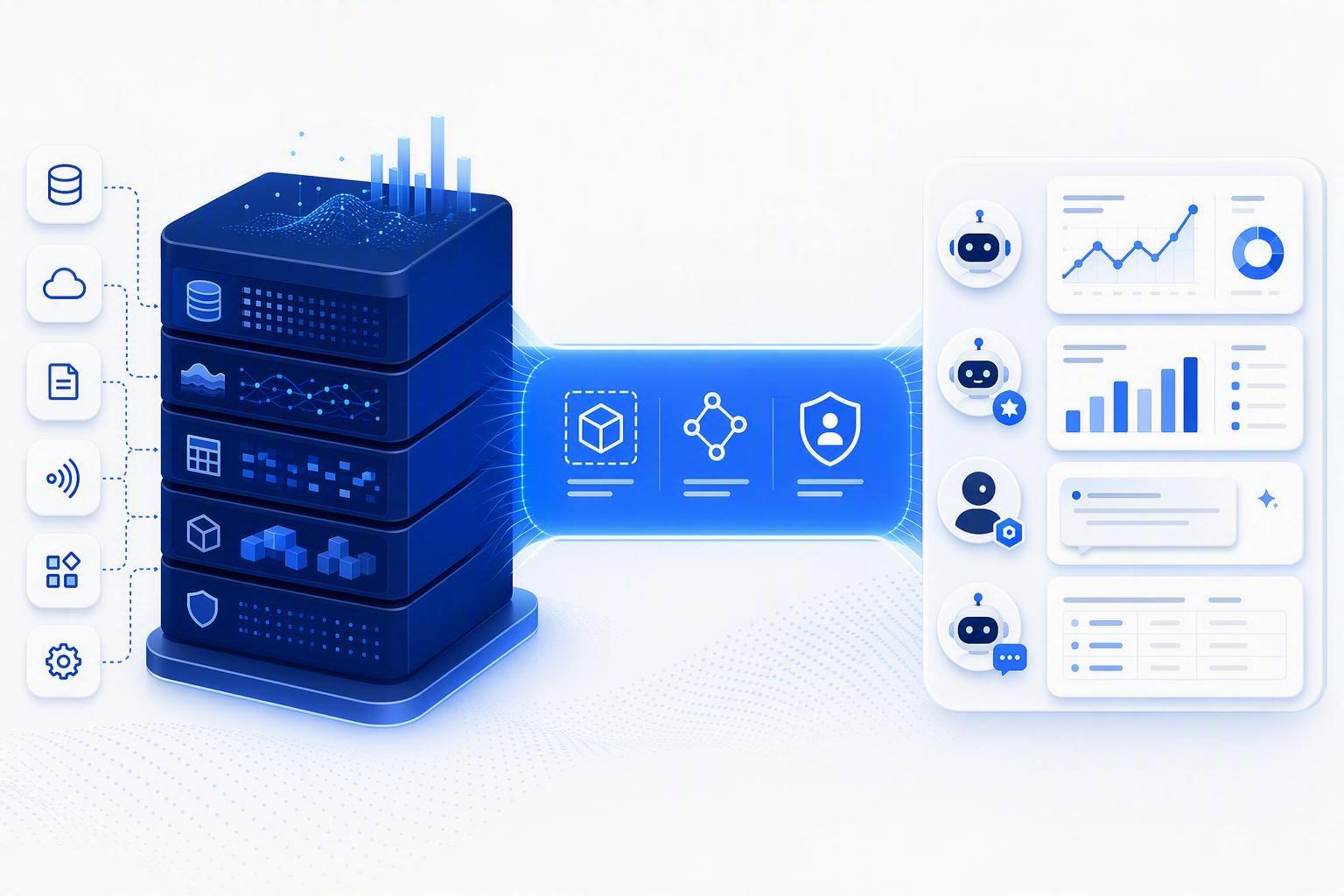
Every enterprise that rushed into AI analytics has landed in the same spot: plenty of raw data, strong models, and answers nobody trusts. The data team points at the model; the model points at the data; the business stops asking questions. The failure is rarely a weak model or an outdated warehouse. It is that the two halves of the stack never learned to talk to each other.
The modern AI data stack has two distinct tiers. On one side sits storage and compute — the warehouse or lakehouse that holds and processes the data. On the other side sit intelligent applications — AI agents, copilots, and natural-language analytics that answer questions and act on the data. Between them sits semantic logic, and that middle layer is the one most teams are missing. Semantic logic is not a nice-to-have component of the stack. It is the bridge that turns a data platform into an AI data stack.
The Stack Has Two Halves, and They Are Disconnected
Talk to most enterprise data teams and you will hear the same quiet complaint about their AI projects. The model returns answers that read fluently, look confident, and are often wrong. The number in the chat matches nothing on the dashboard. Somebody asks for churn, and a different customer segment comes back. Nobody in the room can trace how the answer was produced, so nobody acts on it.
The common response is to buy more: a bigger model, a faster warehouse, more context in the prompt. That spending treats the symptom. The real problem is structural. The warehouse knows how to store and compute data, but it does not carry business meaning. The AI application is fluent in language but has no idea what "active customer" means in your organization. Left to itself, the model guesses — it invents what each column means, which tables join, and which filters apply. Raw schemas named cust_id_01, txn_amt_net, and status_cd tell it almost nothing about the business.
The evidence that this guessing goes badly is consistent across independent benchmarks. On the tidy Spider 1.0 test set, LLM-based methods routinely clear 80% execution accuracy, but performance collapses on realistic, noisy data. According to dbt Labs' 2026 benchmark, frontier models improved from 32.7% accuracy in 2023 to just 64.5% in 2026 on raw text-to-SQL over an unnormalized schema — a modest gain across three years of model releases. On Spider 2.0, which runs against realistic enterprise databases, a 2026 comparative analysis records frontier models answering as few as 6 to 17 percent of questions correctly when pointed straight at the warehouse.
That is not a model-quality problem. It is a missing-meaning problem. The stack has a storage tier and an application tier, but nothing that carries governed business meaning between them.
Semantic Logic Is the Governed Meaning Layer
A semantic layer for the AI data stack is an abstraction that sits between raw data and everything that consumes it — dashboards, BI tools, notebooks, and AI agents. It defines what business terms mean, how metrics are calculated, how entities relate to one another, and who is authorized to see what.
Think of it as the difference between handing someone a database schema and handing them a well-annotated business dictionary plus the rules for reading it. The warehouse remains the system of record for storage, compute, and table management. The semantic layer supplies what those tables mean and how to query them correctly. In its semantic layer architecture guide, Databricks describes the core problem plainly: without such a layer, an LLM querying a warehouse has to infer what "ARR" means, which table holds it, what filters apply, and whether the number should count active contracts or everything. It produces plausible queries that may be subtly wrong, and it presents them with the same confidence either way.
The fix is to stop asking the model to re-derive business logic and instead hand it a curated definition it can reason over. Instead of prompting against raw tables, the agent grounds itself in governed metric definitions, approved dimensions, and explicit join paths. It no longer guesses what "active customer" means because the definition is written down, versioned, and auditable.
This is precisely the architecture that MIT Sloan argues is pivotal to a modern AI strategy. The researchers frame the semantic layer as the mechanism that makes proprietary data understandable to both people and machines. Without it, they conclude, models can produce outputs that are technically plausible but incomplete, misleading, or wrong.
Key Takeaway: The warehouse stores and computes data; semantic logic defines what that data means and how AI should reason over it. The second half is what makes the stack AI-ready.
Why This Bridge Decides Whether AI Analytics Succeeds
The cleanest way to see why semantic logic is load-bearing is to watch what happens to accuracy when you add it and remove nothing else. In controlled benchmarks, the model stays the same — only the meaning layer changes.
The 2026 dbt Labs benchmark is the clearest example. On the same enterprise-style workload, GPT-5.3-Codex scored 84.1% with plain text-to-SQL and 100.0% once queries were grounded in a semantic layer. Claude Sonnet 4.6 moved from 90.0% to 98.2%. On Spider 2.0-style tasks, the same models that scored 6 to 17 percent against the raw warehouse reached 98 to 100 percent through a well-modeled semantic layer. The engine did not change; the meaning layer did.
The pattern repeats across independent teams. A 2026 arXiv study (Rumiantsau and Fokeev) found that adding a roughly 4-kilobyte semantic-context document lifted first-shot accuracy by 17 to 23 percentage points across three frontier models, and within each condition model choice made almost no difference. Snowflake reported its Cortex Analyst rising from 57% to 78% purely by adding a semantic model, with no change to the underlying LLM, and other reporting puts the same move from roughly 51% to above 90% on real BI questions. Google's 2024 research quantified the same gap at the query level: queries generated against raw tables were about 66% less accurate than queries grounded in a semantic layer.
The strategic implication is underappreciated. If adding governed meaning — not a bigger model — accounts for most of the variance, then teams gain freedom. They can choose models on cost, latency, and quality rather than chasing whatever frontier model happens to be newest. Semantic logic becomes the lever that makes model-agnostic AI analytics possible.
For enterprise leaders, the stakes go beyond query correctness. Without a shared meaning layer, every tool and agent re-derives its own definitions from column names, and those definitions drift apart. The same question returns different answers in different tools, and nobody can audit which one is right. Semantic logic ends that drift by making business meaning a single, governed, machine-readable source of truth that every consumer — dashboard, notebook, or agent — references.
Pro Tip: Treat the semantic layer as the upper bound on AI quality. No amount of prompt tuning or model swapping fixes answers grounded in undefined business meaning.
Where Semantic Logic Belongs: The Debate and the Answer
In 2026, the industry does not fully agree on where semantic logic should live, and the question matters because it shapes every downstream decision. Alation's modern data stack explainer frames a modern stack for AI as two broad tiers: a foundation of data plumbing, and a context layer that makes the data AI-ready. That context layer is where semantic logic, ontology, and governance live — sitting above the warehouse and below the agents that consume it.
There are three main architectural positions:
Warehouse-native. Semantics live inside the warehouse or lakehouse as native objects or models, keeping meaning closest to governed data. This is the posture several warehouse platforms favor.
External semantic layer. Semantics sit above the warehouse, independently, reusable across any downstream tool or model. atScale argues the case that semantics should be reusable and not buried in a single vendor stack.
Context-layer model. Semantics are distributed — partly in the warehouse, partly in transformation, and partly in a broader context layer that serves agents. Snowflake describes its own move toward an agent context layer on top of a semantic analytic model.
The healthy way to read this debate is not "one position wins everywhere" but rather "meaning must be governed and centralized enough to be a single source of truth." Whether the definition objects live inside a lakehouse or in a separate tool matters less than whether every consumer reasons over the same governed definitions. The moment each agent and dashboard keeps its own private copy of business logic, metric drift returns and trust collapses.
This is why the most reliable architectures keep the meaning layer close to where the data and agents actually run, rather than as an afterthought bolted on earlier. ThoughtSpot frames it as an agentic semantic layer that sits between data platforms and AI systems — a governed semantic foundation that powers agents. When the working definitions live alongside the data and the agents that consume them, the same answer emerges whether the question comes from a dashboard, a notebook, or a natural-language prompt. That convergence is what makes scalable, self-serve AI access credible in an enterprise.
How to Build the Bridge Without Re-Architecting Everything
Getting semantic logic into the stack does not require a platform rewrite or a multi-year data-modeling project. The workable pattern is incremental and starts with what decisions actually depend on.
Start with a small set of high-value metrics. Work with Finance, Sales, Marketing, and Product to agree on the ten to thirty business definitions that drive real decisions. Document each one's formula, grain, time logic, owner, and a worked example. Derive the definitions from how the business operates, not from the warehouse schema.
Give each metric a canonical owner and ship versioned definitions. Every downstream tool, dashboard, and agent queries that single definition. No exceptions. Changes go through review, and versions are auditable.
Bake governance into the asset. Ownership, certification, masking, and lineage travel with the metric itself rather than living separately in dashboards. A default-deny posture for AI access keeps agents inside the boundaries the organization actually approved.
Choose where the meaning lives deliberately. Whether you keep definitions warehouse-native or in a separate layer, centralize them behind one governed source of truth and make every consumer reference it through an interface. Do not let each tool maintain its own copy.
Let AI help build and maintain the layer. Models are good at generating metadata, classifying data, proposing access controls, and spotting connections among assets. Use AI to author the semantic layer faster, then govern it with the same rigor as any other enterprise asset.
This incremental path mirrors the guidance in the vendor and academic sources above: start with the metrics that drive decisions, govern them as versioned code, co-author with business stakeholders, and expand only after the first definitions are stable and trusted. It pays off quickly in the domain where it starts and compounds as more workloads connect to the same source of meaning.
This is also where an AI-native data platform earns its keep. An AI-native lakehouse can carry the metric definitions, lineage, and access rules that data agents need, and then ground those agents in that governed meaning while they execute. In practice, this means the bridge is not a separate widget bolted on after the fact — it is built in, so the warehouse, the meaning layer, and the intelligent applications all operate on the same governed reality.
The Argument People Raise: Just Make the Warehouse or Model Smarter
The most natural objection is that all of this is temporary — that warehouse-native semantics or faster models will eventually make a dedicated meaning layer unnecessary, or that more careful prompting is enough. The benchmark evidence argues otherwise.
Warehouse-native semantics are a real and valid choice, but they only work if the meaning is actually governed, versioned, and exposed consistently to every consumer. Naming a few views or metrics inside the warehouse is not the same as operating a semantic layer; without governance and a single source of truth, the same drift and inconsistency reappear. The debate between positions matters far less than whether meaning is centralized and enforced.
The model objection is answered by the paired benchmarks. When the semantic layer was present, model choice within a tier had essentially no effect on accuracy, and the improvement from grounding was large, consistent, and independent of the model. That is the signature of an architecture fix, not a model fix. The model is not the bottleneck.
A related objection is that a semantic layer is expensive to build and maintain. It can be, if you try to model the whole enterprise in one pass. Scoped to the metrics that drive decisions, maintained as versioned code, and co-authored with business stakeholders, it is far cheaper than the cost of an ungoverned AI system that produces numbers nobody can trust. The counterargument is really an argument for starting small.
What This Means in Practice
The practical consequence is that an AI data stack becomes trustworthy only when semantic logic actually bridges the two halves. For teams launching natural-language analytics or data agents, the meaning layer is not an optional component upstream of the model; it is the foundation that determines whether the output is reproducible, auditable, and consistent with the numbers the business already uses.
The stack is no longer just a place to store data plus an app that talks to it. In the new AI data stack, the warehouse holds the data, intelligent applications consume that data to answer questions and take action, and semantic logic sits in between — carrying the governed business meaning that makes the whole thing work. Get that bridge right, and the answer is the same whether it comes from a dashboard, a notebook, or an AI agent. That consistency is what separates an AI data stack people trust from one they quietly stop using.
For enterprises moving toward AI agents and natural-language analytics, the question is not whether to add semantic logic. It is how quickly to make it the connective layer of their stack. Get the meaning layer right early, let the agents and dashboards reference it as the single source of truth, and the return compounds as every new workload connects to the same governed reality.
To see how governed semantics and metric definitions stay grounded inside a modern data platform, explore an Analytics Agent that reasons from unified business meaning rather than raw tables.