
The Enterprise Semantic Layer Explained
An enterprise semantic layer translates raw data structures into the business concepts your teams and AI can trust. See how it works and why it matters.
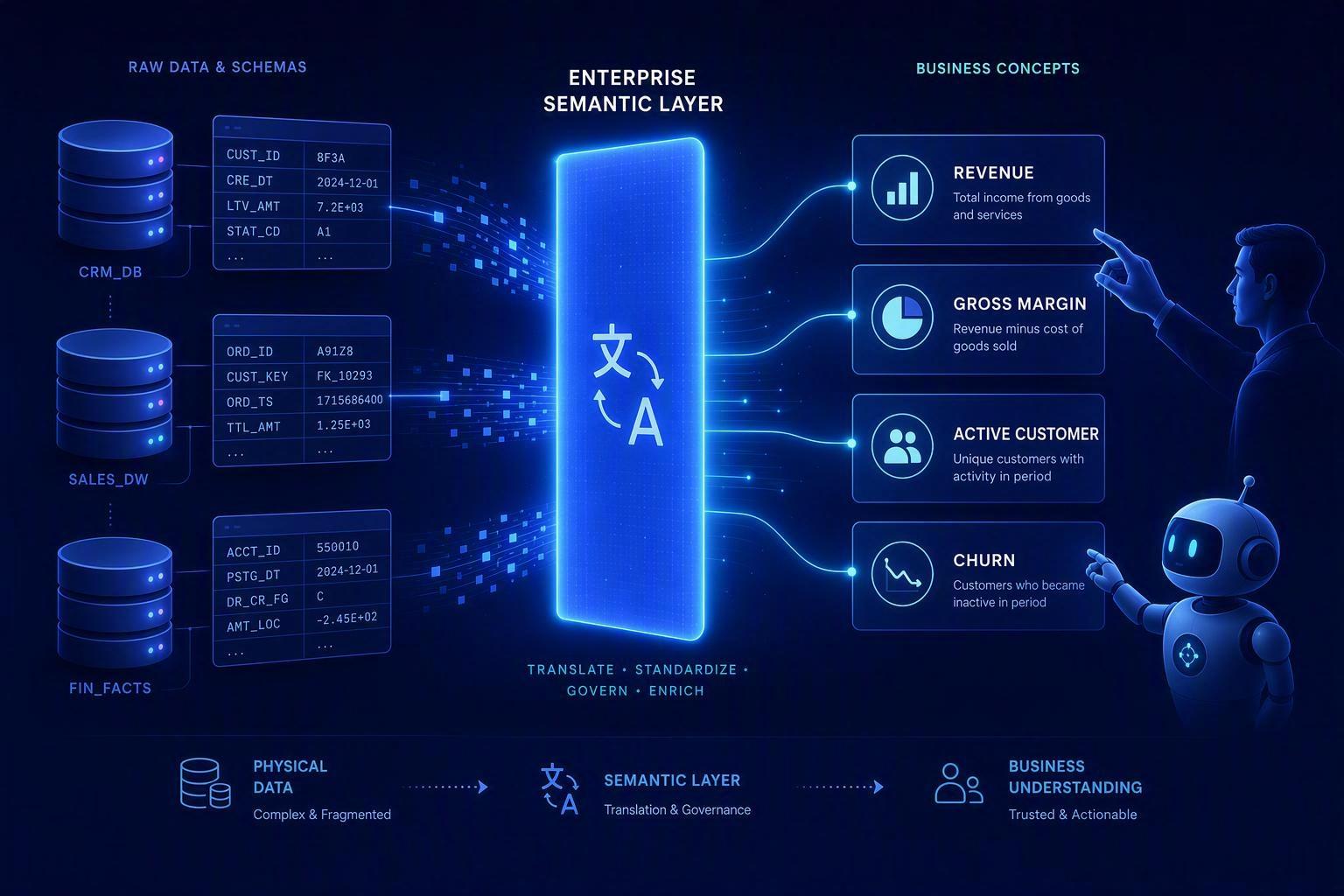
A data warehouse is full of tables with names like cust_trans_2026, txn_amt_net, and status_cd. Few people outside the data team know what they mean. The person asking "what was our gross margin last quarter?" is not thinking about joins and filters. They are thinking about a business concept — and somewhere between the table and the answer, someone has to do the translation.
The enterprise semantic layer exists to make that translation explicit, repeatable, and governed instead of leaving it to whoever happens to write the next query. It is the layer that turns raw data structures into the business concepts the organization actually talks about. Define that well, and dashboards, analysts, and AI agents all mean the same thing by the same word.
What an Enterprise Semantic Layer Is
An enterprise semantic layer is a governed abstraction that sits between your raw data sources and everything that consumes them — dashboards, BI tools, notebooks, and AI agents. Its job is to translate technical, physical schemas into shared business vocabulary: named entities, dimensions, and metrics the whole company recognizes.
This is the idea AtScale's definition of a semantic layer captures when it says the layer "represents your business in clear data form" and turns complex structures into consistent terms like revenue, churn, or customer lifetime value. The phrasing matters: a semantic layer does not simply describe your data. It represents your business — as a set of concepts people and machines can reason about.
A useful shorthand, as dbt Labs' semantic layer architecture explains, is to separate storage from meaning:
Physical data is how the data is stored — tables, columns, joins, files.
The semantic layer is what the data means — the business concepts built on top.
Governed metrics are the approved calculations that everyone actually uses.
Raw data tells you what happened. The semantic layer tells you — and your AI — what that data means.
What the Translation Actually Looks Like
The word "translate" sounds abstract until you see it done. In practice a semantic layer performs four connected moves over your physical data:
Map raw fields to business entities and dimensions. A spread of source tables becomes named concepts — customer, order, product, region, fiscal period. Instead of digging through cust_id_01, a user works with customer and region.
Define every metric once, from how the business operates. Revenue gets one definition with its formula, grain, time logic, and exclusions, agreed with Finance, Sales, and the other teams that touch it. It no longer varies from one report to the next. This is where metric drift dies: there is one calculation of record instead of one per dashboard.
Encode the relationships. The layer records grain, hierarchies, join paths, and dimensions, so a tool knows how revenue by region connects customer, order, and region without guessing which tables bind together.
Apply governance as part of the definition. Access rules, masking, certification, and lineage travel with each metric, so the same permissions and the same approved meaning are enforced everywhere, in a BI tool or in an AI agent.
IBM's primer on the semantic layer frames it as the component that makes self-service analytics realistic, and Databricks' semantic layer architecture guide is explicit about why: without this layer, any consumer of the data has to infer meaning from the schema. The semantic layer removes that guess.
Why an Enterprise Needs It Now
The semantic layer has existed as an idea for years, but it used to be framed as a BI convenience. Two forces turned it into enterprise infrastructure.
Business users need self-service, not schemas
When meaning lives only in the schema, the business is dependent on the data team for every question. Any attempt at self-service collides with the fact that "revenue" in one person's spreadsheet is not "revenue" in another's. A governed semantic layer lets a finance analyst or a product manager ask questions in the language of the business and get answers that reconcile with what leadership already reports. Faster access is the visible win; the quieter one is that every team stops quietly maintaining its own private definition.
AI agents need governed meaning, not guesses
The bigger driver is AI. A large language model given a raw warehouse does not know that Finance's revenue definition excludes trial users or which of two systems that track "the same customer" is authoritative. It picks an interpretation and answers with confidence. A semantic layer steps in front of that: it constrains an agent and a natural-language query to certified metrics and dimensions, applies governance before any SQL runs, and gives the model the one approved meaning to reason over rather than leaving it to infer.
The research community is converging on the same conclusion. MIT CISR's case for a semantic layer argues that with a comprehensive semantic layer, an organization can expand its use of AI without reinventing data governance for every use case, and that AI agents and retrieval systems perform more accurately and with less risk as a result. The market is pricing this in too: Atlan's analysis of semantic-layer grounding for AI cites a Gartner forecast that by 2027, organizations that prioritize semantics in AI-ready data could raise GenAI model accuracy by up to 80% while cutting costs by up to 60%. Accuracy and governance improve together, because both come from the same fix: meaning defined once, and reasoned over everywhere.
What a Semantic Layer Is Not
A definition becomes sharp only when you also say what the thing is not. This is where a lot of enterprise conversations go sideways.
It is not a data catalog. A catalog inventories facts about your data — where it lives, who owns it, when it updated. That is record-keeping. A catalog can list two conflicting revenue definitions; it cannot decide which one is authoritative. Establishing the governing meaning is the semantic layer's job.
It is not metadata by itself. Metadata describes what is present. The semantic layer decides which interpretation is approved and current. On an ambiguous schema, richer metadata can hand a consumer more options to choose from. Meaning must be governed, not merely described.
It is not the warehouse or lake, and not "more context" in general. Storage holds physical data; a semantic layer carries its business meaning. Adding more raw data or documents does not create a shared definition — it creates more candidates.
It is not only a metric store. KPIs are part of it, but a semantic layer also models entities, dimensions, relationships, grain, and governance, not just formulas.
It is not a synonym for the model. The layer sits upstream of whatever reasons over the data. It is the governed meaning a model — or a dashboard — draws on.
Pro Tip: When a new project talks about "adding a semantic layer," ask which business terms it renders authoritative and who owns each one. If the answer is vague, it is probably metadata or a catalog wearing a semantic layer's name.
What an Enterprise Semantic Layer Pays Back
Put together, the translation removes the cost of meaning being re-derived by hand everywhere.
The most immediate payoff is a single source of truth. Define active customer once and every report, notebook, and agent returns the same number for the same question. The reconciliation meetings that exist only to arbitrate "which number is right" stop being a permanent tax on the team.
The second payoff is self-service that is safe to trust. Because the layer carries access rules and masked definitions alongside the metric, business users explore data on their own without accidentally querying what they should not see, and without writing SQL against a schema they were never trained to read.
The third is AI that stays inside approved meaning. Because the model reasons over governed metrics rather than raw tables, its answers are consistent, traceable to a documented definition, and grounded in the same source the dashboards use. That is the difference between an agent that produces a plausible number and one that produces the number the business will actually defend.
For a modern data platform, the cleanest way to realize this is to let the governed definitions live next to the data they describe. An AI-native lakehouse can carry metric definitions, lineage, and access rules alongside the data, so the business meaning that answers depend on is not bolted on in a fragmented toolchain but stored where the compute runs. From that single governed source, Singdata's Analytics Agent maps a plain-language question to a defined metric and answers it in business terms, because the translation from data structure to business concept was done once, in advance.
The Layer Between the Data and the Meaning
An enterprise semantic layer is, most simply, the translation layer between how data is stored and what it means to the business. It maps tables to concepts, defines each metric once, encodes how they relate, and governs who can see and use what. That one layer is what lets a business user speak its own language and an AI agent reason over meaning instead of guessing at it.
The organizations that get this right stop re-deriving the same definitions in a hundred places. Their dashboards reconcile, their self-service is trustworthy, and their AI answers are grounded in the same governed meaning as the reports leadership already trusts. The data has held the business concepts all along — the semantic layer is what finally makes them explicit. If you are building AI agents, natural-language analytics, or self-service on top of governed data, Singdata shows how one governed meaning can ground both people and AI.