
Is Credible Data a Good Semantic Layer for AI?
Credible data is a necessary input to a semantic layer, not a replacement for one. See what quality dimensions miss, what benchmark evidence shows, and how to test your own data.
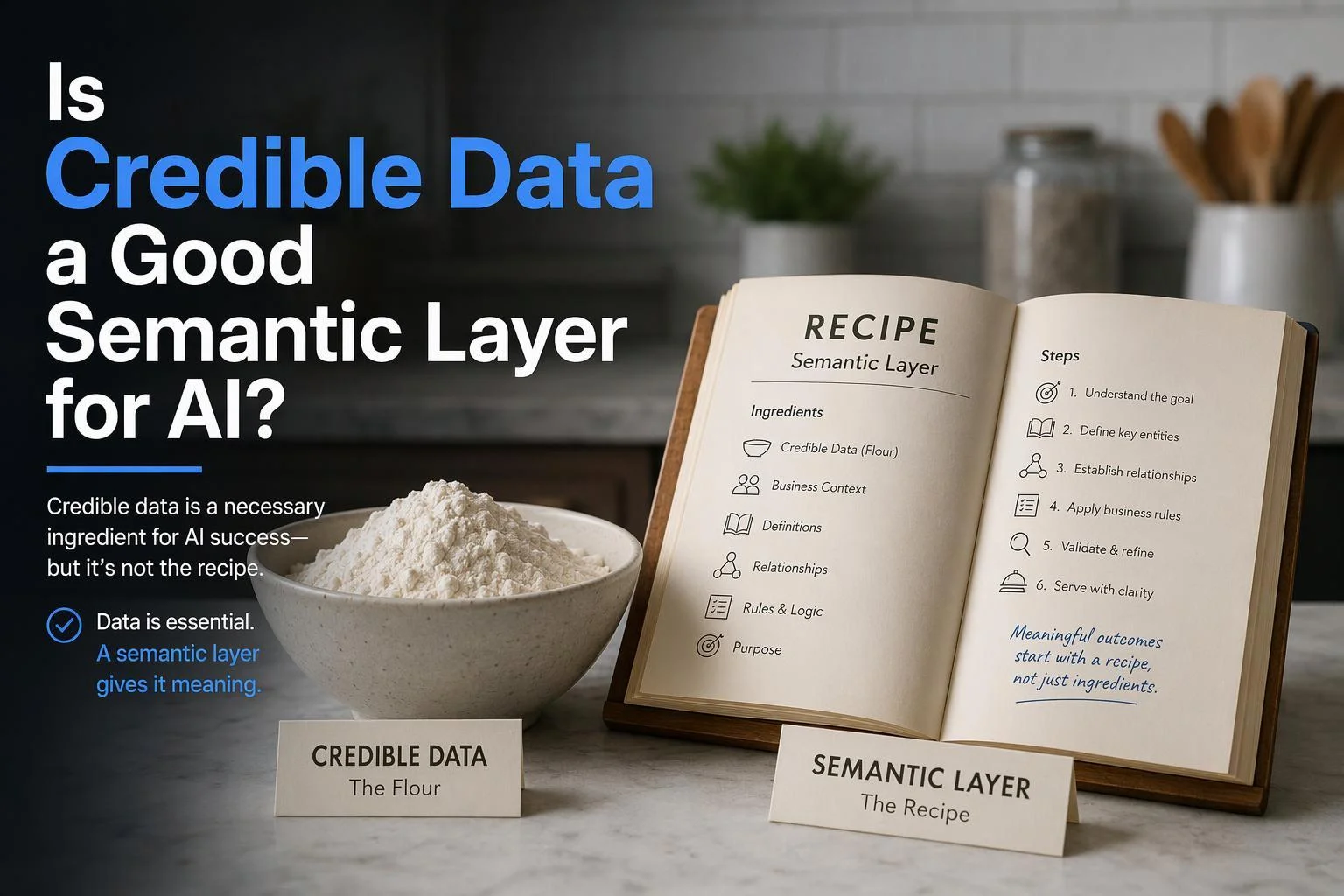
Credible data is the flour; a semantic layer is the recipe. Good flour does not bake bread on its own, and no recipe rescues flour that is spoiled. The same holds for enterprise AI: trustworthy data is a necessary input to a semantic layer, not a substitute for one. For CTOs, data architects and data engineers, the practical question is not whether to invest in one or the other but which gaps your current data leaves open for the AI use cases you plan to run. One clarification before we start: "Credible Data" is also the name of a vendor, and this article means the quality property, not the company.
Two Different Things: Data Credibility vs. a Semantic Layer
Data credibility is a quality property of the data itself. The DAMA UK working group defines six core dimensions for assessing it — completeness, uniqueness, timeliness, validity, accuracy and consistency — and frames them as indicators that help you measure and communicate quality rather than define what data means. That last distinction matters here: a dimension tells you whether a value is fit for use, not what the value represents in your business.
A semantic layer is the other thing. MIT CISR describes it as functioning conceptually between data and the user, human or machine, describing data's business meaning, its relationships with other data, and the rules the data must adhere to. The two are orthogonal. Data can be accurate, complete and current while remaining semantically undefined — nobody has written down which revenue column is authoritative or how two tables join. And a carefully modeled layer can sit on top of dirty data, in which case it faithfully serves wrong numbers.
What a Semantic Layer Must Add Beyond Trustworthy Data
Trustworthy data answers whether a value is right. A semantic layer answers what the value means, how it connects to other data, and who may see it — contributions no quality dimension covers. MIT CISR's research briefings note that in the GenAI era the required scope has widened: the layer must encode data usage constraints, permitted data combinations, rules for handling personal data, and data to support compliance audits. It can also capture codified expertise, such as judgments about data quality or permitted exceptions to business rules.
The Healthcare IQ case shows what that looks like in practice. The company used its semantic layer — data dictionaries, data models, taxonomies, ontologies and access control databases — to turn data from manufacturer websites, public databases and hospital systems into standardized, high-quality data assets. According to MIT CISR, its semantic technologies and techniques automated 80 percent of the effort required to onboard new hospitals, and the shared terminology made heterogeneous data understandable and combinable. That is a semantic contribution, and it is scoped to one company's experience rather than a general benchmark.
The Evidence That Semantics Improve AI Accuracy
The strongest published evidence comes from benchmark research on semantic representations, not from product evaluations. Allemang and Sequeda report that answering questions through a knowledge graph representation of an enterprise SQL database (Text-to-SPARQL) improved accuracy from 16% to 54% in their earlier benchmark. Building on that, they added ontology-based query checking and LLM repair, which raised overall accuracy to 72.55% on the "chat with the data" benchmark, with 8% "I don't know" results and a 19.44% error rate. These are results on a specific benchmark; they do not guarantee accuracy in your environment.
Two other benchmarks show where the difficulty actually sits. Spider 2.0, built from 632 real-world enterprise text-to-SQL workflow problems, found that a code-agent framework based on o1-preview solved only 21.3% of tasks, against 91.2% on Spider 1.0 and 73.0% on BIRD — the authors attribute the gap to complex schemas, metadata search, dialect documentation and project-level codebases. BIRD separately reports GPT-4 at 54.89% execution accuracy against a human result of 92.96%, and its emphasis on database values highlights dirty contents and external knowledge as distinct challenges. Read together, the evidence supports a narrow claim: semantic representation helps, and real enterprise complexity is the harder problem.
Are Vendor Claims About Semantic Layers Independently Validated?
Largely not, at the level of specific products. The peer-reviewed material above evaluates semantic representations and benchmarks in general; it does not test a named commercial semantic layer's error-reduction claims. Most product-level numbers come from the vendors themselves. That is not an accusation — it is a statement about what the published record currently allows you to conclude.
The closest thing to independent directional evidence is survey data. A VB Pulse June 2026 survey of 101 qualified enterprises with more than 100 employees found that 57% had traced a confident but wrong AI agent answer in the past six months to missing or inconsistent business context, and 31% said it happened more than once. The same research notes the sample is a single wave skewed toward the mid-market, so treat it as a directional read, not proof that any product fixes the problem. The practical rule: ask a vendor for the benchmark, the dataset and the configuration behind any accuracy figure, then reproduce it on your own schema before you sign.
How Permissions Are Enforced When an Agent Queries Data
Enforcement at query time is what separates a governed semantic layer from a documented intention. Databricks Unity Catalog's row filters and column masks are a worked example: they restrict the rows and column values a user can see at query time, configured either directly on individual tables in SQL or, for consistent filtering across many tables, through ABAC policies attached at the catalog or schema level and applied automatically based on governed tags.
The documented behavior also shows where care is needed. Time travel is not supported with table-level row filters or column masks, and the docs warn that with ANSI mode disabled, uncastable values are silently converted to NULL, which can make a row filter return all rows instead of filtering them. This connects to MIT CISR's observation that access control databases are part of the semantic layer: when the rules live with the model and are applied on every query, an agent's access is governable rather than advisory.
A Note on the Name: "Credible Data" the Vendor
Credible Data is a company, not a quality property, and the collision is worth resolving. Its product is an AI analytics engine built around Malloy, an MIT-licensed, Linux Foundation data modeling language created by Lloyd Tabb, co-founder of Looker and author of LookML. The company states plainly on its own site that "Credible is not a semantic layer" but an engine that generates one from a data model.
That framing reinforces this article's thesis rather than contradicting it. In the vendor's own description, the model of what data means is the input you own, and the semantic layer is output the engine generates and runs. Whether or not you buy the product, the architecture is the same argument: meaning has to be written down somewhere before anything can serve it consistently.
Testable Criteria: Is Your Current Data Sufficient for AI?
Turn the distinction into checks you can run against one specific AI use case, not your whole estate. DAMA UK is explicit that its dimensions are a checklist to adopt, not a prescriptive list, and that an organization must first agree the quality rules against which data is assessed. So scope each check to the fields your use case actually touches.
Quality rules exist for those fields. The six dimensions — completeness, uniqueness, timeliness, validity, accuracy and consistency — are measured against agreed rules, and you know the current results.
Canonical definitions are written down and owned. Someone is accountable for what "active customer" or "net revenue" means.
Grain is declared. Each table states what one row represents.
Joins are defined in one place. Not restated differently in every dashboard and query.
Permissions are enforced at query time. Not applied by convention or by asking the agent nicely.
The model is versioned. Definitions live in source control and are reviewed like code.
A compact acceptance checklist for a review: rules agreed and measured, definitions owned, grain declared, joins centralized, permissions enforced at query time, model versioned. Failing a check is not a certification failure; it tells you which gap to close first.
Common Misconceptions
Five errors recur once you separate quality from meaning.
Clean data alone makes AI answers reliable. It does not. The VB Pulse respondents had data; what they lacked was consistent business context. A semantic layer rescues untrustworthy data. It cannot — it will serve wrong numbers with better definitions attached. A benchmark accuracy figure transfers to your enterprise.Spider 2.0's 21.3% against 91.2% on Spider 1.0 shows how much the setting changes the result."Semantic layer" and "data catalog" are interchangeable. A catalog inventories assets; a semantic layer encodes meaning, relationships and rules. Installing a layer is a one-time project. MIT CISR advises governing the semantic layer itself, with an accountable owner, and expecting it to grow as you repeatedly solve problems in cleansing, cataloging, benchmarking and permissioning.
FAQ
Is credible data enough on its own? No. It is a necessary input. Without written definitions, joins and permissions, accurate data still produces inconsistent answers.
Does a semantic layer fix bad data? No. It governs meaning and access; it does not repair accuracy or completeness. Fix the data first, or the layer will consistently serve the wrong number.
How do I test a vendor's accuracy claim? Ask for the benchmark, dataset and configuration, then reproduce the test on your own schema and question set. Treat published figures as claims to validate, not established results.
Who should own the semantic layer? MIT CISR recommends an accountable owner who works closely with data platform owners and weighs in on deprecation and lifecycle decisions.
Is Malloy the same as a semantic layer? No. Malloy is a modeling language; a semantic layer is the tier that serves those definitions. Credible describes its engine as generating that tier from the model.
Conclusion
Credible data is a good input to a semantic layer and a poor substitute for one. The layer is where meaning, joins, permissions and versioning live, and that is what makes an AI answer governable rather than merely plausible. The evidence supports the direction — semantic representation improved benchmark accuracy, and real enterprise complexity remains the hard part — while product-level claims still need your own validation. Pick one high-value AI use case and run the checklist against it this quarter. If the gaps cluster around hosting governed data and a versioned semantic model in one place, a unified lakehouse platform is one architecture worth evaluating against those same criteria.