
Contracted Compute Is Not Energized Compute
Contracted compute and energized compute run on different clocks. Why capacity forecasts built on signed megawatts overstate supply and understate unit cost, and how to report three columns with three dates.
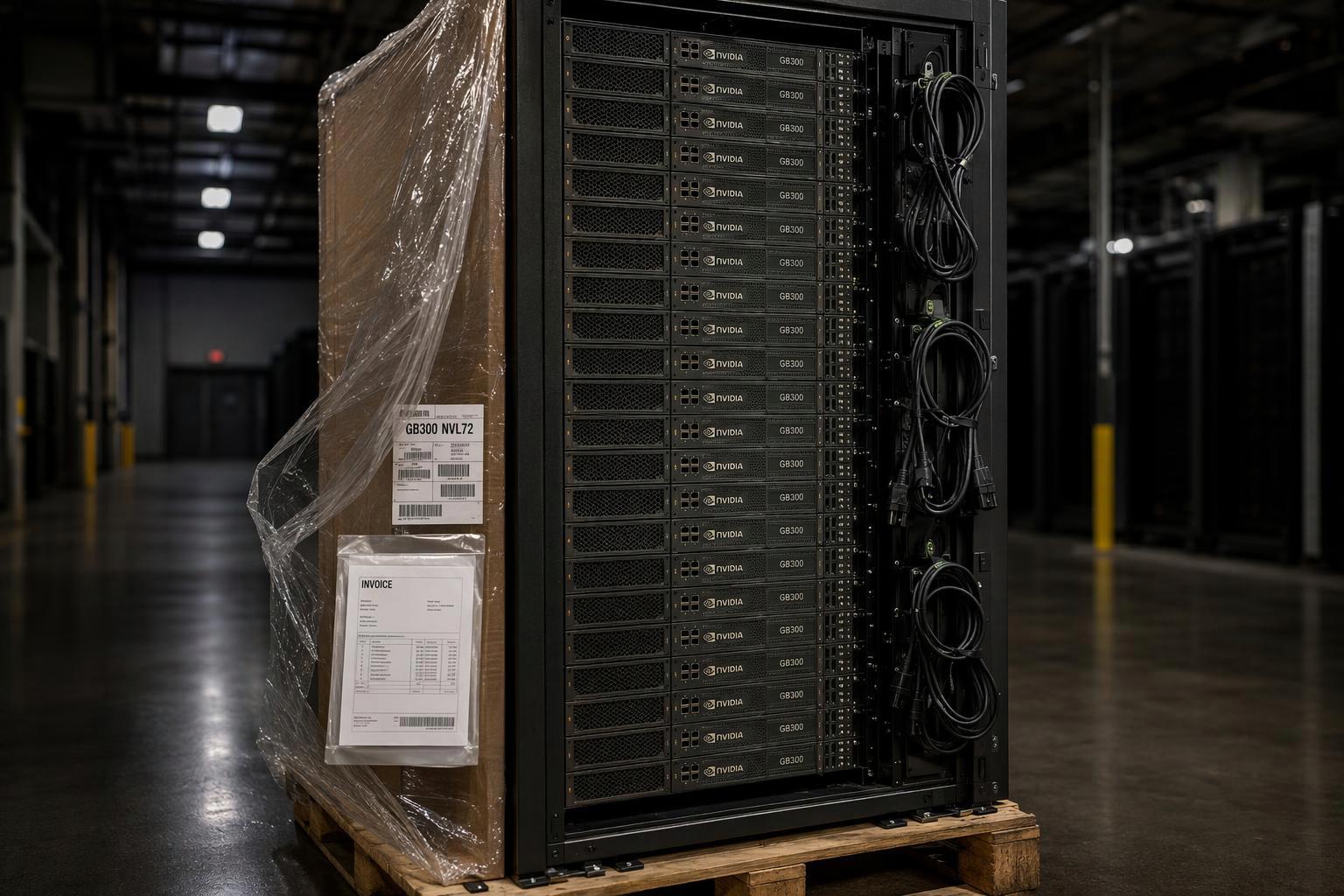
The rack has been invoiced. It has been shipped, received, and booked as an asset. It is also, for now, a very expensive shelf. Under AWS's Early Rack Receipt program, Amazon expected to receive roughly $5 billion of Nvidia GB300 server racks before final deployment, while some facilities lacked enough available power to switch them on, and projected roughly $3 billion more each month "for the foreseeable future," according to August internal emails reviewed by Business Insider (October 20, 2026). Finished equipment waited in intermediary warehouses. At least one team, one email said, did not have "a clear forecasted path" for getting it into a data center.
That is not a metaphor for a planning problem. It is the planning problem, made of metal.
Capacity planning is quietly mixing two different assets: megawatts on a contract and megawatts that can actually be switched on. Procurement is a commercial action, and it completes on a signature. Delivery is an engineering action, and it completes on a construction schedule. Because the two run on different time constants, booked capacity always arrives first and usable capacity arrives later, and the difference between them is physically stored in staging warehouses.
A forecast built on the first number is wrong in two directions at once. It overstates available compute, because some of the contracted quantity cannot be turned on. It understates unit cost, because fixed commitments are paid during idle periods while the denominator includes capacity producing nothing. This article argues that the two errors compound, names where the cost of fixing them falls, and recommends a report with three columns and three dates.
Procurement and Delivery Run on Different Clocks
The distinction is not about competence. It is about clocks.
Procurement is commercial. Its job is to lock quantity, lock price, and lock term. It succeeds when a signature lands, and it can complete in weeks. A capacity commitment is a legal instrument, and legal instruments move at the speed of negotiation.
Delivery is engineering. Its job is to make the capacity real, and its steps are physical: grid interconnection, substation and switchgear, cooling, cabling, commissioning, and the first successful job. Each of those steps has its own queue, its own inspection regime, and its own failure modes. None of them can be compressed by a purchase order.
Because the commercial clock is short and the engineering clock is long, the ordering is structural. Contracted capacity is recorded before energized capacity exists, not because anyone misjudged the schedule, but because the two events are measured on instruments that were never synchronized. A procurement team that executes perfectly still produces a contract date that precedes an availability date. No amount of negotiating skill closes that gap, because the gap is not in the negotiation.
The practical consequence is that a single capacity number in a planning deck is always a blend of two dates. When someone asks how much compute the organization has, the honest answer depends on which clock the question is using.
The Gap Has a Physical Address
The difference between contracted and energized megawatts does not sit in a spreadsheet. It sits in inventory.
Tomasz Tunguz's November 4, 2026 analysis describes the phenomenon directly: finished server racks are already sitting unpowered in staging warehouses because data centers lack the energized utility power to turn them on. The Business Insider reporting supplies the scale at one operator, with roughly $5 billion of GB300 racks expected in August 2026 and about $3 billion per month projected thereafter, staged until facilities were ready.
For the operator, the accounting consequence is immediate. Under the traditional process, ownership transferred on delivery to a data center. Under early receipt, the company pays for and records certain racks earlier in the supply chain. The asset is on the books from that moment. It depreciates from that moment. It earns nothing until the power arrives.
So the gap has a carrying cost, and the carrying cost starts on the receipt date, not the commissioning date. That is what turns a scheduling question into a finance question. A rack in a warehouse is not a neutral placeholder; it is capital that has been converted into hardware and is waiting for a utility to convert it back into revenue. The longer the wait, the more the effective cost of that capacity rises, even though its contract price never changed.
The Binding Constraint Is Interconnection, Not Silicon
The intuitive explanation for constrained AI capacity is a chip shortage. The evidence points further downstream.
Microsoft cut its calendar 2026 capex guidance three times, as reported by VentureBeat on November 4, 2026: about $190 billion in April, including roughly $25 billion attributable to higher component pricing; about $175 billion in July; and about $170 billion in October, with delays in third-party capacity given as the public reason. The Information separately reported a reduction in data center spending tied to IREN delivery delays.
A company that is short of chips does not usually cut the budget for buildings. A company whose buildings and the power to them are late does, because the spend cannot be absorbed on schedule. The constraint has moved from the component to the site.
This is consistent with the physical picture rather than proof of it. Guidance cuts are a financial signal, and financial signals have multiple causes. The mechanism this article describes, commercial completion preceding engineering completion, does not depend on any single quarter's guidance. It depends only on the fact that a contract can be signed faster than a substation can be energized.
Caveats that matter
Three limits apply to the numbers above, and they should travel with the argument.
First, the gigawatt figures and dollar amounts are estimates assembled from sources with inconsistent definitions. A capacity figure that counts contracted megawatts and one that counts energized megawatts are not the same quantity, and comparing them across publications can produce a false precision.
Second, the Anthropic cost figure discussed below is a prospectus-style disclosure and is not audited.
Third, Microsoft's reduction also includes an accounting reclassification of leases, so it is not purely a physical-delay signal. The July step down, in particular, followed a change in how data center leases are classified.
Treat the magnitudes as directional. The mechanism holds regardless of the exact figures, which is why the recommendation later in this article does not depend on them.
Forecasting From Contracted Volume Inflates Supply and Deflates Unit Cost at the Same Time
The error in a contracted-volume forecast is usually described as optimism. It is better described as arithmetic.
Take available compute first. If the denominator of a utilization or availability calculation is the contracted quantity, then capacity that cannot be switched on is counted as though it can. Reported supply is too high by the size of the gap, and every downstream plan that assumes that supply inherits the error.
Now take unit cost. A fixed commitment is paid whether or not the site is energized. If that commitment is divided by the contracted quantity, the result is a cost per unit of capacity that looks reasonable. If it is divided by the capacity that actually produced output, the result is higher. The first number is the one that tends to reach the budget. The second is the one the invoice reflects.
The two errors do not offset. They reinforce. The organization believes it has more compute than it does, at a lower price than it pays. Every decision that follows, from workload placement to expansion timing to pricing a product built on that compute, is made against a number that is wrong in the same direction on both sides.
The idle period is where the money goes
Trace the cash through the gap. During the period between contract effectiveness and energization, the commitment accrues. Rent, lease payments, depreciation, and financing costs do not pause while the substation is finished. Output during that same period is zero from the affected capacity.
This is the mechanism that converts a scheduling delay into a unit-economics problem. The cost is real and dated; the output is real and dated later. When the two are reported on the same line, the mismatch appears as an unexplained cost variance rather than a capacity variance, which is why year-end reviews tend to find the money before they find the reason.
An 82% Cost Move Shows What Happens When the Denominator Is Capacity
The cost evidence is useful precisely because it shows what a capacity-denominated number does when the cheap tranche runs out.
Tunguz's November 4, 2026 analysis puts short-term GPU rental at $3 per hour rising to $12 to $13 per hour, and states that Anthropic's blended GPU-hour cost rose 82% in two quarters, from $3.10 to $5.65. The underlying disclosure describes vendors renting as many accelerators as possible on multi-year contracts that fix prices in a lower range, then buying short-term burst capacity when that long-term capacity is exhausted.
Read the move carefully. It is not a direct measurement of the contracted-versus-energized gap, and it should not be presented as one. It is what a blended cost looks like when the denominator shifts toward the expensive tranche: the same workload, priced against the capacity that was actually available at the moment it ran rather than the capacity that was contracted for the year.
That is the denominator discipline this article is arguing for, seen from the supply side. A blended figure that mixes locked long-term capacity with spot burst capacity will move sharply when the mix changes, and the movement tells you more about availability than about efficiency. The caveat from earlier still applies: the Anthropic figure is a prospectus-style disclosure and is not audited. Use it to illustrate the mechanism, not to size the market.
The Counter-Argument: Signing Early Is Rational, and the Fix Is Not Free
The opposing position deserves its strongest form, because it is largely correct.
Signing early is a rational hedge. It locks price against a market where short-term rental has moved from $3 to $12 or $13 per hour. It locks allocation in a market where the largest buyers describe capacity as sold out years ahead. A buyer who waits for energized capacity before signing may simply not get capacity, and may pay far more for whatever is left. In that frame, paying for racks that sit in a warehouse for a few months is the cost of insurance, not a planning failure. The AWS spokesperson's description of staging finished hardware near deployment sites as routine practice is consistent with that view.
So the recommendation below is not "sign later." It is "report differently." And that reporting change is not free.
Splitting capacity into three columns requires instrumentation at the site level: the utility's energization date, the commissioning schedule, free rack space and cooling in each hall, and the inventory of racks received, staged, and installed. In many organizations those facts live in separate spreadsheets maintained by separate teams, and they drift apart between reviews.
It requires finance and infrastructure to reconcile two ledgers that were never designed to talk to each other. The contract lives in procurement's system with a start date. The asset lives in the fixed-asset register with a placed-in-service date. The power lives in a facilities tracker. None of these was built to be joined, and joining them is manual work before it is automated work.
And the third column, measured schedulable capacity, is often unavailable for months. It depends on benchmarks and production telemetry that do not exist for hardware still in a warehouse. The honest comparison is between two imperfect reports, not between a flawed one and a perfect one. The claim here is narrower: a report that separates the three quantities is less wrong in a way that matters, and the cost of producing it should be budgeted rather than assumed away.
Three Columns, Three Dates, One Signature Rule
For infrastructure leads, capacity planners, and finance business partners, the recommendation is a reporting change with a signature rule attached.
Split the capacity report into three columns, each carrying its own date:
Contracted capacity. Megawatts or units committed under a signed agreement, dated by contract effective date.
Energized capacity. Capacity with power actually available at the site, dated by energization or commissioning date.
Measured schedulable capacity. Capacity demonstrated to run the intended workloads, dated by the measurement.
Sign expansion commitments only against the third column. The first column is a commercial fact and belongs in the report, but it is not a supply forecast. The second is a prerequisite. The third is the only number that answers how much compute the money bought.
The two-week action is concrete. List existing contracts by site with commissioning dates and interconnection milestones. Mark the gap between "contract effective" and "interconnection complete" for each one. Take that gap, site by site, to next quarter's risk review, and attach a carrying cost to it so the conversation is about money rather than schedule.
One further lever matters when energized capacity is the binding constraint. If the peak, not the average, determines how much capacity has to be contracted, then reducing the peak reduces the commitment. That is the position where incremental processing earns its place: recomputing the same unchanged data is work that shows up at the peak, and processing only what changed cuts the peak rather than the average. Singdata builds its lakehouse around that model, and it is worth evaluating on that criterion rather than on a headline benchmark.
Skip the exercise and the year-end story writes itself. Budget was approved on contracted volume. The bill was paid on idle capacity. The gap can only be explained as "delivery delay," and there is no answer to the question the board will actually ask: how much runnable compute did the money buy?
FAQ
Why isn't contracted capacity a valid forecast input?
Because the contract date is not an availability date. Procurement completes on a signature; delivery completes on interconnection, substation work, cooling, and commissioning. The two run on different clocks, so a forecast built on contracted volume counts capacity that cannot yet be switched on. Contracted capacity is a valid input for a commitment and cash-flow forecast. It is not a valid input for a supply forecast.
How do you measure schedulable capacity?
At the site level, and with a date attached. The practical design is three columns: contracted capacity dated by contract effective date, energized capacity dated by energization or commissioning, and measured schedulable capacity dated by the measurement itself. The third column is the one to sign against, and it is usually the last to become available, because it depends on production telemetry rather than paperwork.
Does this problem apply outside the largest cloud providers?
Few operators will receive billions of dollars of racks in a month, but the mechanism does not depend on scale. A rack arrives on the vendor's schedule; the power to run it arrives on the utility's schedule, after the transformer, switchgear, and circuits are in and tested. Whenever the first runs ahead of the second, the operator owns hardware that cannot be energized. The size of the gap scales with the buildout; the existence of the gap does not.
Previous posts
1. Medallion Architecture: What Changes Between Bronze, Silver, and Gold? — https://singdata.com/trending/medallion-bronze-silver-gold
2. How Much Data Preparation Is Hidden in Your BI Reports? — https://singdata.com/trending/hidden-data-prep-in-bi-reports
3. How to Migrate from ETL to ELT Without Breaking Reporting or Agentic AI Freshness — https://singdata.com/trending/2026-11-04-elt-file-first-ingestion