
Hive → Lakehouse Migration in Practice: E-commerce User Behavior Data Warehouse
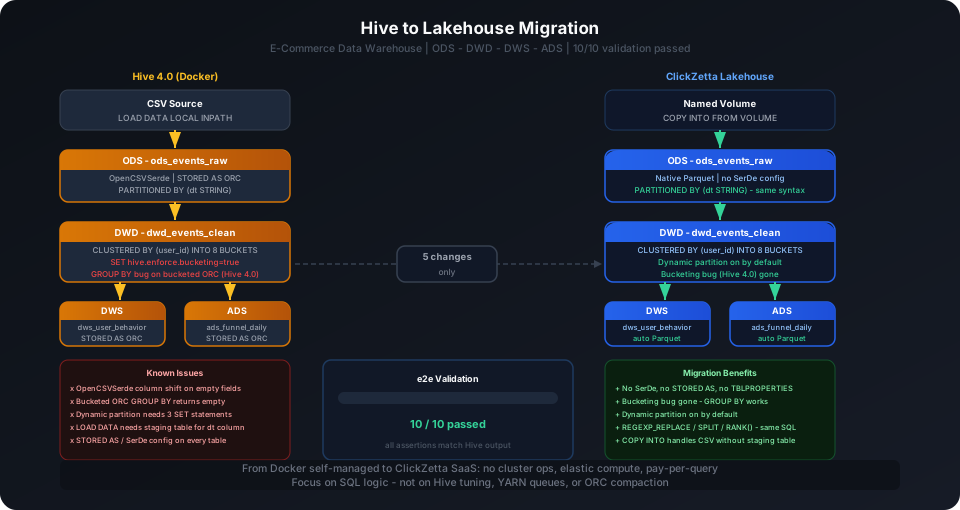
If your data warehouse runs on Hive, migrating to Singdata Lakehouse requires less effort than you might expect. The core Hive SQL syntax — SELECT, JOIN, GROUP BY, window functions, conditional aggregation — runs directly in Lakehouse without modification. Changes are concentrated in 4 areas: storage format declarations, data loading methods, dynamic partition SET statements, and SerDe configuration.
This article validates this with a real project: a complete migration of a Hive 4.0-based e-commerce user behavior data warehouse (ODS → DWD → DWS → ADS four-layer architecture) to Singdata Lakehouse, passing all 10 automated validation checks.
Full code on GitHub: hive2lakehouse-ecommerce-events
Original Project
The data source is the Kaggle E-commerce User Behavior Dataset, containing user behavior logs from a cosmetics e-commerce website in October–November 2019. Fields include event_time, event_type (view/cart/purchase), product_id, category_code, brand, price, user_id, user_session, totaling approximately 6.5 million rows.
The Hive implementation runs in a Docker container (apache/hive:4.0.1) with a four-layer architecture:
| Layer | Table | Description |
|---|---|---|
| ODS | ods_events_raw | Raw events, partitioned by date, ORC format |
| DWD | dwd_events_clean | Cleaned events, bucketed into 8 buckets by user_id, ORC format |
| DWS | dws_user_behavior | Daily user behavior summary (view/cart/purchase counts and amounts) |
| ADS | ads_funnel_daily | Daily funnel conversion rates (view→cart→purchase) |
The migrated code is in the 03_lakehouse/ directory and can be compared file-by-file with 01_hive/.
Conclusion First
Your SQL query logic does not need a single change. The 5 changes are all in CREATE TABLE statements and data loading methods — remove Hive-specific storage configuration, replace LOAD DATA syntax, and the business logic is fully preserved.
| Change | Effort | Description |
|---|---|---|
Remove STORED AS ORC / TBLPROPERTIES | Very low | Delete directly, no logic changes |
LOAD DATA → COPY INTO FROM VOLUME | Low | Different syntax structure, but same logic |
| Remove dynamic partition SET statements | Very low | Delete 3 SET lines directly |
| Remove SerDe configuration | Very low | Delete ROW FORMAT SERDE block directly |
SELECT / JOIN / GROUP BY / window functions / conditional aggregation — the core operations of a data warehouse — have identical syntax and require no changes.
Technology Stack Comparison
| Hive 4.0 | Lakehouse | |
|---|---|---|
| Storage format | ORC (requires explicit STORED AS ORC) | Native Parquet (no declaration needed) |
| CSV parsing | ROW FORMAT SERDE 'OpenCSVSerde' | COPY INTO ... USING CSV OPTIONS (...) |
| Bucketing acceleration | CLUSTERED BY (col) INTO N BUCKETS | Same syntax, directly compatible |
| Dynamic partitioning | Requires 3 SET statements to enable | Enabled by default, no SET needed |
| Data loading | LOAD DATA LOCAL INPATH + staging table | COPY INTO FROM VOLUME |
| Runtime environment | Docker container (beeline client) | cz-cli / Python SDK |
Project Background
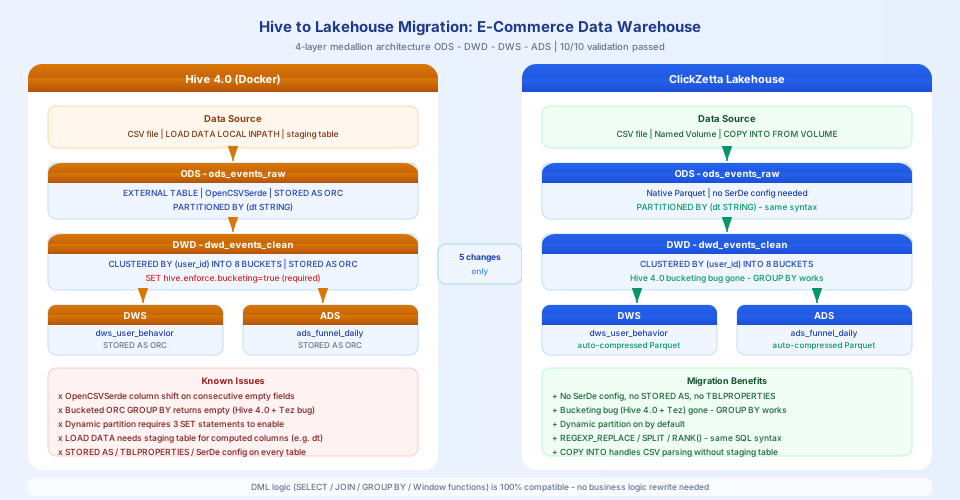
The data architecture has four layers, each corresponding to a schema:
- ODS (
ecommerce_ods): Raw data, partitioned by date, retaining original fields - DWD (
ecommerce_dwd): Cleansing layer,event_timeconverted to TIMESTAMP,category_codesplit into three levels, dirty data filtered - DWS (
ecommerce_dws): Daily user behavior summary — view/cart/purchase counts and spending per user per day - ADS (
ecommerce_ads): Funnel analysis — daily view→cart→purchase conversion rates
Sample data (20 rows) validation results:
| Metric | Value |
|---|---|
| ODS row count | 19 (1 row filtered for column-shift dirty data) |
| DWD row count | 19 |
| DWS user count | 6 |
| View user count | 6 |
| Cart user count | 4 |
| Purchase user count | 3 |
| View→cart conversion rate | 66.67% |
| Cart→purchase conversion rate | 75% |
Migration Steps
Step 1: Remove Storage Format Declarations
Hive requires every table to declare a storage format. Lakehouse uses native Parquet — just delete the declarations.
Step 2: Replace Data Loading Method
Hive uses LOAD DATA to load files into an EXTERNAL TABLE. Lakehouse uses COPY INTO FROM VOLUME.
Step 3: Remove Dynamic Partition SET Statements
Hive dynamic partitioning is disabled by default and requires 3 SET statements to enable. Lakehouse enables it by default — just delete the SET statements.
Step 4: Remove SerDe Configuration
Hive requires SerDe configuration to parse CSV. Lakehouse specifies this in COPY INTO's OPTIONS — no format configuration is needed at table creation time.
Fully Compatible Parts
The following Hive SQL runs directly in Lakehouse without any modification:
ETL transformation logic (ODS → DWD):
Aggregation logic (DWD → DWS/ADS):
Window function analysis:
Notes
1. OpenCSVSerde Column Shift
Symptom: When CSV has consecutive empty fields (e.g., brand is empty, appearing as ,,), OpenCSVSerde parsing causes subsequent columns to shift left — the value of price gets read as user_id.
Example:
brand is empty → price=35.79 is read as user_id, producing a dirty data row with user_id=35.
Handling: Filter abnormal user_ids when INSERT INTO ODS:
Lakehouse impact: COPY INTO uses ON_ERROR=CONTINUE to skip malformed rows; the same filter is applied during INSERT.
2. Hive 4.0 Bucketed Table GROUP BY Returns Empty
Symptom: Under Hive 4.0 + Tez engine, GROUP BY queries on CLUSTERED BY bucketed ORC tables return empty results, but COUNT(*) returns the correct row count via metadata stats.
Root cause: CombineHiveInputFormat (default) has a bug in the execution plan for bucketed ORC tables.
Temporary fix:
Lakehouse impact: This issue does not exist. Lakehouse also supports CLUSTERED BY ... INTO N BUCKETS bucketing, but GROUP BY works correctly without this bug.
3. COPY INTO Does Not Support Column Reference Syntax
Symptom: Lakehouse COPY INTO does not support $1, $2 column references:
Correct approach: Use FROM VOLUME ... USING CSV OPTIONS (...) FILES (...) syntax, mapping columns directly by order. When computed columns are needed (e.g., extracting dt), first COPY INTO an unpartitioned staging table, then INSERT INTO the target table.
4. Dynamic Partition Default Behavior Differences
| Behavior | Hive | Lakehouse |
|---|---|---|
| Dynamic partition switch | Disabled by default, requires SET hive.exec.dynamic.partition=true | Enabled by default |
| Strict mode | Strict by default, requires SET ... mode=nonstrict | No such restriction |
| Bucketed writes | Requires SET hive.enforce.bucketing=true | Supported by default, no SET needed |
End-to-End Validation
03_lakehouse/e2e.py runs 10 automated checks on the migration results:
| Check | Expected | Result |
|---|---|---|
| ODS row count | 19 | ✓ |
| DWD row count | 19 | ✓ |
| DWS user count | 6 | ✓ |
| Funnel view_users | 6 | ✓ |
| Funnel cart_users | 4 | ✓ |
| Funnel purchase_users | 3 | ✓ |
| View→cart conversion rate | 0.6667 | ✓ |
| Cart→purchase conversion rate | 0.75 | ✓ |
| Top spending user ID | 526595547 | ✓ |
| Top spending amount | 1422.0 | ✓ |
Actual run result: 10/10 passed.
Full Compatibility Reference
| Category | Hive Syntax | Lakehouse | Compatibility |
|---|---|---|---|
| Partitioned table | PARTITIONED BY (dt STRING) | Same | ✅ Fully compatible |
| Dynamic partition write | INSERT OVERWRITE ... PARTITION (dt) | Same | ✅ Fully compatible |
| REGEXP_REPLACE | REGEXP_REPLACE(col, pattern, replace) | Same | ✅ Fully compatible |
| SPLIT | SPLIT(col, '\\.') | Same | ✅ Fully compatible |
| SIZE | SIZE(SPLIT(...)) | Same | ✅ Fully compatible |
| SUBSTR | SUBSTR(col, 1, 10) | Same | ✅ Fully compatible |
| CAST | CAST(col AS TIMESTAMP) | Same | ✅ Fully compatible |
| NULLIF | NULLIF(expr, 0) | Same | ✅ Fully compatible |
| Conditional aggregation | SUM(CASE WHEN ... END) | Same | ✅ Fully compatible |
| COUNT DISTINCT | COUNT(DISTINCT CASE WHEN ...) | Same | ✅ Fully compatible |
| Window functions | RANK() OVER (ORDER BY ...) | Same | ✅ Fully compatible |
| STORED AS ORC | STORED AS ORC | Not needed | ✅ Delete it |
| CLUSTERED BY | CLUSTERED BY (col) INTO N BUCKETS | Same syntax | ✅ Fully compatible |
| OpenCSVSerde | ROW FORMAT SERDE 'OpenCSVSerde' | Not needed | ✅ Delete, use COPY INTO instead |
| LOAD DATA | LOAD DATA LOCAL INPATH | Not supported | ⚠️ Use COPY INTO FROM VOLUME |
| Dynamic partition SET | SET hive.exec.dynamic.partition=true | Not needed | ✅ Delete it |
Migration Conclusion
The effort for migrating a Hive data warehouse to Lakehouse is mainly in DDL and loading statements, not in business logic. In this project, the ETL transformation SQL (REGEXP_REPLACE, SPLIT, conditional aggregation) and analytical queries (window functions, funnel calculations) are all reused directly. Changes are concentrated in 4 known difference points, all of which are mechanical replacements.
SQL-Level Benefits
- The GROUP BY bug on bucketed ORC tables disappears naturally
- No need to maintain SerDe configuration and TBLPROPERTIES
- Dynamic partitioning is enabled by default, no SET statements needed
- COPY INTO is cleaner than LOAD DATA + staging table
Deployment Model Benefits
Migrating from a self-managed Docker Hive cluster to Singdata Lakehouse SaaS brings benefits beyond SQL simplification:
| Hive (self-managed Docker) | Lakehouse (SaaS) | |
|---|---|---|
| Cluster operations | Must maintain Docker containers, JVM parameters, YARN queues | No operations needed, fully managed |
| Compute resources | Fixed resources, wasted during idle periods | Elastic scaling, billed per query |
| Storage format | ORC files require periodic compaction | Native Parquet, automatically managed |
| Tuning cost | Must tune Hive parameters, Tez configuration, bucketing strategy | Focus on SQL logic, no low-level tuning |
| Version upgrades | Manual Hive and Hadoop dependency upgrades | Platform auto-upgrades |
After migration, data engineers can shift their focus from "keeping Hive running" to "making data valuable."